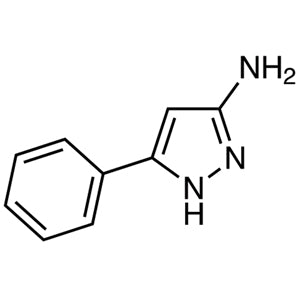
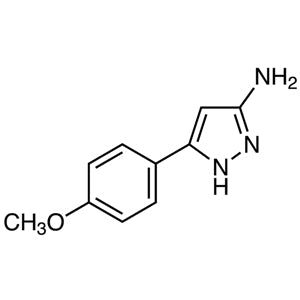
5-Amino-3-(4-methoxyphenyl)-1-phenylpyrazole is a chemical compound widely used in laboratory settings for the synthesis of complex molecules. As a heterocyclic building block, it plays a crucial role in organic chemistry research, particularly in the development of bioactive compounds. This compound is valued for its structural versatility and functional group diversity, making it an essential tool for chemists working on advanced synthetic pathways. Its presence in various chemical reactions allows for the creation of a wide range of derivatives with potential pharmaceutical and material applications.
The compound’s molecular structure provides stability and reactivity under different chemical conditions, which makes it a preferred choice for researchers. Its functional groups, including the amino and methoxy substituents, enable participation in substitution and condensation reactions. These properties enhance its utility in the synthesis of bioactive molecules and functional materials. The compound’s ability to integrate into complex molecular frameworks also supports its use in drug discovery and medicinal chemistry. Its chemical stability ensures consistent performance in laboratory experiments, contributing to reliable and reproducible results.
In Indonesian laboratories, 5-Amino-3-(4-methoxyphenyl)-1-phenylpyrazole is commonly used in organic chemistry research projects. It is particularly relevant in the development of pharmaceutical compounds and functional materials. Researchers in pharmacology, medicinal chemistry, and materials science rely on this compound as a key building block for their experiments. Its availability in the local market supports ongoing scientific investigations and innovation in various chemical disciplines.
Related TCI products
- TCI A0174 826-85-7 5-Amino-1-phenylpyrazole
- TCI A3033 19652-14-3 5-Amino-3-(4-chlorophenyl)-1-phenylpyrazole
- TCI A2102 1572-10-7 3-Amino-5-phenylpyrazole
- TCI A1311 1131-18-6 5-Amino-3-methyl-1-phenylpyrazole
- TCI E1258 16078-71-0 Ethyl 5-Amino-1-phenylpyrazole-4-carboxylate
- TCI A3255 1021426-42-5 1-[4-(4-Amino-3-methoxyphenyl)piperazin-1-yl]ethanone
- Organic synthesis projects benefit from this compound due to its versatile heterocyclic structure and functional groups, enabling the creation of complex molecules with bioactive properties.
- Medicinal chemistry research utilizes this compound as a building block for the development of pharmaceutical compounds with potential therapeutic applications.
- Material science applications leverage its chemical stability and reactivity to synthesize functional materials with specific properties for industrial use.
- Bioactive compound development relies on its ability to participate in substitution and condensation reactions, aiding in the synthesis of molecules with biological activity.
- Chemical research in Indonesian laboratories often incorporates this compound to explore new synthetic pathways and molecular structures for scientific advancement.
| Brand | TCI |
|---|---|
| CAS number | 19652-13-2 |
| Molecular formula | — |
| Purity | — |
| Category | Chemistry > Building Blocks > Heterocyclic Building Blocks |
| Pack sizes | Available in various quantities as per supplier specifications |
| Physical form | Solid (as per standard product description) |
| Storage | Store in a cool, dry place away from direct sunlight and moisture |
This compound should be stored in a cool, dry environment to maintain its chemical stability and prevent degradation. It is recommended to use airtight containers to protect it from moisture and air exposure. Due to its chemical nature, it should be handled with appropriate personal protective equipment, such as gloves and safety goggles, to ensure laboratory safety. Proper ventilation is essential when working with this material to minimize inhalation risks. It should be kept away from incompatible substances to avoid any potential chemical reactions. Regular inspection of storage conditions ensures the compound remains in optimal condition for use in laboratory applications.
—
Produk Terkait
-
5-Amino-1-phenylpyrazole TCI A0174
Regular price From Rp 4.425.750,00Regular priceRp 3.110.100,00Sale price From Rp 4.425.750,00 -
5-Amino-3-(4-chlorophenyl)-1-phenylpyrazole TCI A3033
Regular price From Rp 1.563.450,00Regular priceRp 1.108.800,00Sale price From Rp 1.563.450,00 -
3-Amino-5-phenylpyrazole TCI A2102
Regular price Rp 689.850,00Regular priceRp 497.700,00Sale price Rp 689.850,00 -
5-Amino-3-methyl-1-phenylpyrazole TCI A1311
Regular price Rp 1.618.050,00Regular priceRp 1.146.600,00Sale price Rp 1.618.050,00 -
Ethyl5-Amino-1-phenylpyrazole-4-carboxylate TCI E1258
Regular price From Rp 2.173.500,00Regular priceRp 1.535.100,00Sale price From Rp 2.173.500,00 -
1-[4-(4-Amino-3-methoxyphenyl)piperazin-1-yl]ethanone TCI A3255
Regular price From Rp 1.246.350,00Regular priceRp 887.250,00Sale price From Rp 1.246.350,00 -
3-Amino-5-(4-methoxyphenyl)pyrazole TCI A2953
Regular price From Rp 1.113.000,00Regular priceRp 793.800,00Sale price From Rp 1.113.000,00 -
1,3,5-Trimethylpyrazole TCI T2724
Regular price From Rp 769.650,00Regular priceRp 553.350,00Sale price From Rp 769.650,00