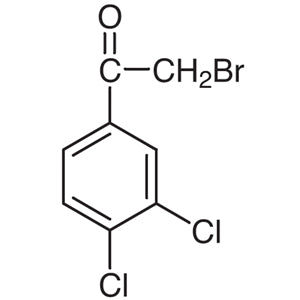
Phenacyl Bromide (TCI B0535), with CAS number 70-11-1, is a chemical compound widely used as a building block in organic synthesis. It plays a crucial role in laboratory settings where nucleophilic substitution reactions are required. This compound is essential for the preparation of various organic compounds, including heterocyclic and aromatic derivatives. Its versatility makes it a valuable reagent for chemists working on complex molecular structures. Due to its reactivity and stability, Phenacyl Bromide is frequently used in research and development projects that demand precise chemical reactions.
One of the key properties that make Phenacyl Bromide a preferred choice is its chemical stability combined with reactivity. It is capable of undergoing substitution reactions under controlled conditions, making it suitable for a wide range of synthetic applications. Its molecular structure is simple yet highly effective, allowing it to participate in multiple reaction pathways. The compound’s ability to react quickly and efficiently enhances the speed and accuracy of chemical synthesis processes, making it a go-to reagent for many laboratory applications.
In Indonesian laboratories, Phenacyl Bromide is commonly used in academic and research institutions. It is a staple in organic chemistry laboratories where students and researchers conduct experiments involving nucleophilic substitution. Its availability and effectiveness make it a preferred choice for both educational and industrial research. The compound is also used in the development of new chemical compounds and materials, supporting innovation in various scientific fields.
- Organic synthesis experiments where nucleophilic substitution reactions are required due to its reactivity and stability.
- Preparation of heterocyclic compounds as it facilitates the formation of complex ring structures through substitution reactions.
- Aromatic compound synthesis as it is a key reagent in reactions that introduce bromide groups into aromatic systems.
- Research and development projects in chemical industries that require precise and efficient chemical transformations.
- Educational purposes in Indonesian universities and research centers for teaching and practical laboratory work.
| Brand | TCI |
|---|---|
| CAS number | 70-11-1 |
| Molecular formula | — |
| Purity | — |
| Category | Chemistry > Building Blocks > Non-Heterocyclic Building Blocks |
| Pack sizes | Available in various quantities as per standard laboratory supply |
| Physical form | Liquid |
| Storage | Store in a cool, dry place away from light and incompatible materials |
Phenacyl Bromide should be stored in a cool, dry place away from direct sunlight and sources of heat. It is recommended to keep the compound in a tightly sealed container to prevent exposure to air and moisture. Due to its reactivity, it should be stored separately from strong bases and oxidizing agents to avoid unwanted chemical reactions. In laboratory settings, proper personal protective equipment such as gloves and goggles should be worn when handling this compound. It is important to ensure good ventilation in the workspace to minimize inhalation of vapors. Regular monitoring of storage conditions is advised to maintain the integrity and safety of the material.
—
Produk Terkait
-
Phenacyl4-(Bromomethyl)phenylacetate TCI B1315
Regular price From Rp 1.192.800,00Regular priceRp 849.450,00Sale price From Rp 1.192.800,00 -
PhenacylBromide[forHPLCLabeling] TCI A5508
Regular price Rp 1.618.050,00Regular priceRp 1.146.600,00Sale price Rp 1.618.050,00 -
AcetylBromide TCI A0080
Regular price From Rp 742.350,00Regular priceRp 534.450,00Sale price From Rp 742.350,00 -
ValerylBromide TCI V0038
Regular price Rp 2.439.150,00Regular priceRp 1.720.950,00Sale price Rp 2.439.150,00 -
3-BromophenacylBromide TCI B4125
Regular price From Rp 1.167.600,00Regular priceRp 831.600,00Sale price From Rp 1.167.600,00 -
2-BromophenacylBromide TCI B4124
Regular price From Rp 1.961.400,00Regular priceRp 1.387.050,00Sale price From Rp 1.961.400,00 -
3-CyanophenacylBromide TCI B4079
Regular price Rp 7.102.200,00Regular priceRp 4.982.250,00Sale price Rp 7.102.200,00 -
3,4-DichlorophenacylBromide TCI B2837
Regular price From Rp 1.192.800,00Regular priceRp 849.450,00Sale price From Rp 1.192.800,00