


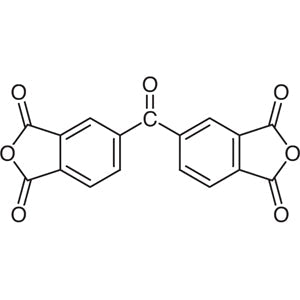
3,3',4,4'-Benzophenonetetracarboxylic Dianhydride is a chemical compound widely used in scientific and industrial applications, particularly in the field of materials science and polymer chemistry. As a monomer, it plays a crucial role in the synthesis of polymers, contributing to the development of advanced materials with specific functional properties. This compound is commonly used in laboratories to create materials with superior thermal and mechanical properties, such as heat-resistant and corrosion-resistant substances. Its versatility makes it an essential component in the production of films, composites, and insulating materials.
The compound’s complex molecular structure allows for highly specific and efficient chemical reactions, making it a preferred choice for polymerization processes. It is known for its stability under certain conditions and high reactivity, which enhances its effectiveness in various chemical transformations. These properties make it suitable for a wide range of applications, including the development of new materials and the creation of substances with unique characteristics. Its chemical stability and reactivity also contribute to its reliability in both research and industrial settings.
In Indonesian laboratories, 3,3',4,4'-Benzophenonetetracarboxylic Dianhydride is frequently used in the research and development of composite materials, films, and insulating substances. It is commonly found in academic and research institutions focused on materials science and technology. Its application extends to various projects aimed at improving material performance and developing innovative solutions for industrial and scientific challenges.
TCI brochures (PDF)
- Polymerization Initiators 2025-09-17 · p. 3
- Raw Materials for Polyimide Synthesis 2026-05-11 · p. 2
- Biomaterials Research Reagents 2025-02-19 · p. 24
- Monomers 2025-05-28 · p. 38
Related TCI products
- TCI B4260 2421-28-5 3,3',4,4'-Benzophenonetetracarboxylic Dianhydride (purified by sublimation)
- TCI T2698 738-90-9 Tricyclo[6.4.0.0(2,7)]dodecane-1,8:2,7-tetracarboxylic Dianhydride
- TCI B1770 17309-39-6 meso-Butane-1,2,3,4-tetracarboxylic Dianhydride
- TCI B1317 1719-83-1 Bicyclo[2.2.2]oct-7-ene-2,3,5,6-tetracarboxylic Dianhydride
- TCI N0755 81-30-1 Naphthalene-1,4,5,8-tetracarboxylic Dianhydride (purified by sublimation)
- TCI N0369 81-30-1 Naphthalene-1,4,5,8-tetracarboxylic Dianhydride
- Polymer synthesis for creating advanced composite materials due to its role as a monomer in forming high-performance polymers.
- Film production where thermal and mechanical stability is required for applications in electronics and insulation.
- Insulating material development for use in electrical and thermal insulation applications due to its chemical stability.
- Research into new material properties for innovation in materials science and engineering applications.
- Composite material development for aerospace and automotive industries requiring high strength and heat resistance.
| Brand | TCI |
|---|---|
| CAS number | 2421-28-5 |
| Molecular formula | — |
| Purity | — |
| Category | Materials Science > Polymer/Macromolecule Reagents > Monomers |
| Pack sizes | Available in standard laboratory quantities as specified by the supplier. |
| Physical form | Solid, typically in powder or crystalline form. |
| Storage | Store in a cool, dry place away from moisture and direct sunlight. |
This compound should be stored in a cool, dry environment, away from moisture and direct sunlight to maintain its chemical stability. It is recommended to use airtight containers made of materials that are chemically inert to prevent contamination and degradation. When handling, it is important to use appropriate personal protective equipment, such as gloves and safety goggles, to avoid direct contact. Due to its reactivity, it should be kept in a well-ventilated area to minimize exposure to airborne particles. Proper labeling of storage containers is essential to ensure safe handling and prevent accidental use. Laboratories should follow standard chemical safety protocols when working with this compound to ensure a safe and controlled environment.
—
Product Categories
- Polymer/Macromolecule ReagentsMonomersTetracarboxylic Dianhydride Monomers
- Polymer/Macromolecule ReagentsPolyimide Raw MaterialsTetracarboxylic Dianhydrides [Polyimide Raw Materials]
- Polymer/Macromolecule ReagentsPolymerization ReagentsPolymerization Initiators
- Biomaterials/Biocompatible Materials Research ReagentsPolymerization Reagents (Initiators, Catalysts, Ligands) [Biomaterials/Biocompatible Materials Research Reagents]Photopolymerization Initiators
Produk Terkait
-
3,3',4,4'-BenzophenonetetracarboxylicDianhydride(purifiedbysublimation) TCI B4260
Regular price From Rp 2.121.000,00Regular priceRp 1.498.350,00Sale price From Rp 2.121.000,00 -
Tricyclo[6.4.0.0(2,7)]dodecane-1,8:2,7-tetracarboxylicDianhydride TCI T2698
Regular price From Rp 6.704.250,00Regular priceRp 4.688.250,00Sale price From Rp 6.704.250,00 -
meso-Butane-1,2,3,4-tetracarboxylicDianhydride TCI B1770
Regular price From Rp 1.749.300,00Regular priceRp 1.239.000,00Sale price From Rp 1.749.300,00 -
Bicyclo[2.2.2]oct-7-ene-2,3,5,6-tetracarboxylicDianhydride TCI B1317
Regular price From Rp 1.140.300,00Regular priceRp 796.950,00Sale price From Rp 1.140.300,00 -
Naphthalene-1,4,5,8-tetracarboxylicDianhydride(purifiedbysublimation) TCI N0755
Regular price From Rp 2.227.050,00Regular priceRp 1.557.150,00Sale price From Rp 2.227.050,00 -
Naphthalene-1,4,5,8-tetracarboxylicDianhydride TCI N0369
Regular price From Rp 2.439.150,00Regular priceRp 1.705.200,00Sale price From Rp 2.439.150,00 -
Bicyclo[2.2.2]octane-2,3,5,6-tetracarboxylic2,3:5,6-Dianhydride TCI B6198
Regular price From Rp 2.995.650,00Regular priceRp 2.094.750,00Sale price From Rp 2.995.650,00 -
1,2,3,4-Tetramethyl-1,2,3,4-cyclobutanetetracarboxylicDianhydride TCI T2697
Regular price From Rp 3.048.150,00Regular priceRp 2.131.500,00Sale price From Rp 3.048.150,00


