

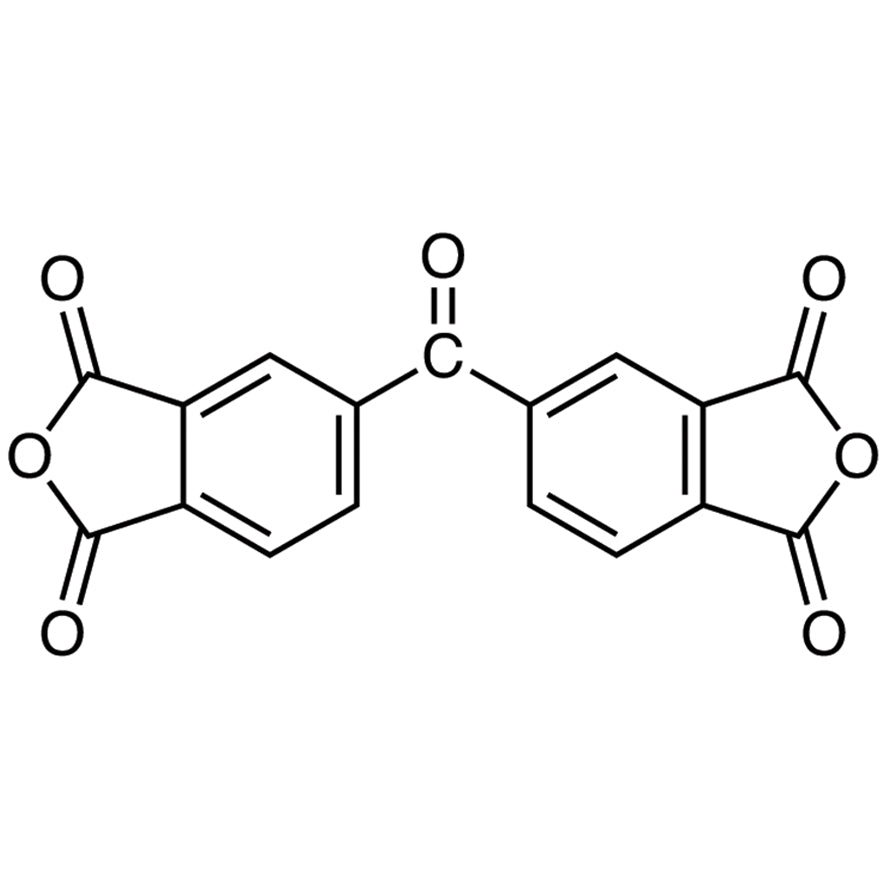
3,3',4,4'-Benzophenonetetracarboxylic Dianhydride (BPTA) is a complex chemical compound widely used in scientific and industrial applications. This high-purity material is essential in the laboratory for its stability and reactivity, making it a key component in the synthesis of advanced organic compounds. As a purified compound through sublimation, BPTA ensures minimal impurities, which is critical for precise and reliable experimental outcomes. Its unique chemical structure allows it to serve as a precursor in various chemical processes, supporting innovation in material science and chemical engineering.
BPTA is preferred due to its exceptional purity and stable chemical properties. It maintains its integrity under normal conditions, reducing the risk of degradation during storage and use. The compound's high melting point and density make it suitable for a range of laboratory procedures, including polymer synthesis and coating applications. Its ability to remain chemically inert under controlled environments ensures consistent performance, which is vital for high-accuracy research. The sublimation purification process further enhances its reliability, making it a trusted choice for demanding scientific applications.
In Indonesian laboratories, BPTA is commonly used in chemical, material, and technology research. Its high purity and stable characteristics make it ideal for experiments requiring precision and quality. It is frequently employed in the development of electronic materials, advanced polymers, and specialty coatings. The compound's versatility supports a wide array of research activities, contributing to scientific advancements in both academic and industrial settings.
TCI brochures (PDF)
- Chemical Compounds Purified by Sublimation 2025-05-07 · p. 3
- Raw Materials for Polyimide Synthesis 2026-05-11 · p. 2
- Monomers 2025-05-28 · p. 38
Related TCI products
- TCI P2103 89-32-7 Pyromellitic Dianhydride (purified by sublimation)
- TCI N0755 81-30-1 Naphthalene-1,4,5,8-tetracarboxylic Dianhydride (purified by sublimation)
- TCI C2920 6053-68-5 1,2,3,4-Cyclopentanetetracarboxylic Dianhydride (purified by sublimation)
- TCI C2919 2754-41-8 1,2,4,5-Cyclohexanetetracarboxylic Dianhydride (purified by sublimation)
- TCI C2842 4415-87-6 1,2,3,4-Cyclobutanetetracarboxylic Dianhydride (purified by sublimation)
- TCI B4262 2420-87-3 4,4'-Biphthalic Anhydride (purified by sublimation)
- Polymer synthesis and advanced material development due to its role as a key precursor in creating high-performance polymers.
- Coating and film formation applications because of its chemical stability and ability to form uniform layers.
- Electronic material research as it is used in the production of semiconductors and dielectric materials.
- Organic synthesis processes where high-purity compounds are essential for accurate and reproducible results.
- Material characterization studies due to its well-defined physical and chemical properties that aid in analytical techniques.
| Brand | TCI |
|---|---|
| CAS number | 2421-28-5 |
| Molecular formula | — |
| Purity | — |
| Category | Materials Science > High Purity Compounds > Compounds Purified by Sublimation |
| Pack sizes | Available in standard laboratory quantities as per supplier specifications |
| Physical form | Solid |
| Storage | Store in a cool, dry place away from moisture and direct sunlight |
This compound should be stored in a cool, dry environment to maintain its stability and prevent degradation. It is recommended to use airtight containers to minimize exposure to moisture and air, which could affect its purity. As a solid material, it should be kept in a secure location away from heat sources and direct sunlight. Laboratory personnel should handle it with care, using appropriate personal protective equipment to ensure safety. Due to its high purity, it is crucial to maintain proper storage conditions to preserve its chemical integrity and ensure consistent performance in experimental applications.
—
Product Categories
Produk Terkait
-
PyromelliticDianhydride(purifiedbysublimation) TCI P2103
Regular price From Rp 2.704.800,00Regular priceRp 1.891.050,00Sale price From Rp 2.704.800,00 -
Naphthalene-1,4,5,8-tetracarboxylicDianhydride(purifiedbysublimation) TCI N0755
Regular price From Rp 2.227.050,00Regular priceRp 1.557.150,00Sale price From Rp 2.227.050,00 -
1,2,3,4-CyclopentanetetracarboxylicDianhydride(purifiedbysublimation) TCI C2920
Regular price From Rp 1.565.550,00Regular priceRp 1.094.100,00Sale price From Rp 1.565.550,00 -
1,2,4,5-CyclohexanetetracarboxylicDianhydride(purifiedbysublimation) TCI C2919
Regular price Rp 1.565.550,00Regular priceRp 1.094.100,00Sale price Rp 1.565.550,00 -
1,2,3,4-CyclobutanetetracarboxylicDianhydride(purifiedbysublimation) TCI C2842
Regular price From Rp 1.908.900,00Regular priceRp 1.334.550,00Sale price From Rp 1.908.900,00 -
4,4'-BiphthalicAnhydride(purifiedbysublimation) TCI B4262
Regular price Rp 4.347.000,00Regular priceRp 3.039.750,00Sale price Rp 4.347.000,00 -
4,4'-OxydiphthalicAnhydride(purifiedbysublimation) TCI O0423
Regular price Rp 4.399.500,00Regular priceRp 3.092.250,00Sale price Rp 4.399.500,00 -
4,4'-(Hexafluoroisopropylidene)diphthalicAnhydride(purifiedbysublimation) TCI H1438
Regular price From Rp 1.405.950,00Regular priceRp 982.800,00Sale price From Rp 1.405.950,00


