

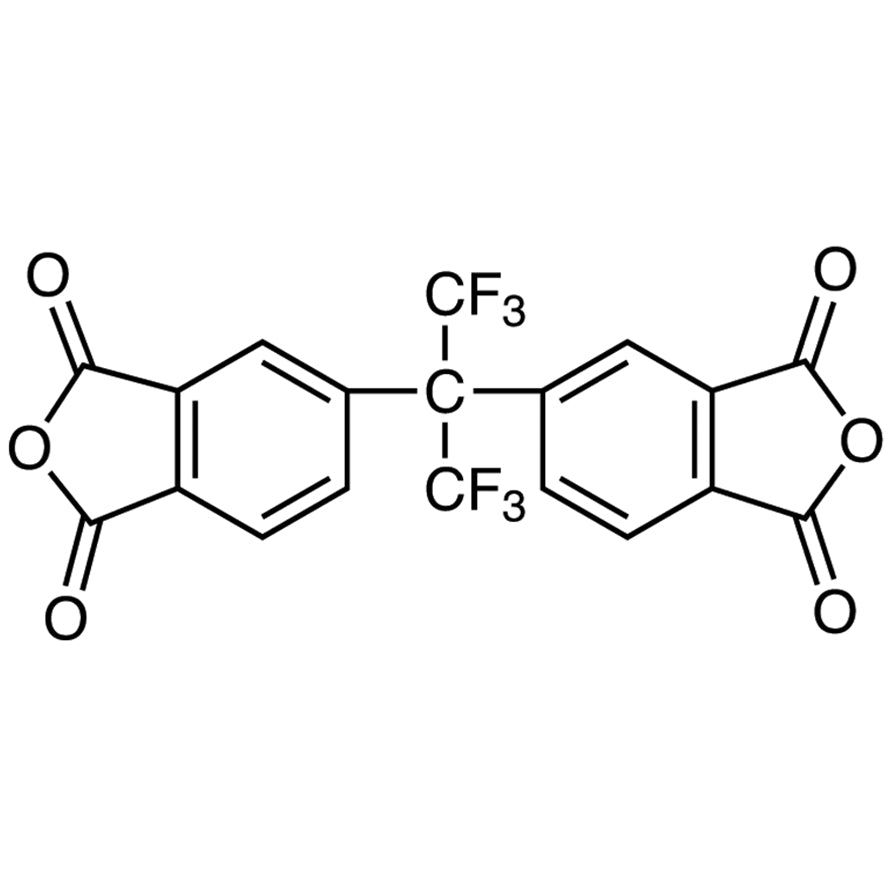
4,4'-(Hexafluoroisopropylidene)diphthalic Anhydride, commonly abbreviated as 6FDA, is an aromatic dianhydride in which two phthalic anhydride groups are joined through a hexafluoroisopropylidene bridge. This particular grade has been purified by sublimation, a purification method in which the solid passes directly into the vapour phase and then condenses back into a solid, making it suitable for work that demands a high level of purity. In the laboratory, the compound serves as a principal monomer for the preparation of polyimides, a class of high-performance polymers widely studied for gas separation membranes, dielectric layers, and heat-resistant materials.
The property that sets this dianhydride apart lies in the hexafluoroisopropylidene group at the centre of the molecule. This bridge is bulky and rigid, so it prevents polymer chains from packing tightly together, producing a larger free volume while at the same time improving the solubility of the resulting polyimides in common organic solvents, something conventional polyimides achieve only with difficulty. The presence of fluorine atoms also lowers the dielectric constant, raises thermal and oxidative stability, and improves the optical clarity of the films that are produced. Both anhydride groups remain highly reactive toward aromatic amines.
In Indonesian laboratories, this material is typically encountered in university and institutional research groups working on polymer chemistry and membrane technology, as well as in materials science programmes studying heat-resistant and low-dielectric films. It is usually ordered as a research-scale monomer for polycondensation work, where the sublimation-purified grade is chosen because polymerisation results depend strongly on the quality of the starting monomer. Users generally handle it under controlled conditions as part of a broader synthesis programme.
TCI brochures (PDF)
- Chemical Compounds Purified by Sublimation 2025-05-07 · p. 3
- Raw Materials for Polyimide Synthesis 2026-05-11 · p. 3
- Monomers 2025-05-28 · p. 38
Related TCI products
- TCI B4262 2420-87-3 4,4'-Biphthalic Anhydride (purified by sublimation)
- TCI O0423 1823-59-2 4,4'-Oxydiphthalic Anhydride (purified by sublimation)
- TCI E1412 129808-00-0 4,4'-(Ethyne-1,2-diyl)diphthalic Anhydride (purified by sublimation)
- TCI B4260 2421-28-5 3,3',4,4'-Benzophenonetetracarboxylic Dianhydride (purified by sublimation)
- TCI P2103 89-32-7 Pyromellitic Dianhydride (purified by sublimation)
- TCI N0755 81-30-1 Naphthalene-1,4,5,8-tetracarboxylic Dianhydride (purified by sublimation)
- Polyimide synthesis — serves as the dianhydride monomer that reacts with aromatic diamines in polycondensation, giving researchers direct control over the backbone structure of the resulting high-performance polymer.
- Gas separation membrane research — the bulky hexafluoroisopropylidene bridge hinders chain packing and creates greater free volume, a structural feature central to studies of permeability behaviour in polymer membranes.
- Low-dielectric film development — the fluorine content of the molecule lowers the dielectric constant of the resulting polyimide, making it relevant to work on dielectric layers for electronic applications.
- Solvent-processable polyimide formulations — the central bridge improves the solubility of the resulting polyimide in common organic solvents, allowing solution-based processing that conventional polyimides do not readily permit.
- Optically clear and heat-resistant coatings — the combination of fluorine substitution and thermal stability supports research on transparent films that must retain their properties under elevated temperature and oxidative conditions.
| Brand | TCI |
|---|---|
| CAS number | 1107-00-2 |
| Molecular formula | — |
| Purity | — |
| Category | Materials Science > High Purity Compounds > Compounds Purified by Sublimation |
| Pack sizes | please refer to the packaging options listed on this product page |
| Physical form | — |
| Storage | store in a tightly closed container in a cool, dry place, following the manufacturer's instructions on the label |
- Catalogue code: H1438
- Grade: purified by sublimation
Store this dianhydride in a tightly closed original container in a cool, dry location, away from moisture and from any source of heat. Because both anhydride groups are highly reactive toward amines and are sensitive to moisture, containers should be kept sealed and opened only when needed, preferably in a dry environment or under an inert atmosphere where the laboratory's procedures call for it. Handle the material in a fume hood, wear safety glasses, gloves, and a laboratory coat, and avoid generating or inhaling dust when weighing the solid. Keep it away from incompatible substances such as amines and strong bases, and always consult the manufacturer's safety data sheet before use.
—
Product Categories
Produk Terkait
-
4,4'-BiphthalicAnhydride(purifiedbysublimation) TCI B4262
Regular price Rp 4.347.000,00Regular price -
4,4'-OxydiphthalicAnhydride(purifiedbysublimation) TCI O0423
Regular price Rp 4.347.000,00Regular price -
4,4'-(Ethyne-1,2-diyl)diphthalicAnhydride(purifiedbysublimation) TCI E1412
Regular price From Rp 1.035.300,00Regular price -
3,3',4,4'-BenzophenonetetracarboxylicDianhydride(purifiedbysublimation) TCI B4260
Regular price From Rp 2.068.500,00Regular price -
PyromelliticDianhydride(purifiedbysublimation) TCI P2103
Regular price From Rp 2.704.800,00Regular price -
Naphthalene-1,4,5,8-tetracarboxylicDianhydride(purifiedbysublimation) TCI N0755
Regular price From Rp 2.227.050,00Regular price -
1,2,3,4-CyclopentanetetracarboxylicDianhydride(purifiedbysublimation) TCI C2920
Regular price From Rp 1.565.550,00Regular price -
1,2,4,5-CyclohexanetetracarboxylicDianhydride(purifiedbysublimation) TCI C2919
Regular price Rp 1.565.550,00Regular price


