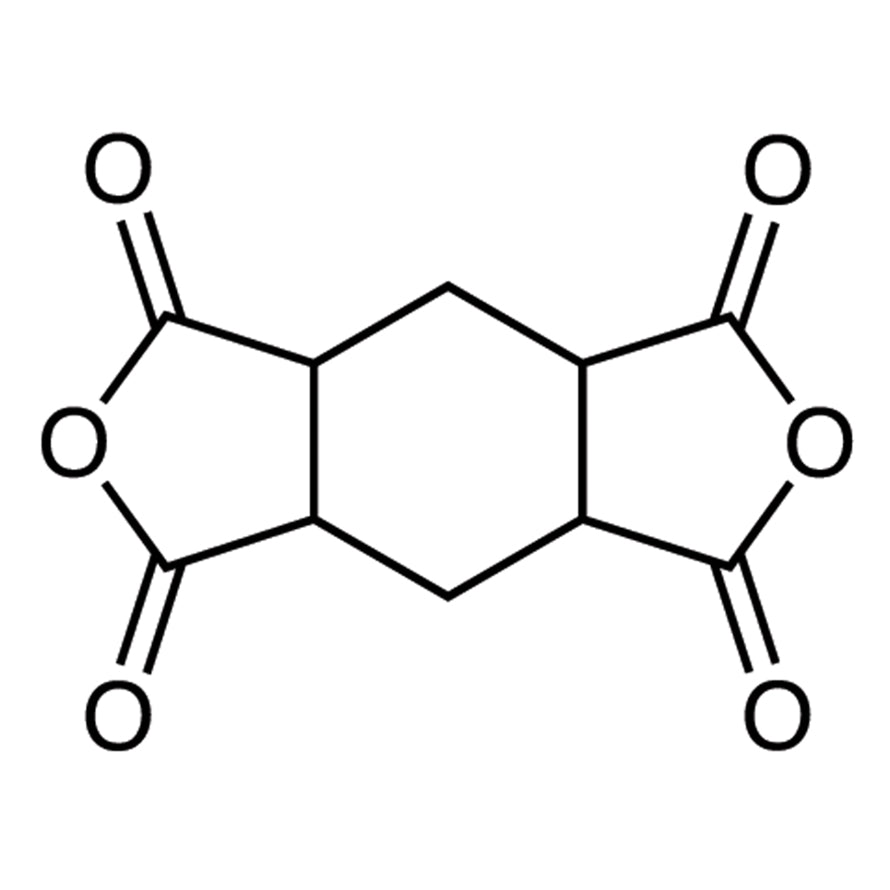
TCI C2919 is 1,2,4,5-Cyclohexanetetracarboxylic Dianhydride, an alicyclic dianhydride compound frequently referred to as H-PMDA because its structure is the hydrogenated version of pyromellitic dianhydride. In the laboratory, this material serves as a dianhydride monomer that is reacted with a range of aromatic and aliphatic diamines to form polyamic acid, which is subsequently imidized into polyimide. Because the aromatic ring has been replaced by a saturated cyclohexane ring, this monomer is a key building block for researchers developing transparent polyimides, high-performance optical films, and engineered polymer materials for electronics and aerospace research.
The characteristic that makes this product a widely preferred choice is the purity achieved through a sublimation purification process, a method that effectively separates the compound from free acid residues, residual solvents, and non-volatile impurities. In step-growth polymerization chemistry, monomer purity is decisive, because even the smallest stoichiometric imbalance will cut down the molecular weight of the chains that form. In addition, the alicyclic structure suppresses the formation of charge-transfer complexes, which is precisely what allows the resulting polymer films to remain optically clear rather than developing the yellow coloration typical of fully aromatic polyimides.
In Indonesian laboratories, this grade is typically used by polymer chemistry and materials science research groups working on the synthesis of polyimide resins and thin films at bench scale. It is commonly handled in university research laboratories, national research institutes, and industrial R&D units that prepare polyamic acid solutions in polar aprotic solvents before thermal or chemical imidization. Sublimation-purified material is chosen for work where reproducibility between synthesis batches is essential.
- Transparent polyimide synthesis: the saturated cyclohexane ring suppresses charge-transfer complex formation, so films stay optically clear instead of turning yellow like fully aromatic polyimides.
- Polyamic acid preparation: functions as the dianhydride monomer reacted with aromatic or aliphatic diamines, with sublimation purity ensuring accurate stoichiometry and reliably high molecular weight.
- High-performance optical film research: supports the development of colorless, thermally stable film materials where residual impurities would otherwise degrade transparency and optical consistency across batches.
- Engineered polymer materials for electronics research: used to build polyimide systems for electronic applications where consistent monomer quality controls chain length and final material performance.
- Aerospace materials research: serves as a monomer for polyimide resins investigated in aerospace contexts, where purified starting material supports reproducible mechanical and thermal property evaluation.
| Brand | TCI |
|---|---|
| CAS number | 2754-41-8 |
| Molecular formula | — |
| Purity | — |
| Category | Materials Science > High Purity Compounds > Compounds Purified by Sublimation |
| Pack sizes | available in the pack sizes listed on the product page; storage per the manufacturer's label and safety data sheet |
| Physical form | — |
| Storage | — |
- Chemical name: 1,2,4,5-Cyclohexanetetracarboxylic Dianhydride (H-PMDA)
- Grade: purified by sublimation
Store the container tightly closed in a cool, dry place away from moisture, since dianhydride groups are readily hydrolyzed by atmospheric humidity to the corresponding tetracarboxylic acid, which reduces reactivity in polymerization. Amber glass or the original manufacturer's container is suitable, ideally kept in a desiccator or under an inert atmosphere after opening. Weigh and transfer the material in a fume hood using dry glassware and spatulas, wear gloves, safety glasses, and a laboratory coat, and avoid inhaling dust. Always consult the manufacturer's safety data sheet before use.
—
Produk Terkait
-
Bicyclo[2.2.2]octane-1,4-dicarboxylicAcid TCI B5595
Regular price Rp 4.957.050,00Regular price -
Bicyclo[2.2.2]octane-2,3,5,6-tetracarboxylic2,3:5,6-Dianhydride TCI B6198
Regular price From Rp 2.995.650,00Regular price -
Bicyclo[1.1.1]pentane-1,3-dicarboxylicAcid TCI B6522
Regular price Rp 4.797.450,00Regular price -
(+)-CamphoricAcid TCI C0012
Regular price From Rp 1.220.100,00Regular price -
cis-1,2-CyclohexanedicarboxylicAcid TCI C0458
Regular price From Rp 1.008.000,00Regular price -
trans-1,2-CyclohexanedicarboxylicAcid TCI C0474
Regular price From Rp 2.199.750,00Regular price -
trans-1,4-CyclohexanedicarboxylicAcid TCI C0475
Regular price From Rp 1.881.600,00Regular price -
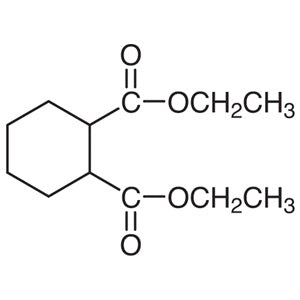
Diethylcis-1,2-Cyclohexanedicarboxylate(containsDiethyltrans-1,2-Cyclohexanedicarboxylate) TCI C0476
Regular price From Rp 1.749.300,00Regular price
![Bicyclo[2.2.2]octane-1,4-dicarboxylic Acid (CAS 711-02-4) - TCI B5595 - AMI Scientific](http://amiscientific.com/cdn/shop/files/TCI2510B5595.jpg?v=1767092548&width=533)
![Bicyclo[2.2.2]octane-2,3,5,6-tetracarboxylic 2,3:5,6-Dianhydride (CAS 2754-40-7) - TCI B6198 - AMI Scientific](http://amiscientific.com/cdn/shop/files/TCI2510B6198.jpg?v=1768816002&width=533)
![Bicyclo[1.1.1]pentane-1,3-dicarboxylic Acid (CAS 56842-95-6) - TCI B6522 - AMI Scientific](http://amiscientific.com/cdn/shop/files/TCI2510B6522.jpg?v=1767093799&width=533)