

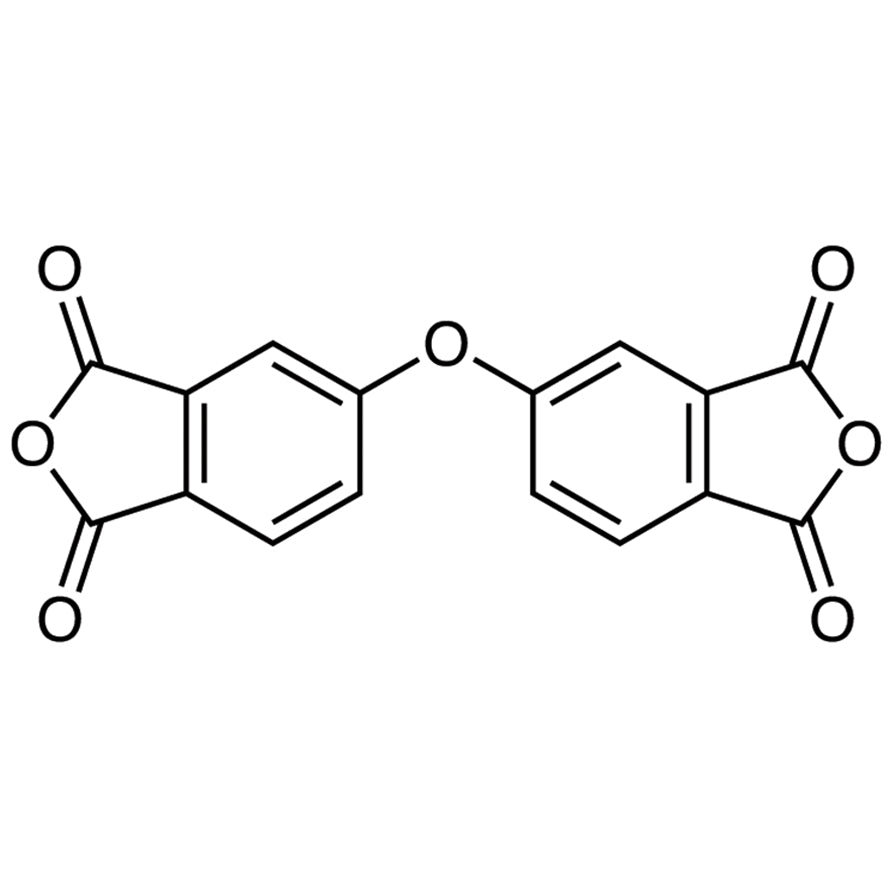
4,4'-Oxydiphthalic Anhydride (purified by sublimation) is a high-purity chemical compound widely used in laboratory settings for its unique chemical properties and reactivity. This compound is commonly employed in organic chemistry and materials science for the synthesis of complex molecules and functional materials. Its anhydride structure makes it highly reactive, enabling it to participate in various chemical reactions, including esterification and acylation. Due to its versatility, it is a valuable resource for researchers aiming to develop new compounds or materials with specific properties.
The compound is preferred for its exceptional purity, which is achieved through the sublimation process. This purification method ensures that the material is free from impurities and contaminants, making it ideal for applications that require high accuracy and consistency. Its crystalline physical form and stable chemical properties under controlled conditions further enhance its reliability in laboratory experiments. The combination of purity, reactivity, and stability makes it a go-to material for advanced chemical research.
In Indonesian laboratories, 4,4'-Oxydiphthalic Anhydride is frequently used in organic chemistry research, material development, and chemical synthesis projects. Its role is critical in studies focused on creating new polymers, dyes, and other advanced materials. Researchers in Indonesia rely on this compound to achieve precise results in their experiments, contributing to the growth of scientific innovation in the region.
TCI brochures (PDF)
- Chemical Compounds Purified by Sublimation 2025-05-07 · p. 3
- Raw Materials for Polyimide Synthesis 2026-05-11 · p. 3
- Monomers 2025-05-28 · p. 38
Related TCI products
- TCI B4262 2420-87-3 4,4'-Biphthalic Anhydride (purified by sublimation)
- TCI H1438 1107-00-2 4,4'-(Hexafluoroisopropylidene)diphthalic Anhydride (purified by sublimation)
- TCI E1412 129808-00-0 4,4'-(Ethyne-1,2-diyl)diphthalic Anhydride (purified by sublimation)
- TCI B4260 2421-28-5 3,3',4,4'-Benzophenonetetracarboxylic Dianhydride (purified by sublimation)
- TCI P2103 89-32-7 Pyromellitic Dianhydride (purified by sublimation)
- TCI N0755 81-30-1 Naphthalene-1,4,5,8-tetracarboxylic Dianhydride (purified by sublimation)
- Organic synthesis experiments benefit from this compound due to its reactivity and ability to form esters and acyl groups, enabling the creation of complex organic molecules.
- Material science research utilizes it for the development of advanced polymers and functional coatings, as its structure allows for cross-linking and chemical modification.
- Chemical analysis applications rely on its high purity to ensure accurate and reproducible results in analytical procedures such as spectroscopy and chromatography.
- Industrial chemical processes use it as a key intermediate in the production of dyes, pigments, and specialty chemicals, where purity is essential for consistent product quality.
- Educational institutions incorporate it into teaching labs to demonstrate advanced chemical reactions and synthesis techniques to students pursuing chemistry and materials science.
| Brand | TCI |
|---|---|
| CAS number | 1823-59-2 |
| Molecular formula | — |
| Purity | — |
| Category | Materials Science > High Purity Compounds > Compounds Purified by Sublimation |
| Pack sizes | Available in various quantities as per standard laboratory supply specifications |
| Physical form | Crystalline solid |
| Storage | Store in a cool, dry place away from moisture and direct sunlight |
This compound should be stored in a cool, dry environment to maintain its stability and prevent degradation. It is recommended to keep it in a sealed container to avoid exposure to moisture, which can affect its reactivity and purity. Due to its anhydride nature, it should be handled with care to prevent contact with water or other reactive substances. In laboratory settings, it is best stored in a desiccator or airtight container to minimize the risk of contamination. Always ensure proper ventilation when handling the material to avoid inhalation of any vapors. General laboratory safety practices, such as wearing appropriate personal protective equipment, should be followed to ensure safe handling and storage.
—
Product Categories
Produk Terkait
-
4,4'-BiphthalicAnhydride(purifiedbysublimation) TCI B4262
Regular price Rp 4.347.000,00Regular priceRp 3.039.750,00Sale price Rp 4.347.000,00 -
4,4'-(Hexafluoroisopropylidene)diphthalicAnhydride(purifiedbysublimation) TCI H1438
Regular price From Rp 1.405.950,00Regular priceRp 982.800,00Sale price From Rp 1.405.950,00 -
4,4'-(Ethyne-1,2-diyl)diphthalicAnhydride(purifiedbysublimation) TCI E1412
Regular price From Rp 1.035.300,00Regular priceRp 723.450,00Sale price From Rp 1.035.300,00 -
3,3',4,4'-BenzophenonetetracarboxylicDianhydride(purifiedbysublimation) TCI B4260
Regular price From Rp 2.121.000,00Regular priceRp 1.498.350,00Sale price From Rp 2.121.000,00 -
PyromelliticDianhydride(purifiedbysublimation) TCI P2103
Regular price From Rp 2.704.800,00Regular priceRp 1.891.050,00Sale price From Rp 2.704.800,00 -
Naphthalene-1,4,5,8-tetracarboxylicDianhydride(purifiedbysublimation) TCI N0755
Regular price From Rp 2.227.050,00Regular priceRp 1.557.150,00Sale price From Rp 2.227.050,00 -
1,2,3,4-CyclopentanetetracarboxylicDianhydride(purifiedbysublimation) TCI C2920
Regular price From Rp 1.565.550,00Regular priceRp 1.094.100,00Sale price From Rp 1.565.550,00 -
1,2,4,5-CyclohexanetetracarboxylicDianhydride(purifiedbysublimation) TCI C2919
Regular price Rp 1.565.550,00Regular priceRp 1.094.100,00Sale price Rp 1.565.550,00


