

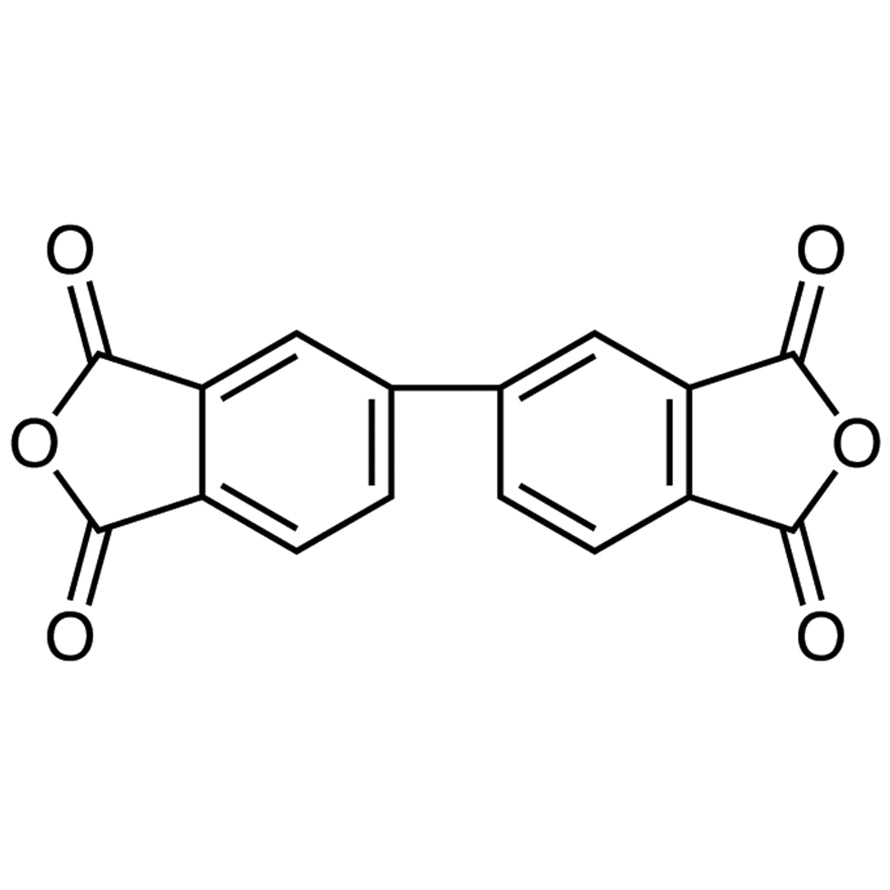
4,4'-Biphtalik Anhydride (BPA) is a chemical compound widely used in various chemical reactions, particularly in the synthesis of complex organic compounds. It is a high-purity material that plays a crucial role in laboratories for its reactivity and stability. As an anhydride, it is highly reactive and serves as a key reagent in the formation of ester and amide bonds. This makes it indispensable in the development of polymers, pharmaceuticals, and industrial chemicals. Its chemical structure allows it to participate in a wide range of synthetic pathways, making it a versatile material for researchers and chemists.
The properties of BPA that make it a preferred choice include its high purity and the fact that it has been purified through sublimation. This process ensures that the compound is free from contaminants, providing consistent results in experiments. Its stability under certain conditions also contributes to its reliability in laboratory settings. The combination of high reactivity and purity makes BPA ideal for applications requiring precision and accuracy. Its physical and chemical properties are well-defined, allowing for predictable behavior in different reaction conditions.
In Indonesian laboratories, BPA is commonly used in organic chemistry, pharmaceutical research, and material science. Its role in the synthesis of complex molecules and its reliability in chemical reactions make it a valuable resource. Researchers in Indonesia rely on BPA for its consistent performance and high quality, which are essential for scientific accuracy and reproducibility in their work.
TCI brochures (PDF)
- Chemical Compounds Purified by Sublimation 2025-05-07 · p. 3
- Raw Materials for Polyimide Synthesis 2026-05-11 · p. 2
- Monomers 2025-05-28 · p. 38
Related TCI products
- TCI O0423 1823-59-2 4,4'-Oxydiphthalic Anhydride (purified by sublimation)
- TCI H1438 1107-00-2 4,4'-(Hexafluoroisopropylidene)diphthalic Anhydride (purified by sublimation)
- TCI E1412 129808-00-0 4,4'-(Ethyne-1,2-diyl)diphthalic Anhydride (purified by sublimation)
- TCI B4260 2421-28-5 3,3',4,4'-Benzophenonetetracarboxylic Dianhydride (purified by sublimation)
- TCI P2103 89-32-7 Pyromellitic Dianhydride (purified by sublimation)
- TCI N0755 81-30-1 Naphthalene-1,4,5,8-tetracarboxylic Dianhydride (purified by sublimation)
- Organic synthesis applications benefit from BPA due to its ability to form ester and amide bonds, which are essential in creating complex organic molecules.
- Pharmaceutical research utilizes BPA for the development of new drugs, as it is a key reagent in the synthesis of various active pharmaceutical ingredients.
- Polymer production relies on BPA as it contributes to the formation of ester linkages, which are crucial in creating high-performance polymers.
- Material science experiments use BPA for its stability and reactivity, enabling the creation of advanced composite materials with specific properties.
- Industrial chemical manufacturing incorporates BPA due to its high purity and reactivity, allowing for the production of high-quality chemical products.
| Brand | TCI |
|---|---|
| CAS number | 2420-87-3 |
| Molecular formula | — |
| Purity | — |
| Category | Materials Science > High Purity Compounds > Compounds Purified by Sublimation |
| Pack sizes | Available in various quantities as per supplier specifications |
| Physical form | Solid |
| Storage | Store in a cool, dry place away from moisture and direct sunlight |
BPA should be stored in a cool, dry environment to maintain its stability and prevent degradation. It is recommended to use airtight containers to avoid exposure to moisture and air, which can affect its purity. Since BPA is a reactive compound, it should be handled in a well-ventilated area, preferably with appropriate personal protective equipment. It is important to keep it away from incompatible substances such as strong acids or bases. Regular inspection of storage conditions ensures the compound remains in optimal condition for use in laboratory applications. Proper handling and storage practices are essential to maintain its high purity and effectiveness in chemical reactions.
—
Product Categories
Produk Terkait
-
4,4'-OxydiphthalicAnhydride(purifiedbysublimation) TCI O0423
Regular price Rp 4.399.500,00Regular priceRp 3.092.250,00Sale price Rp 4.399.500,00 -
4,4'-(Hexafluoroisopropylidene)diphthalicAnhydride(purifiedbysublimation) TCI H1438
Regular price From Rp 1.405.950,00Regular priceRp 982.800,00Sale price From Rp 1.405.950,00 -
4,4'-(Ethyne-1,2-diyl)diphthalicAnhydride(purifiedbysublimation) TCI E1412
Regular price From Rp 1.035.300,00Regular priceRp 723.450,00Sale price From Rp 1.035.300,00 -
3,3',4,4'-BenzophenonetetracarboxylicDianhydride(purifiedbysublimation) TCI B4260
Regular price From Rp 2.121.000,00Regular priceRp 1.498.350,00Sale price From Rp 2.121.000,00 -
PyromelliticDianhydride(purifiedbysublimation) TCI P2103
Regular price From Rp 2.704.800,00Regular priceRp 1.891.050,00Sale price From Rp 2.704.800,00 -
Naphthalene-1,4,5,8-tetracarboxylicDianhydride(purifiedbysublimation) TCI N0755
Regular price From Rp 2.227.050,00Regular priceRp 1.557.150,00Sale price From Rp 2.227.050,00 -
1,2,3,4-CyclopentanetetracarboxylicDianhydride(purifiedbysublimation) TCI C2920
Regular price From Rp 1.565.550,00Regular priceRp 1.094.100,00Sale price From Rp 1.565.550,00 -
1,2,4,5-CyclohexanetetracarboxylicDianhydride(purifiedbysublimation) TCI C2919
Regular price Rp 1.565.550,00Regular priceRp 1.094.100,00Sale price Rp 1.565.550,00


