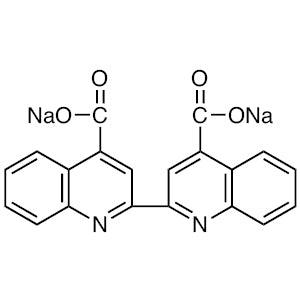
2,2'-Bicinchoninic Acid Dipotassium Salt is a chemical compound widely used in laboratory settings for the quantitative analysis of copper (Cu) ions. It serves as a key reagent in spectrophotometric methods, enabling precise and reliable detection of copper concentrations in various samples. This compound is particularly valuable in analytical chemistry due to its high reactivity with copper ions, which allows for the formation of colored complexes that can be easily measured using spectrophotometry. Its role in laboratory analysis is critical for ensuring accurate and reproducible results in both research and industrial applications.
The compound is preferred for its high purity, chemical stability, and specificity in reacting with copper ions. These properties make it an essential component in analytical procedures that require precision and consistency. Its ability to form stable, colored complexes with copper ions ensures that measurements are not only accurate but also reproducible across different samples and experimental conditions. Additionally, its non-toxic and environmentally safe nature enhances its appeal for use in modern laboratories that prioritize both efficiency and safety.
In Indonesian laboratories, 2,2'-Bicinchoninic Acid Dipotassium Salt is commonly used in environmental, industrial, and biological sample analysis. It is a staple in quality control processes and research studies that require the detection of copper levels in diverse matrices. Its reliability and ease of use make it a favored choice among laboratory professionals in Indonesia for its consistent performance and compatibility with standard analytical protocols.
TCI brochures (PDF)
- Bipyridine/Terpyridine Ligands Bearing Phosphonate Ester Moieties 2025-08-07 · p. 1
- Ligands 2025-12-01 · p. 14
Related TCI products
- TCI B4509 979-88-4 Bicinchoninic Acid Disodium Salt
- TCI M0300 3002-78-6 5-Methyl-1,10-phenanthroline [for Colorimetric Determination of Iron]
- TCI A0956 1750-12-5 4-Amino-3-hydrazino-5-mercapto-1,2,4-triazole [for Determination of Aldehydes]
- TCI B0989 53744-42-6 Bathophenanthrolinedisulfonic Acid Disodium Salt Hydrate [for Determination of Ferrous Ion]
- TCI B0985 52698-84-7 Disodium Bathocuproinedisulfonate [for Determination of Cu in Blood]
- TCI A5015 14609-54-2 TCPP [=Tetrakis(4-carboxyphenyl)porphyrin] [Ultra-high sensitive spectrophotometric reagent for Cu, Cd] [For the simultaneous determination of metals by HPLC]
- Environmental analysis for detecting copper levels in water and soil samples due to its high sensitivity and specificity for copper ions.
- Industrial quality control to monitor copper content in manufacturing processes and raw materials for accuracy and compliance.
- Biological research for measuring copper concentrations in blood, tissue, and other biological fluids to support health and disease studies.
- Academic research in analytical chemistry for developing and validating spectrophotometric methods for copper detection.
- Forensic analysis to identify trace amounts of copper in evidence samples, ensuring reliable and reproducible results in legal investigations.
| Brand | TCI |
|---|---|
| CAS number | 63451-34-3 |
| Molecular formula | — |
| Purity | — |
| Category | Chemistry > Building Blocks > Heterocyclic Building Blocks |
| Pack sizes | Available in various quantities as per supplier specifications |
| Physical form | Solid powder |
| Storage | Store in a cool, dry place away from light and moisture |
This compound should be stored in a cool, dry place, away from direct light and moisture to maintain its chemical stability and effectiveness. It is recommended to use airtight containers to prevent exposure to humidity and contaminants. Laboratory personnel should handle the material with care, using appropriate personal protective equipment such as gloves and safety goggles. While it is considered non-toxic and environmentally safe, proper handling and storage are essential to ensure its performance and safety in laboratory settings. The compound is stable under normal laboratory conditions and does not require special refrigeration unless specified by the supplier. Always follow standard laboratory safety protocols when working with chemical reagents to minimize risks and ensure a safe working environment.
—
Product Categories
Produk Terkait
-
BicinchoninicAcidDisodiumSalt TCI B4509
Regular price From Rp 1.008.000,00Regular priceRp 720.300,00Sale price From Rp 1.008.000,00 -
5-Methyl-1,10-phenanthroline[forColorimetricDeterminationofIron] TCI M0300
Regular price From Rp 1.113.000,00Regular priceRp 793.800,00Sale price From Rp 1.113.000,00 -
4-Amino-3-hydrazino-5-mercapto-1,2,4-triazole[forDeterminationofAldehydes] TCI A0956
Regular price From Rp 1.723.050,00Regular priceRp 1.220.100,00Sale price From Rp 1.723.050,00 -
BathophenanthrolinedisulfonicAcidDisodiumSaltHydrate[forDeterminationofFerrousIon] TCI B0989
Regular price Rp 5.724.600,00Regular priceRp 4.018.350,00Sale price Rp 5.724.600,00 -
DisodiumBathocuproinedisulfonate[forDeterminationofCuinBlood] TCI B0985
Regular price From Rp 1.538.250,00Regular priceRp 1.090.950,00Sale price From Rp 1.538.250,00 -
TCPP[=Tetrakis(4-carboxyphenyl)porphyrin][Ultra-highsensitivespectrophotometricreagentforCu,Cd][ForthesimultaneousdeterminationofmetalsbyHPLC] TCI A5015
Regular price From Rp 955.500,00Regular priceRp 683.550,00Sale price From Rp 955.500,00 -
AzocalA[forCalciumdetermination] TCI A0582
Regular price Rp 4.638.900,00Regular priceRp 3.243.450,00Sale price Rp 4.638.900,00 -
SodiumFlavonol-2'-sulfonateHydrate[forDeterminationofSn,Zr] TCI F0184
Regular price Rp 4.611.600,00Regular priceRp 3.240.300,00Sale price Rp 4.611.600,00