

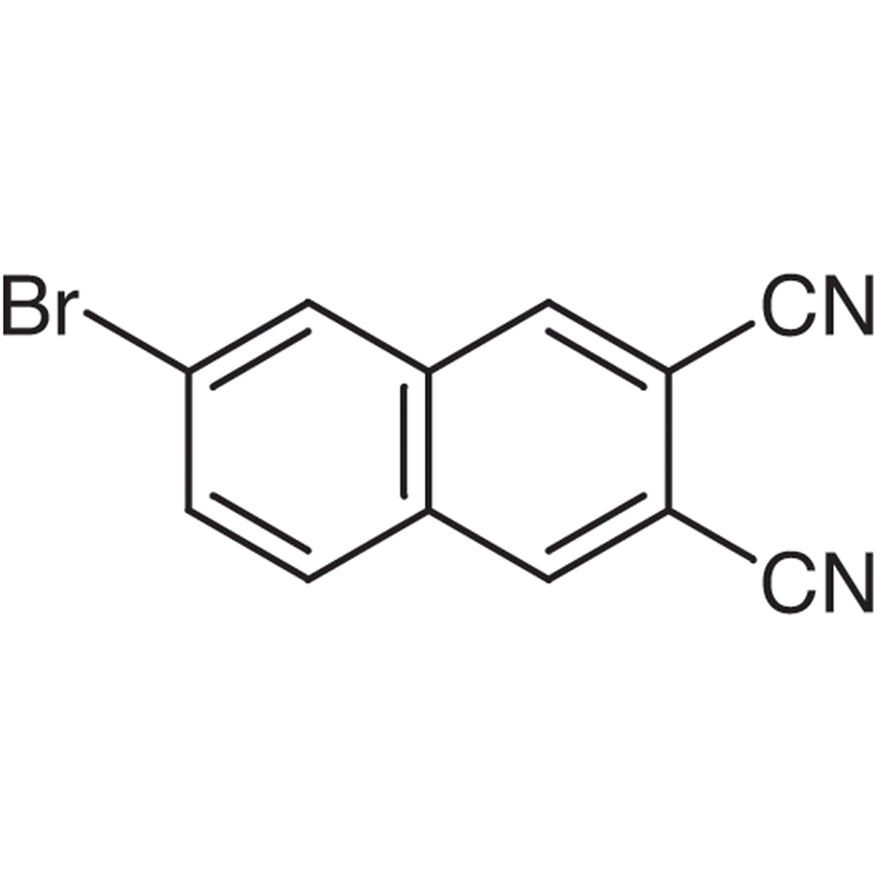
6-Bromo-2,3-dicyanonaphthalene is a chemical compound widely used in scientific research, particularly in the fields of organic chemistry and materials science. This compound serves as a key building block for the synthesis of complex molecules, including those with phthalocyanine structures. Its unique molecular configuration makes it an essential tool for researchers aiming to design and develop advanced materials with specific optical or electronic properties. In laboratory settings, it plays a crucial role in molecular modification and structural innovation, enabling the creation of novel compounds with tailored functionalities.
The compound is valued for its complex chemical structure and high reactivity, which allow it to interact with a wide range of reagents. This versatility makes it a preferred choice for synthetic chemists seeking to explore new reaction pathways and functional group transformations. Additionally, its stability under certain conditions ensures reliable performance in various synthetic processes. These characteristics make it a reliable and flexible material for both academic and industrial research applications.
In Indonesian laboratories, 6-Bromo-2,3-dicyanonaphthalene is commonly used by researchers in organic chemistry, materials science, and related fields. It is an integral part of ongoing research in educational and national research institutions, supporting the development of new materials and technologies. Its availability in the local market ensures that Indonesian scientists can access this important compound for their experimental work.
Related TCI products
- Organic synthesis experiments benefit from this compound due to its reactivity and structural versatility, enabling the creation of complex molecular frameworks.
- Material science research utilizes it as a building block for phthalocyanine derivatives, which are essential in developing advanced optical and electronic materials.
- Pharmaceutical research may incorporate it in the design of novel compounds with specific functional groups, enhancing drug development possibilities.
- Analytical chemistry applications leverage its unique chemical properties for use in spectroscopic and chromatographic analyses.
- Industrial research and development projects use it to explore new synthetic routes and material innovations in the chemical industry.
| Brand | TCI |
|---|---|
| CAS number | 70484-02-5 |
| Molecular formula | — |
| Purity | — |
| Category | Materials Science > Material Building Blocks > Phthalocyanine Building Blocks |
| Pack sizes | Available in various quantities as per standard laboratory supply |
| Physical form | Solid |
| Storage | Store in a cool, dry place away from light and moisture |
This compound should be stored in a cool, dry environment, away from direct sunlight and moisture. It is recommended to use airtight containers made of glass or high-density polyethylene to prevent contamination and maintain chemical integrity. Due to its reactivity, it should be handled in a well-ventilated area, ideally with a fume hood, to minimize exposure. Personal protective equipment such as gloves, goggles, and lab coats should be worn at all times when handling this material. Proper disposal procedures must be followed to ensure compliance with safety and environmental regulations.
—
Produk Terkait
-
2,3-Dibromo-6,7-dicyanonaphthalene TCI D2282
Regular price Rp 11.315.850,00Regular priceRp 7.928.550,00Sale price Rp 11.315.850,00 -
2,3-Dicyanonaphthalene TCI D1977
Regular price Rp 2.942.100,00Regular priceRp 2.072.700,00Sale price Rp 2.942.100,00 -
2,7-Dicyanonaphthalene TCI D3705
Regular price Rp 3.763.200,00Regular priceRp 2.647.050,00Sale price Rp 3.763.200,00 -
1,4-Dicyanonaphthalene TCI D2758
Regular price Rp 2.969.400,00Regular priceRp 2.091.600,00Sale price Rp 2.969.400,00 -
1,2-Naphthalenedicarbonitrile TCI N0578
Regular price From Rp 4.213.650,00Regular priceRp 2.962.050,00Sale price From Rp 4.213.650,00 -
2,3-Dicyano-1,4-dihydroxy-5-nitronaphthalene TCI D2434
Regular price Rp 12.481.350,00Regular priceRp 8.743.350,00Sale price Rp 12.481.350,00 -
2,3-Dicyano-6-nitronaphthalene TCI D2027
Regular price Rp 12.296.550,00Regular priceRp 8.614.200,00Sale price Rp 12.296.550,00 -
1,3-Diiminobenz[f]isoindoline TCI D2009
Regular price Rp 11.473.350,00Regular priceRp 8.038.800,00Sale price Rp 11.473.350,00


