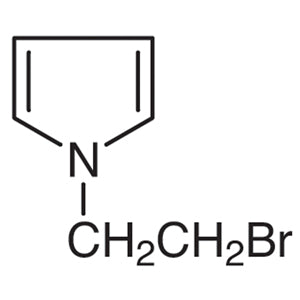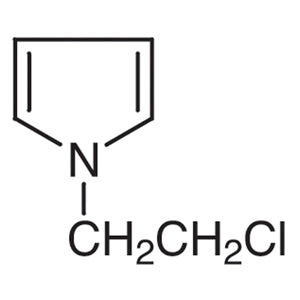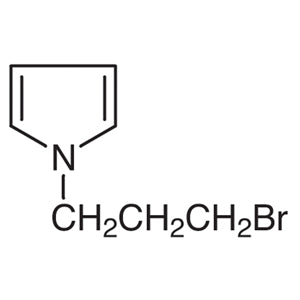
1-(3-Bromopropyl)pyrrole is a chemical compound widely used in organic reactions, particularly in the synthesis of heterocyclic compounds. Its structure is based on a pyrrole ring with a bromopropyl group attached, making it a versatile building block for complex molecular architectures. This compound plays a crucial role in laboratory settings where the construction of heterocyclic structures is required, such as in pharmaceutical and industrial chemical applications. Its unique chemical composition allows for a range of chemical transformations, making it a valuable tool for chemists working on advanced synthetic routes.
The compound is known for its chemical stability under controlled conditions, although it exhibits high reactivity towards various chemical environments, such as elevated temperatures or catalytic influences. This reactivity makes it ideal for reactions that demand precision and control. Additionally, its molecular structure enables participation in substitution and sililation reactions, which are essential in the synthesis of complex organic molecules. These properties make it a preferred choice for researchers aiming to develop new compounds with specific functional groups.
In Indonesian laboratories, 1-(3-Bromopropyl)pyrrole is extensively used in organic chemistry research, especially in pharmacology and the synthesis of new compounds. It is a key reagent in experimental setups where the formation of heterocyclic structures is necessary. Many research institutions and universities rely on this compound for their experimental work, contributing to advancements in chemical science and drug development.
Related TCI products
- Organic synthesis of heterocyclic compounds due to its pyrrole ring and bromopropyl substituent, enabling complex molecular structures.
- Pharmaceutical research for the development of new drugs, as it can be used in the synthesis of bioactive molecules.
- Industrial chemical production where heterocyclic compounds are required for various applications in materials science and polymer chemistry.
- Academic research in universities and research centers focusing on synthetic chemistry and medicinal chemistry.
- Custom compound preparation for specialized applications in chemical manufacturing and analytical chemistry.
| Brand | TCI |
|---|---|
| CAS number | 100779-91-7 |
| Molecular formula | — |
| Purity | — |
| Category | Chemistry > Building Blocks > Heterocyclic Building Blocks |
| Pack sizes | Available in various quantities as per standard laboratory supply |
| Physical form | Liquid |
| Storage | Store in a cool, dry place away from light and incompatible materials |
This compound should be stored in a cool, dry environment, away from direct sunlight and sources of heat. It is recommended to use airtight containers made of glass or polyethylene to prevent contamination and maintain chemical integrity. Due to its reactivity, it should be handled with care, using appropriate personal protective equipment such as gloves and safety goggles. It is important to ensure good ventilation in the workspace to minimize exposure. The compound should not be stored near incompatible substances such as strong oxidizers or acids. Always follow standard laboratory safety protocols when working with reactive chemicals.
—
Produk Terkait
-
9-(3-Bromopropyl)carbazole TCI B5183
Regular price From Rp 2.041.200,00Regular priceRp 1.442.700,00Sale price From Rp 2.041.200,00 -
2-(Trichloroacetyl)pyrrole TCI T1619
Regular price From Rp 822.150,00Regular priceRp 590.100,00Sale price From Rp 822.150,00 -
3-Bromo-1-(triisopropylsilyl)pyrrole TCI B1899
Regular price From Rp 2.491.650,00Regular priceRp 1.757.700,00Sale price From Rp 2.491.650,00 -
1-(2-Bromoethyl)pyrrole TCI B1622
Regular price From Rp 2.306.850,00Regular priceRp 1.628.550,00Sale price From Rp 2.306.850,00 -
1-(2-Chloroethyl)pyrrole TCI C1347
Regular price Rp 4.081.350,00Regular priceRp 2.869.650,00Sale price Rp 4.081.350,00 -
Benzyl3-BromopropylEther TCI B2818
Regular price From Rp 2.545.200,00Regular priceRp 1.779.750,00Sale price From Rp 2.545.200,00