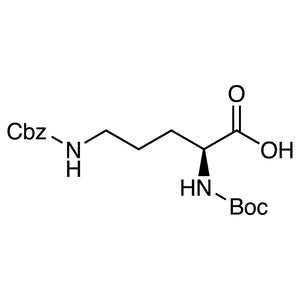
Nalpha-(tert-Butoxycarbonyl)-Nepsilon-benzyloxycarbonyl-L-lysine is a chemical compound widely used in peptide synthesis. This compound plays a crucial role in the laboratory by enabling the formation of peptide bonds through controlled chemical reactions. Its complex structure allows for precise modification of amino acid residues, making it essential in the development of bioactive molecules. In research settings, it is a key reagent for creating custom peptides with specific biological functions.
The compound's stability under certain conditions and its functional groups—tert-butoxycarbonyl and benzyloxycarbonyl—make it a preferred choice for synthetic chemists. These protecting groups prevent unwanted side reactions, ensuring the integrity of the final product. The compound’s chemical properties allow it to be used in a variety of synthetic pathways, offering versatility in laboratory applications. Its ability to withstand specific reaction conditions enhances its utility in complex peptide synthesis protocols.
In Indonesian laboratories, this compound is commonly used in research related to peptides and bioactive compounds. Scientists in universities and research institutions rely on it for developing new therapeutic agents and studying molecular interactions. Its availability in solid form simplifies storage and handling, making it a reliable material for consistent experimental results.
TCI brochures (PDF)
- Amino Acids and Peptide Synthesis Reagents 2025-08-14 · p. 12
Related TCI products
- TCI B4931 78081-87-5 Nalpha,Nepsilon-Bis[(9H-fluoren-9-ylmethoxy)carbonyl]-L-lysine
- TCI B4184 109425-55-0 Ndelta-(tert-Butoxycarbonyl)-Nalpha-[(9H-fluoren-9-ylmethoxy)carbonyl]-L-ornithine
- TCI B3915 4587-33-1 Nalpha-(tert-Butoxycarbonyl)-L-asparagine 4-Nitrophenyl Ester
- TCI B3789 132388-68-2 Nalpha-tert-Butoxycarbonyl-Ngamma-trityl-L-asparagine
- TCI B3072 71989-26-9 Nepsilon-(tert-Butoxycarbonyl)-Nalpha-[(9H-fluoren-9-ylmethoxy)carbonyl]-L-lysine
- TCI B3071 92122-45-7 Nepsilon-(tert-Butoxycarbonyl)-Nalpha-[(9H-fluoren-9-ylmethoxy)carbonyl]-D-lysine
- Peptide Synthesis: This compound is ideal for constructing custom peptides due to its protecting groups, which allow controlled deprotection during synthesis.
- Bioactive Compound Development: Its role in forming stable peptide bonds makes it essential for creating molecules with pharmacological activity.
- Molecular Interaction Studies: Researchers use it to study how specific amino acid modifications affect protein function and behavior.
- Drug Discovery Research: Its application in synthesizing bioactive peptides supports the development of new therapeutic agents.
- Chemical Biology Experiments: The compound is used to explore the structural and functional properties of peptides in various biological contexts.
| Brand | TCI |
|---|---|
| CAS number | 2389-45-9 |
| Molecular formula | — |
| Purity | — |
| Category | Chemistry > Chemical Biology > Peptide Chemistry |
| Pack sizes | Available in standard laboratory quantities |
| Physical form | Solid |
| Storage | Store in a cool, dry place away from light |
This compound should be stored in a cool, dry environment, away from direct sunlight and moisture. It is recommended to keep it in a sealed container to prevent exposure to air and humidity. Due to its chemical stability, it does not require refrigeration but should be protected from extreme temperature fluctuations. In a laboratory setting, it is important to handle the compound with appropriate personal protective equipment, such as gloves and safety goggles, to ensure safe handling. The compound is non-hazardous under normal conditions but should be used in a well-ventilated area to minimize any potential risks associated with chemical exposure.
—
Product Categories
Produk Terkait
-
Nalpha,Nepsilon-Bis[(9H-fluoren-9-ylmethoxy)carbonyl]-L-lysine TCI B4931
Regular price From Rp 1.060.500,00Regular priceRp 757.050,00Sale price From Rp 1.060.500,00 -
Ndelta-(tert-Butoxycarbonyl)-Nalpha-[(9H-fluoren-9-ylmethoxy)carbonyl]-L-ornithine TCI B4184
Regular price Rp 1.934.100,00Regular priceRp 1.368.150,00Sale price Rp 1.934.100,00 -
Nalpha-(tert-Butoxycarbonyl)-L-asparagine4-NitrophenylEster TCI B3915
Regular price Rp 1.351.350,00Regular priceRp 960.750,00Sale price Rp 1.351.350,00 -
Nalpha-tert-Butoxycarbonyl-Ngamma-trityl-L-asparagine TCI B3789
Regular price From Rp 1.643.250,00Regular priceRp 1.164.450,00Sale price From Rp 1.643.250,00 -
Nepsilon-(tert-Butoxycarbonyl)-Nalpha-[(9H-fluoren-9-ylmethoxy)carbonyl]-L-lysine TCI B3072
Regular price Rp 1.167.600,00Regular priceRp 831.600,00Sale price Rp 1.167.600,00 -
Nepsilon-(tert-Butoxycarbonyl)-Nalpha-[(9H-fluoren-9-ylmethoxy)carbonyl]-D-lysine TCI B3071
Regular price From Rp 1.272.600,00Regular priceRp 905.100,00Sale price From Rp 1.272.600,00 -
Nalpha-(tert-Butoxycarbonyl)-Ndelta-benzyloxycarbonyl-L-ornithine TCI B2253
Regular price From Rp 928.200,00Regular priceRp 664.650,00Sale price From Rp 928.200,00 -
Nalpha-(tert-Butoxycarbonyl)-D-arginineHydrochlorideMonohydrate TCI B2204
Regular price From Rp 848.400,00Regular priceRp 609.000,00Sale price From Rp 848.400,00