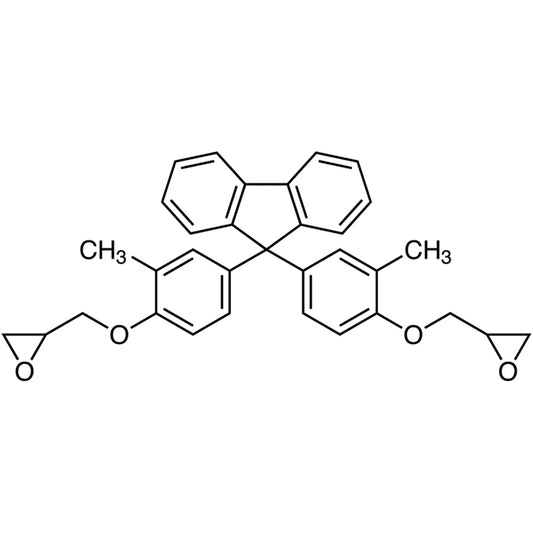
9,9-Bis(4-hydroxyphenyl)fluorene is a chemical compound widely used in material science and polymer chemistry research. This compound plays a crucial role in the synthesis of polymers with unique optical and electronic properties. As a monomer, it is essential for creating complex molecular structures that find applications in optical, electronic, and composite material fields. In the laboratory, it serves as a key reagent for developing materials with specific functional properties. Its versatility makes it a valuable tool for researchers aiming to design advanced materials with tailored characteristics.
The compound is preferred due to its complex molecular structure and ability to form bonds with various functional groups. It exhibits good chemical stability and can participate in a wide range of polymerization reactions. These properties make it suitable for use in both academic and industrial research settings. Its optical and electronic properties are particularly useful in the development of advanced materials, such as light-emitting diodes (LEDs) and optoelectronic devices. This versatility ensures its continued relevance in modern material science applications.
In Indonesian laboratories, 9,9-Bis(4-hydroxyphenyl)fluorene is commonly used in polymer and material research. It is a key component in the development of new materials with specific optical and electronic properties. Many research institutions and universities in Indonesia utilize this compound to advance their studies in polymer science and composite materials. Its role in creating functional materials supports innovation in various scientific and industrial sectors.
TCI brochures (PDF)
- Fluorenes and Fluorenones 2026-04-15 · p. 5
- Monomers 2025-05-28 · p. 23
Related TCI products
- TCI S0953 4081-00-9 Spiro[fluorene-9,9'-xanthene]-3',6'-diol
- TCI F0447 117344-32-8 9,9-Bis[4-(2-hydroxyethoxy)phenyl]fluorene
- TCI B0945 1478-61-1 2,2-Bis(4-hydroxyphenyl)hexafluoropropane
- TCI B0494 80-05-7 2,2-Bis(4-hydroxyphenyl)propane
- TCI D3223 14868-03-2 1,1-Dichloro-2,2-bis(4-hydroxyphenyl)ethylene
- TCI B4666 114205-89-9 9,9-Bis(4-glycidyloxy-3-methylphenyl)fluorene
- Polymer synthesis for optoelectronic devices due to its ability to form complex molecular structures with unique optical properties.
- Development of composite materials where its chemical stability and reactivity contribute to enhanced material performance.
- Research in light-emitting diodes (LEDs) as it provides a foundation for creating materials with controlled optical characteristics.
- Study of electronic materials for applications in advanced semiconductor technologies due to its electronic property modulation.
- Investigation of functional polymers for use in sensor technologies, leveraging its reactivity with various functional groups.
| Brand | TCI |
|---|---|
| CAS number | 3236-71-3 |
| Molecular formula | — |
| Purity | — |
| Category | Materials Science > Polymer/Macromolecule Reagents > Monomers |
| Pack sizes | Available in various quantities as per standard laboratory requirements |
| Physical form | Solid |
| Storage | Store in a cool, dry place away from light and moisture |
This compound should be stored in a cool, dry environment, away from direct light and moisture. It is recommended to use airtight containers to prevent exposure to air and humidity. Proper labeling of storage containers is essential for safe handling and identification. Laboratory personnel should wear appropriate personal protective equipment, such as gloves and safety goggles, when handling the compound. It is important to ensure good ventilation in the workspace to minimize inhalation risks. Avoid contact with skin and eyes, and follow standard safety protocols for chemical handling. Regular monitoring of storage conditions helps maintain the compound's integrity and safety.
—
Product Categories
Produk Terkait
-
Spiro[fluorene-9,9'-xanthene]-3',6'-diol TCI S0953
Regular price From Rp 3.127.950,00Regular priceRp 2.202.900,00Sale price From Rp 3.127.950,00 -
9,9-Bis[4-(2-hydroxyethoxy)phenyl]fluorene TCI F0447
Regular price From Rp 848.400,00Regular priceRp 609.000,00Sale price From Rp 848.400,00 -
2,2-Bis(4-hydroxyphenyl)hexafluoropropane TCI B0945
Regular price From Rp 689.850,00Regular priceRp 481.950,00Sale price From Rp 689.850,00 -
2,2-Bis(4-hydroxyphenyl)propane TCI B0494
Regular price From Rp 477.750,00Regular priceRp 333.900,00Sale price From Rp 477.750,00 -
1,1-Dichloro-2,2-bis(4-hydroxyphenyl)ethylene TCI D3223
Regular price Rp 6.943.650,00Regular priceRp 4.855.200,00Sale price Rp 6.943.650,00 -
9,9-Bis(4-glycidyloxy-3-methylphenyl)fluorene TCI B4666
Regular price From Rp 2.518.950,00Regular priceRp 1.760.850,00Sale price From Rp 2.518.950,00 -
9,9-Bis(4-allyloxyphenyl)fluorene TCI B4622
Regular price From Rp 3.155.250,00Regular priceRp 2.206.050,00Sale price From Rp 3.155.250,00 -
9,9-Bis(4-glycidyloxyphenyl)fluorene TCI B4269
Regular price From Rp 1.035.300,00Regular priceRp 723.450,00Sale price From Rp 1.035.300,00