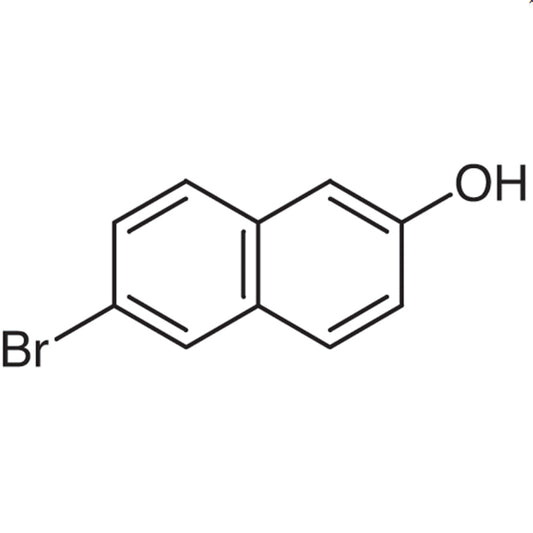
3-Bromo-2-naphthol is a chemical compound widely used in organic synthesis as a building block for the creation of complex organic molecules. This compound features an aromatic naphthalene ring with a bromo group at the 3-position and a hydroxyl group at the 2-position, making it highly reactive in various chemical reactions. Its unique structure allows it to participate in substitution and electrophilic reactions, making it a valuable reagent in synthetic chemistry. In laboratory settings, 3-Bromo-2-naphthol is essential for the development of phenolic compounds, intermediates, and other high-reactivity chemical products.
The compound’s aromatic structure provides stability while maintaining reactivity, which is crucial for synthetic processes. Its high purity and well-defined chemical and physical properties make it a reliable choice for both research and educational purposes. The presence of both bromo and hydroxyl functional groups enhances its versatility, enabling it to be used in a wide range of chemical transformations. This combination of reactivity and stability ensures that it remains a preferred material in organic chemistry laboratories.
In Indonesian laboratories, 3-Bromo-2-naphthol is commonly used in organic chemistry research, particularly in the synthesis of new compounds and structural modifications. It is also frequently employed in advanced educational experiments to train students in synthesis techniques and compound characterization. Its reliability and effectiveness make it a staple in both academic and industrial research environments.
- Organic synthesis of phenolic compounds due to its reactive hydroxyl and bromo groups.
- Development of intermediates in complex molecule synthesis because of its structural versatility.
- Educational experiments in advanced chemistry courses to demonstrate functional group reactivity.
- Research in chemical modification of organic structures for pharmaceutical and industrial applications.
- Preparation of high-reactivity compounds for further chemical transformations in synthetic pathways.
| Brand | TCI |
|---|---|
| CAS number | 30478-88-7 |
| Molecular formula | — |
| Purity | — |
| Category | Chemistry > Building Blocks > Non-Heterocyclic Building Blocks |
| Pack sizes | Available in various quantities as per standard laboratory supply standards. |
| Physical form | Solid, typically in crystalline or powder form. |
| Storage | Store in a cool, dry place away from light and moisture. |
3-Bromo-2-naphthol should be stored in a cool, dry environment to maintain its chemical integrity. It is recommended to keep it in airtight containers to prevent exposure to moisture and air, which could lead to degradation. Due to its potential reactivity, it should be handled with care, using appropriate personal protective equipment such as gloves and safety goggles. It is advisable to store it away from incompatible substances like strong oxidizers. Regular inspection of storage conditions ensures the compound remains in optimal condition for use in laboratory applications. Proper labeling and storage practices help maintain safety and prevent cross-contamination in the lab.
—
Produk Terkait
-
7-Bromo-2-naphthol TCI B4580
Regular price From Rp 769.650,00Regular priceRp 537.600,00Sale price From Rp 769.650,00 -
6-Bromo-2-naphthol TCI B0621
Regular price From Rp 1.961.400,00Regular priceRp 1.371.300,00Sale price From Rp 1.961.400,00 -
1-Bromo-2-naphthol TCI B0620
Regular price Rp 2.782.500,00Regular priceRp 1.945.650,00Sale price Rp 2.782.500,00 -
5,6,7,8-Tetrahydro-1-naphthol TCI T2816
Regular price From Rp 1.405.950,00Regular priceRp 998.550,00Sale price From Rp 1.405.950,00 -
1,2,3,4-Tetrahydro-1-naphthol TCI T1111
Regular price From Rp 1.167.600,00Regular priceRp 815.850,00Sale price From Rp 1.167.600,00 -
5,6,7,8-Tetrahydro-2-naphthol TCI T0108
Regular price Rp 2.439.150,00Regular priceRp 1.720.950,00Sale price Rp 2.439.150,00