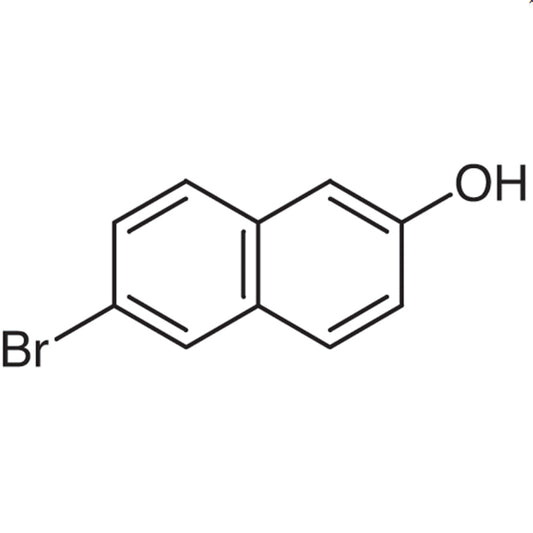
5,6,7,8-Tetrahydro-2-naphthol from TCI is a phenolic compound made of a hydroxyl-bearing aromatic ring fused to a saturated six-membered ring. Its structure can be seen as a phenol carrying a cyclic alkyl substituent, or as a tetralin derivative with an OH group on its aromatic ring. In the laboratory it serves as a building block for organic synthesis. It is especially useful for building molecules that need a functionalised tetralin scaffold, as in medicinal chemistry and materials research.
Chemists choose this compound because it has two reactive regions that complement each other. The phenolic hydroxyl group can be alkylated or acylated, or converted to a triflate for cross-coupling reactions. The aromatic ring is activated by the OH group, so it can undergo electrophilic aromatic substitution. The saturated ring adds lipophilic character and gives the molecule a three-dimensional shape that ordinary naphthols do not have. Together, these features make it a versatile starting material for designing analogues of bioactive compounds.
In Indonesian laboratories, this compound is relevant to university research groups in organic synthesis and pharmaceutical chemistry that are developing new molecular scaffolds and analogues of bioactive compounds. It suits multi-step synthesis projects, thesis and dissertation research, and exploratory work in medicinal chemistry or materials science that needs a reliable non-heterocyclic building block from an established reagent brand. Researchers can use it to explore structure–activity relationships based on the tetralin framework.
- Phenol O-alkylation and O-acylation: the free phenolic hydroxyl group reacts readily to form ethers and esters, so researchers can attach side chains or protecting groups to the tetralin core.
- Triflate formation for cross-coupling: converting the hydroxyl group into a triflate creates a reactive handle for palladium-catalysed coupling reactions, which extends the aromatic ring with new carbon–carbon or carbon–heteroatom bonds.
- Electrophilic aromatic substitution: the OH group activates the aromatic ring, so halogenation, nitration, or acylation can be used to add more functional groups to the scaffold.
- Medicinal chemistry analogue design: the lipophilic saturated ring and its three-dimensional shape set it apart from flat naphthols, which helps when building analogue series of bioactive molecules for structure–activity studies.
- Materials research intermediates: its fused-ring tetralin framework with a reactive phenolic site makes it a useful starting point for functional organic molecules studied in materials chemistry projects.
| Brand | TCI (product code T0108) |
|---|---|
| CAS number | 1125-78-6 |
| Molecular formula | — |
| Purity | — |
| Category | Chemistry > Building Blocks > Non-Heterocyclic Building Blocks |
| Pack sizes | standard TCI pack sizes; please confirm availability when ordering |
| Physical form | refer to the TCI product label and certificate of analysis |
| Storage | keep the container tightly closed and follow the storage conditions on the TCI label and SDS |
Store this compound in its original, tightly closed TCI container in a cool, dry, well-ventilated place, away from direct sunlight, heat sources, and strong oxidising agents. Phenolic compounds can slowly discolour when exposed to air and light, so reseal the container promptly after each use. If you transfer portions, use clean, dry, clearly labelled glass containers. Handle the material in a fume hood and wear nitrile gloves, safety glasses, and a lab coat. Avoid skin contact, eye contact, and inhaling dust or vapour. Consult the Safety Data Sheet before use, and dispose of waste according to institutional chemical waste procedures.
—
Produk Terkait
-
5,6,7,8-Tetrahydro-1-naphthol TCI T2816
Regular price From Rp 1.405.950,00Regular priceRp 998.550,00Sale price From Rp 1.405.950,00 -
1,2,3,4-Tetrahydro-1-naphthol TCI T1111
Regular price From Rp 1.167.600,00Regular priceRp 815.850,00Sale price From Rp 1.167.600,00 -
Disodium1-Naphthol-3,6-disulfonateHydrate TCI V0037
Regular price Rp 584.850,00Regular priceRp 408.450,00Sale price Rp 584.850,00 -
7-Bromo-2-naphthol TCI B4580
Regular price From Rp 769.650,00Regular priceRp 537.600,00Sale price From Rp 769.650,00 -
3-Bromo-2-naphthol TCI B3127
Regular price From Rp 2.650.200,00Regular priceRp 1.853.250,00Sale price From Rp 2.650.200,00 -
6-Bromo-2-naphthol TCI B0621
Regular price From Rp 1.961.400,00Regular priceRp 1.371.300,00Sale price From Rp 1.961.400,00 -
1-Bromo-2-naphthol TCI B0620
Regular price Rp 2.782.500,00Regular priceRp 1.945.650,00Sale price Rp 2.782.500,00 -
4-Nitro-1-naphthol TCI N0672
Regular price From Rp 3.870.300,00Regular priceRp 2.705.850,00Sale price From Rp 3.870.300,00