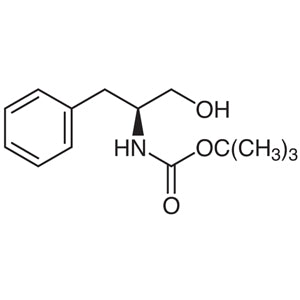
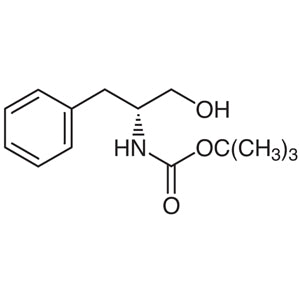
N-(tert-Butoxycarbonyl)-D-2-phenylglycinol is a chiral building block widely used in asymmetric synthesis, playing a crucial role in the development of chiral compounds. This compound is essential for creating molecules with specific spatial configurations, which is vital in pharmaceutical and organic chemistry research. Its unique structure allows for precise control over the stereochemistry of the final product, making it a key component in the synthesis of bioactive molecules. Due to its stability and reactivity, it is frequently employed in advanced chemical processes requiring high selectivity.
The compound’s chiral nature and the presence of the tert-butoxycarbonyl group make it a preferred choice for synthetic chemists. The tert-butoxycarbonyl group provides structural stability while allowing for controlled chemical transformations under specific reaction conditions. This makes it highly versatile in a variety of synthetic pathways. Its ability to act as a chiral auxiliary is particularly valuable in the preparation of enantiomerically pure compounds, which are essential in drug development and other specialized chemical applications.
In Indonesian laboratories, N-(tert-Butoxycarbonyl)-D-2-phenylglycinol is commonly used in organic chemistry research, especially in asymmetric synthesis and pharmaceutical development. It is a staple in academic and research institutions where precision and control over molecular structure are paramount. Its solid form facilitates easy handling and storage, making it a practical choice for laboratory use.
TCI brochures (PDF)
- Chiral Building Blocks 2025-04-14 · p. 7
Related TCI products
- TCI B3272 117049-14-6 N-(tert-Butoxycarbonyl)-L-2-phenylglycinol
- TCI B2604 66605-57-0 N-(tert-Butoxycarbonyl)-L-phenylalaninol
- TCI B1966 106454-69-7 N-(tert-Butoxycarbonyl)-D-phenylalaninol
- TCI B3230 33125-05-2 N-(tert-Butoxycarbonyl)-D-2-phenylglycine
- TCI B3211 2900-27-8 N-(tert-Butoxycarbonyl)-L-2-phenylglycine
- TCI F1193 111524-95-9 N-[(9H-Fluoren-9-ylmethoxy)carbonyl]-D-2-phenylglycine
- Asymmetric synthesis is a key application where this compound serves as a chiral auxiliary, enabling the selective formation of enantiomers with high stereocontrol.
- Organic chemistry research benefits from its structural stability and reactivity, allowing for the synthesis of complex molecules with specific stereochemistry.
- Pharmaceutical development relies on its ability to produce chiral compounds with desired biological activity, supporting drug discovery and formulation.
- Chiral building block applications are widespread in synthetic chemistry, where precise control over molecular structure is required for advanced chemical processes.
- Academic and research institutions use it for high-precision experiments, particularly in the study of stereochemistry and molecular interactions.
| Brand | TCI |
|---|---|
| CAS number | 102089-74-7 |
| Molecular formula | — |
| Purity | — |
| Category | Chemistry > Asymmetric Synthesis > Chiral Building Blocks |
| Pack sizes | Available in standard laboratory quantities |
| Physical form | Solid |
| Storage | Store in a cool, dry place away from light |
This compound should be stored in a cool, dry environment, away from direct light and moisture. It is recommended to use airtight containers to prevent contamination and maintain its chemical integrity. Due to its chiral nature, it is important to handle it with care to avoid any unintended stereochemical changes. Proper labeling and storage conditions are essential to ensure its effectiveness in laboratory applications. Always follow standard chemical safety protocols when handling and using this compound in a laboratory setting.
—
Product Categories
- Asymmetric SynthesisChiral Building BlocksChiral Non-Heterocyclic Building Blocks
- Building BlocksChiral Building BlocksChiral Non-Heterocyclic Building Blocks
- Chemical BiologyPeptide ChemistryAmino Acid Derivatives [Peptide Chemistry]
- Pharmaceutical Development and Drug Discovery Research ReagentsPeptide ChemistryAmino Acid Derivatives [Peptide Chemistry]
Produk Terkait
-
N-(tert-Butoxycarbonyl)-L-2-phenylglycinol TCI B3272
Regular price From Rp 557.550,00Regular priceRp 405.300,00Sale price From Rp 557.550,00 -
N-(tert-Butoxycarbonyl)-L-phenylalaninol TCI B2604
Regular price Rp 1.272.600,00Regular priceRp 905.100,00Sale price Rp 1.272.600,00 -
N-(tert-Butoxycarbonyl)-D-phenylalaninol TCI B1966
Regular price From Rp 530.250,00Regular priceRp 386.400,00Sale price From Rp 530.250,00 -
N-(tert-Butoxycarbonyl)-D-2-phenylglycine TCI B3230
Regular price From Rp 505.050,00Regular priceRp 368.550,00Sale price From Rp 505.050,00 -
N-(tert-Butoxycarbonyl)-L-2-phenylglycine TCI B3211
Regular price From Rp 875.700,00Regular priceRp 627.900,00Sale price From Rp 875.700,00 -
N-[(9H-Fluoren-9-ylmethoxy)carbonyl]-D-2-phenylglycine TCI F1193
Regular price Rp 822.150,00Regular priceRp 590.100,00Sale price Rp 822.150,00 -
N-[(9H-Fluoren-9-ylmethoxy)carbonyl]-L-2-phenylglycine TCI F0669
Regular price From Rp 557.550,00Regular priceRp 405.300,00Sale price From Rp 557.550,00 -
Nalpha-(tert-Butoxycarbonyl)-L-tryptophanol TCI B4287
Regular price From Rp 1.008.000,00Regular priceRp 720.300,00Sale price From Rp 1.008.000,00