


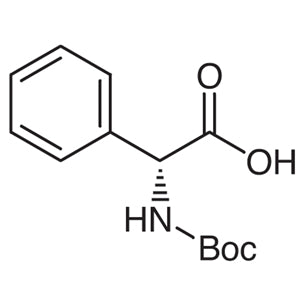
N-(tert-Butoxycarbonyl)-D-2-phenylglycine is a chemical compound widely used in peptide chemistry research. It serves as a key reagent in the synthesis of peptides, particularly in the preparation of amino acids with specific structural configurations. This compound plays a crucial role in peptide bond formation, contributing to the stability of the resulting peptide structures. Its application extends beyond basic research, supporting advanced studies in biochemical and pharmacological fields.
The compound's unique structure, featuring the tert-butoxycarbonyl group, makes it a preferred choice for peptide synthesis. This protective group effectively blocks unwanted chemical reactions, ensuring the selectivity required during complex synthetic processes. Its ability to accelerate reactions while minimizing interference from other reactive species enhances its utility in laboratory settings. Additionally, its high purity ensures reliable and reproducible experimental results.
In Indonesian laboratories, this compound is commonly used in biochemical and pharmacological research. Scientists utilize it for the synthesis of bioactive compounds, drug development, and the study of chemical reaction mechanisms. Its availability in the local market supports ongoing research efforts, making it an essential tool for researchers working in these fields.
TCI brochures (PDF)
- Amino Acids and Peptide Synthesis Reagents 2025-08-14 · p. 13
Related TCI products
- TCI B3211 2900-27-8 N-(tert-Butoxycarbonyl)-L-2-phenylglycine
- TCI F1193 111524-95-9 N-[(9H-Fluoren-9-ylmethoxy)carbonyl]-D-2-phenylglycine
- TCI F0669 102410-65-1 N-[(9H-Fluoren-9-ylmethoxy)carbonyl]-L-2-phenylglycine
- TCI B5350 68856-96-2 N-(tert-Butoxycarbonyl)-4-methoxy-D-phenylalanine
- TCI B5322 159622-10-3 (1R,2S)-1-[(tert-Butoxycarbonyl)amino]-2-vinylcyclopropanecarboxylic Acid
- TCI B5011 85466-66-6 N-(tert-Butoxycarbonyl)-N-methyl-D-phenylalanine
- Peptide Synthesis: This compound is ideal for synthesizing peptides due to its protective group, which prevents premature reactions and ensures accurate bond formation.
- Biochemical Research: It is used in studies involving amino acid structures and their interactions, supporting investigations into protein function and enzyme activity.
- Drug Development: The compound aids in the creation of bioactive molecules, contributing to the design of new therapeutic agents and pharmaceutical compounds.
- Chemical Reaction Mechanism Studies: Its role in stabilizing peptide bonds makes it valuable for understanding the kinetics and pathways of chemical reactions.
- Analytical Chemistry: It serves as a standard in analytical procedures, helping to calibrate instruments and validate experimental results.
| Brand | TCI |
|---|---|
| CAS number | 33125-05-2 |
| Molecular formula | — |
| Purity | — |
| Category | Chemistry > Chemical Biology > Peptide Chemistry |
| Pack sizes | Available in various sizes as per supplier specifications |
| Physical form | Solid |
| Storage | Store in a cool, dry place away from moisture and direct sunlight |
This compound should be stored in a cool, dry environment to maintain its chemical integrity and prevent degradation. It is recommended to use airtight containers to minimize exposure to moisture and air, which can affect its stability. Due to its chemical nature, it should be handled with appropriate personal protective equipment, such as gloves and safety goggles, to ensure laboratory safety. Avoid contact with incompatible substances to prevent unintended reactions. Regular monitoring of storage conditions is advised to ensure optimal preservation of the material. Proper labeling of containers is essential for safe handling and easy identification.
—
Product Categories
- Chemical BiologyPeptide ChemistryAmino Acid Derivatives [Peptide Chemistry]
- Chemical BiologyPeptide ChemistryUnnatural Amino Acid Derivatives
- Pharmaceutical Development and Drug Discovery Research ReagentsPeptide ChemistryAmino Acid Derivatives [Peptide Chemistry]
- Pharmaceutical Development and Drug Discovery Research ReagentsPeptide ChemistryUnnatural Amino Acid Derivatives
Produk Terkait
-
N-(tert-Butoxycarbonyl)-L-2-phenylglycine TCI B3211
Regular price From Rp 875.700,00Regular priceRp 627.900,00Sale price From Rp 875.700,00 -
N-[(9H-Fluoren-9-ylmethoxy)carbonyl]-D-2-phenylglycine TCI F1193
Regular price Rp 822.150,00Regular priceRp 590.100,00Sale price Rp 822.150,00 -
N-[(9H-Fluoren-9-ylmethoxy)carbonyl]-L-2-phenylglycine TCI F0669
Regular price From Rp 557.550,00Regular priceRp 405.300,00Sale price From Rp 557.550,00 -
N-(tert-Butoxycarbonyl)-4-methoxy-D-phenylalanine TCI B5350
Regular price From Rp 1.723.050,00Regular priceRp 1.220.100,00Sale price From Rp 1.723.050,00 -
(1R,2S)-1-[(tert-Butoxycarbonyl)amino]-2-vinylcyclopropanecarboxylicAcid TCI B5322
Regular price From Rp 689.850,00Regular priceRp 497.700,00Sale price From Rp 689.850,00 -
N-(tert-Butoxycarbonyl)-N-methyl-D-phenylalanine TCI B5011
Regular price From Rp 1.643.250,00Regular priceRp 1.164.450,00Sale price From Rp 1.643.250,00 -
N-(tert-Butoxycarbonyl)-4-cyano-L-phenylalanine TCI B4877
Regular price From Rp 2.518.950,00Regular priceRp 1.776.600,00Sale price From Rp 2.518.950,00 -
N-(tert-Butoxycarbonyl)-4-trifluoromethyl-L-phenylalanine TCI B4369
Regular price Rp 6.306.300,00Regular priceRp 4.425.750,00Sale price Rp 6.306.300,00


