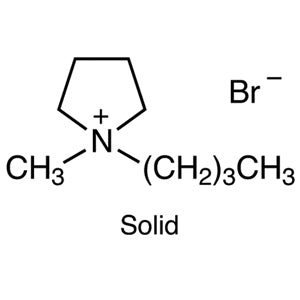
1-Butyl-1-methylpyrrolidinium Bromide is an ionic liquid widely used in modern chemical applications. As a member of the ionic liquid family, it exhibits unique properties such as high boiling points and low viscosity. This compound serves as a versatile solvent or reaction medium in laboratory settings, capable of dissolving a wide range of organic and inorganic substances. Due to its non-volatile nature, it is also employed in separation and purification processes. Its stable ionic structure allows it to function effectively under extreme reaction conditions, making it a valuable tool in chemical research and development.
The key properties that make this compound a preferred choice include its thermal stability, non-volatility, and ability to act as both a catalyst and a solvent. These characteristics enable it to be used in a variety of chemical reactions without undergoing significant degradation. Its low vapor pressure reduces the risk of evaporation, ensuring consistent performance in long-term experiments. Additionally, its ability to dissolve a broad spectrum of compounds makes it suitable for diverse applications in both analytical and synthetic chemistry.
In Indonesian laboratories, 1-Butyl-1-methylpyrrolidinium Bromide is commonly used in organic synthesis, separation techniques, and analytical methods. Its availability and favorable chemical properties make it a popular choice among researchers working on new compound development and process optimization. The compound is also utilized in studies focused on green chemistry and sustainable reaction conditions, reflecting its growing importance in modern scientific research.
TCI brochures (PDF)
- Ionic Liquids 2026-06-08 · p. 11
Related TCI products
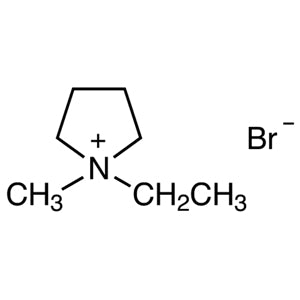
- TCI E1050 69227-51-6 1-Ethyl-1-methylpyrrolidinium Bromide
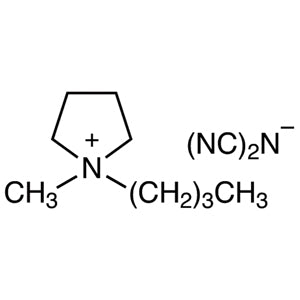
- TCI B5453 370865-80-8 1-Butyl-1-methylpyrrolidinium Dicyanamide
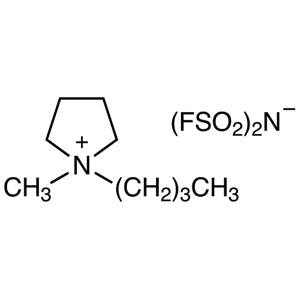
- TCI B5398 1057745-51-3 1-Butyl-1-methylpyrrolidinium Bis(fluorosulfonyl)imide
- TCI B3358 479500-35-1 1-Butyl-1-methylpyrrolidinium Chloride
- TCI B2851 223437-11-4 1-Butyl-1-methylpyrrolidinium Bis(trifluoromethanesulfonyl)imide
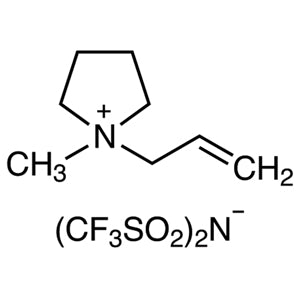
- TCI A3089 1059624-23-5 1-Allyl-1-methylpyrrolidinium Bis(trifluoromethanesulfonyl)imide
- Organic synthesis applications benefit from its ability to dissolve a wide range of organic compounds, making it an ideal reaction medium for complex chemical transformations.
- Separation and purification processes utilize its non-volatile nature, ensuring minimal loss during distillation or extraction steps.
- Analytical chemistry techniques rely on its stable ionic structure, which allows for consistent and reliable results in spectroscopic and chromatographic analyses.
- Catalytic reactions take advantage of its unique properties, enabling efficient and selective chemical transformations under mild conditions.
- Green chemistry initiatives incorporate this compound due to its low environmental impact and reduced volatility compared to traditional solvents.
| Brand | TCI |
|---|---|
| CAS number | 93457-69-3 |
| Molecular formula | — |
| Purity | — |
| Category | Chemistry > Specialty Synthesis > Ionic Liquids |
| Pack sizes | Available in various quantities as per standard laboratory supply |
| Physical form | Liquid |
| Storage | Store in a cool, dry place away from direct sunlight and incompatible materials |
This compound should be stored in a cool, dry environment, away from direct sunlight and sources of heat. It is recommended to use sealed, non-reactive containers to prevent contamination and maintain its chemical integrity. Due to its non-volatile nature, it does not require special containment for vapor control, but it should be kept away from incompatible substances such as strong oxidizers. In laboratory settings, personal protective equipment such as gloves and safety goggles should be worn when handling to ensure safe operation. Proper labeling and storage conditions are essential to maintain the compound's effectiveness and safety during use.
—
Produk Terkait
-
1-Ethyl-1-methylpyrrolidiniumBromide TCI E1050
Regular price From Rp 557.550,00Regular priceRp 405.300,00Sale price From Rp 557.550,00 -
1-Butyl-1-methylpyrrolidiniumDicyanamide TCI B5453
Regular price From Rp 2.306.850,00Regular priceRp 1.628.550,00Sale price From Rp 2.306.850,00 -
1-Butyl-1-methylpyrrolidiniumBis(fluorosulfonyl)imide TCI B5398
Regular price Rp 3.551.100,00Regular priceRp 2.499.000,00Sale price Rp 3.551.100,00 -
1-Butyl-1-methylpyrrolidiniumChloride TCI B3358
Regular price From Rp 1.326.150,00Regular priceRp 942.900,00Sale price From Rp 1.326.150,00 -
1-Butyl-1-methylpyrrolidiniumBis(trifluoromethanesulfonyl)imide TCI B2851
Regular price From Rp 1.881.600,00Regular priceRp 1.331.400,00Sale price From Rp 1.881.600,00 -
1-Allyl-1-methylpyrrolidiniumBis(trifluoromethanesulfonyl)imide TCI A3089
Regular price Rp 2.809.800,00Regular priceRp 1.980.300,00Sale price Rp 2.809.800,00 -
1-(2-Methoxyethyl)-1-methylpyrrolidiniumBis(fluorosulfonyl)imide TCI M2998
Regular price From Rp 2.252.250,00Regular priceRp 1.590.750,00Sale price From Rp 2.252.250,00 -
1-Hexyl-1-methylpyrrolidin-1-iumBis((trifluoromethyl)sulfonyl)amide TCI H1824
Regular price From Rp 2.068.500,00Regular priceRp 1.461.600,00Sale price From Rp 2.068.500,00