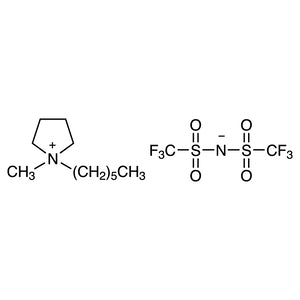
1-Hexyl-1-methylpyrrolidin-1-ium Bis((trifluoromethyl)sulfonyl)amide is a specialized ionic liquid used in complex chemical reactions within laboratory settings. As a member of the ionic liquids category, it plays a crucial role in organic synthesis and material science research. This compound is valued for its unique properties that make it suitable for a wide range of chemical processes. It is commonly used as a solvent or catalyst in reactions requiring a non-reactive and stable environment. Its versatility and chemical stability make it an essential tool for researchers working on advanced chemical synthesis.
The compound’s non-volatile nature and high thermal stability are key factors that contribute to its popularity in laboratory applications. Unlike conventional organic solvents, it maintains its properties over a wide temperature range, making it ideal for high-temperature reactions. Additionally, its low viscosity and high boiling point allow for efficient use in various synthetic procedures. These characteristics ensure that it remains a preferred choice for scientists and students engaged in complex chemical experiments. Its ability to stabilize reactions and reduce side reactions further enhances its value in laboratory research.
In Indonesian laboratories, this ionic liquid is widely used in scientific research and educational institutions. It is particularly popular in organic chemistry and material technology studies. Researchers and students rely on it for conducting experiments that require precise control over reaction conditions. Its availability and performance make it a standard component in many laboratory setups, supporting both academic and industrial research efforts.
- Organic synthesis reactions benefit from this ionic liquid due to its non-reactive nature and ability to stabilize complex chemical processes.
- It is ideal for high-temperature applications because of its thermal stability and resistance to decomposition under extreme conditions.
- In material science research, it serves as a solvent for creating advanced polymers and nanomaterials due to its unique solvation properties.
- It supports green chemistry initiatives by reducing the need for volatile organic solvents, thus minimizing environmental impact.
- Educational institutions use it to teach students about advanced chemical techniques and the properties of ionic liquids in synthetic chemistry.
| Brand | TCI |
|---|---|
| CAS number | 380497-19-8 |
| Molecular formula | — |
| Purity | — |
| Category | Chemistry > Specialty Synthesis > Ionic Liquids |
| Pack sizes | Available in various quantities as per standard laboratory supply |
| Physical form | Liquid |
| Storage | Store in a cool, dry place away from moisture and direct sunlight |
This ionic liquid should be stored in a cool, dry environment to maintain its chemical integrity. It is recommended to use airtight, non-reactive containers such as glass or high-density polyethylene to prevent contamination and evaporation. Due to its non-volatile nature, it does not require refrigeration but should be kept away from sources of heat. Laboratory personnel should handle it with care, using appropriate personal protective equipment when necessary. Its stability under normal storage conditions makes it a reliable choice for long-term use in research settings. Proper labeling and storage practices ensure safety and maintain the compound’s effectiveness in experimental applications.
—
Produk Terkait
-
TCI B5774 5,10-Bis(4,4,5,5-tetramethyl-1,3,2-dioxaborolan-2-yl)naphtho[1,2-c:5,6-c']bis([1,2,5]oxadiazole)
Regular price Rp 10.255.350,00Regular price -
Dihydroiodide TCI B6569
Regular price From Rp 1.936.200,00Regular price -
Trifluoromethanesulfonate TCI B7003
Regular price From Rp 1.936.200,00Regular price
![5,10-Bis(4,4,5,5-tetramethyl-1,3,2-dioxaborolan-2-yl)naphtho[1,2-c:5,6-c']bis([1,2,5]oxadiazole) - TCI B5774 - AMI Scientific](http://amiscientific.com/cdn/shop/files/TCI2510B5774.jpg?v=1769180228&width=533)