
![1-Ethyl-1-methylpyrrolidin-1-ium Bis[(trifluoromethyl)sulfonyl]amide (CAS 223436-99-5) - TCI E1498 - AMI Scientific](http://amiscientific.com/cdn/shop/files/TCI2510E1498.jpg?v=1768197366&width=1946)
![1-Ethyl-1-methylpyrrolidin-1-ium Bis[(trifluoromethyl)sulfonyl]amide (CAS 223436-99-5) - TCI E1498 - AMI Scientific](http://amiscientific.com/cdn/shop/files/TCI2510E1498.jpg?v=1768197366&width=1445)
TCI E1498 1-Ethyl-1-methylpyrrolidin-1-ium Bis[(trifluoromethyl)sulfonyl]amide is an ionic liquid salt composed of a quaternary pyrrolidinium cation paired with the bis(trifluoromethylsulfonyl)imide anion, commonly abbreviated as TFSI. Compounds in the ionic liquid class have become important materials in electrochemistry and materials laboratories because they act as conductive media without requiring any additional molecular solvent. The combination of a pyrrolidinium cation that is stable toward reduction and a TFSI anion that is stable toward oxidation makes this material widely studied as an electrolyte component in battery research, supercapacitor development, and other electrochemical devices.
The principal characteristics that make this material a preferred choice are its wide electrochemical window, very low vapour pressure, good thermal stability, and its non-flammable nature compared with conventional organic electrolytes. The TFSI anion contributes relative hydrophobicity and a high degree of charge delocalisation, which gives the salt a lower viscosity and better ionic conductivity than many alternative anions. The saturated pyrrolidinium cation carries no acidic proton of the kind present on an imidazolium ring, so its cathodic stability is correspondingly greater, an advantage when researchers need an electrolyte that survives strongly reducing conditions at the working electrode.
In Indonesian laboratories this ionic liquid is typically encountered in university and institutional research groups working on energy storage, electrochemistry, and advanced materials. It is normally purchased in small research quantities for electrolyte formulation studies, cyclic voltammetry work, and device prototyping rather than for bulk process use. Because it requires no supporting molecular solvent, it also suits laboratories that prefer to limit the handling of volatile organic solvents in their experimental workflow.
- Battery electrolyte research — the wide electrochemical window and reductive stability of the pyrrolidinium cation allow researchers to evaluate cell chemistries under conditions that would degrade conventional organic electrolyte systems.
- Supercapacitor studies — the low vapour pressure and non-flammable character make this ionic liquid suitable for investigating electrode–electrolyte behaviour across extended potential ranges without solvent evaporation losses during measurement.
- Electrochemical measurement media — the salt conducts current on its own, so cyclic voltammetry and related techniques can be run without adding a molecular solvent or separate supporting electrolyte.
- Materials and interface investigations — good thermal stability lets the material serve in experiments where elevated temperatures would drive off or decompose a traditional volatile organic solvent system.
- Solvent-free reaction and separation studies — the relative hydrophobicity imparted by the TFSI anion supports phase-behaviour work and solvent-substitution research aimed at reducing volatile organic compound use.
| Brand | TCI |
|---|---|
| CAS number | 223436-99-5 |
| Molecular formula | — |
| Purity | — |
| Category | Chemistry > Specialty Synthesis > Ionic Liquids [Specialty Synthesis] |
| Pack sizes | available in standard TCI research-scale packaging; please confirm the currently offered size when ordering |
| Physical form | — |
| Storage | keep in a tightly closed original container, protected from moisture |
- Product code: E1498
Store the container tightly closed in a cool, dry, well-ventilated area away from moisture, since the hygroscopic tendency of ionic liquids can allow water uptake that alters conductivity and electrochemical behaviour. Retain the material in its original TCI container or transfer it to a clean, chemically compatible, tightly sealed vessel. Handle in a fume hood using standard laboratory personal protective equipment, including safety glasses, gloves, and a laboratory coat, and avoid contact with skin and eyes. For electrochemical work, dispensing inside a glovebox or under an inert atmosphere helps preserve sample quality. Always consult the manufacturer's safety data sheet before use and dispose of residues through approved chemical waste channels.
—
Produk Terkait
-
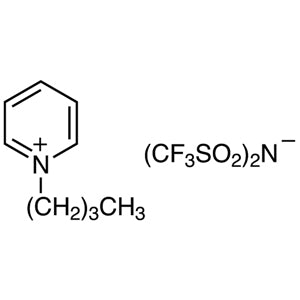
1-ButylpyridiniumBis(trifluoromethanesulfonyl)imide TCI B5571
Regular price From Rp 2.094.750,00Regular price -
2-(tert-Butyldimethylsilyl)-N,N-dimethyl-1H-imidazole-1-sulfonamide TCI B5658
Regular price From Rp 2.650.200,00Regular price -
3-Bromobenzenesulfonamide TCI B5734
Regular price From Rp 1.405.950,00Regular price -
1-Butyl-4-methylpyridiniumBis(trifluoromethanesulfonyl)imide TCI B5763
Regular price From Rp 903.000,00Regular price -
[3-(Bromomethyl)-1-tosylazetidin-3-yl]methanol TCI B5852
Regular price From Rp 1.378.650,00Regular price -
Belinostat TCI B5888
Regular price From Rp 2.306.850,00Regular price -
(-)-4-tert-Butyl-2,6-bis[(4S,5S)-4,5-tetramethylene-1-(2,4,6-trimethylbenzenesulfonyl)imidazolin-2-yl]phenol(contains5%Dichloromethaneatmaximum) TCI B6146
Regular price Rp 8.322.300,00Regular price


![[3-(Bromomethyl)-1-tosylazetidin-3-yl]methanol (CAS 1041026-55-4) - TCI B5852 - AMI Scientific](http://amiscientific.com/cdn/shop/files/TCI2510B5852_08c96097-28a8-4e07-aa20-fbef24394b16.jpg?v=1767863600&width=533)

![(-)-4-tert-Butyl-2,6-bis[(4S,5S)-4,5-tetramethylene-1-(2,4,6-trimethylbenzenesulfonyl)imidazolin-2-yl]phenol (contains 5% Dichloromethane at maximum) (CAS 2102316-91-4) - TCI B6146 - AMI Scientific](http://amiscientific.com/cdn/shop/files/TCI2510B6146.jpg?v=1767093225&width=533)