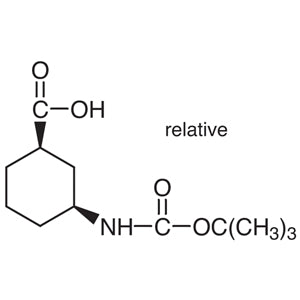
(1R,3S)-3-(tert-Butoxycarbonylamino)cyclohexanecarboxylic Acid is a specialized chemical compound widely used in laboratory settings for peptide synthesis and related chemical processes. This compound is a key reagent in organic and biochemical research, particularly in the development of complex molecules such as peptides and their analogs. Its unique structure, featuring a protected amino group on a cyclohexane ring, makes it essential for controlled chemical reactions where reactivity needs to be precisely managed. In the laboratory, it serves as a building block for the synthesis of bioactive compounds and pharmaceutical intermediates.
The compound's molecular structure and functional groups make it a preferred choice for chemists working in peptide chemistry. The tert-butoxycarbonyl (Boc) protecting group ensures stability during synthesis, allowing for selective reactions and reducing unwanted side reactions. This property is crucial in multi-step synthetic pathways, where maintaining the integrity of specific functional groups is essential. Its chemical stability and compatibility with various reaction conditions further enhance its utility in both academic and industrial research environments.
In Indonesian laboratories, this compound is frequently used in biochemical and pharmaceutical research. It is a vital component in the development of new drugs and bioactive molecules. Research institutions and universities in Indonesia rely on this material for advanced studies in organic chemistry, drug discovery, and biotechnology. Its application supports the growth of scientific innovation and the advancement of medical research in the region.
TCI brochures (PDF)
- Amino Acids and Peptide Synthesis Reagents 2025-08-14 · p. 14
Related TCI products
- TCI B3539 222530-34-9 (1S,3R)-3-(tert-Butoxycarbonylamino)cyclohexanecarboxylic Acid
- TCI B3831 35264-09-6 1-(tert-Butoxycarbonylamino)cyclopentanecarboxylic Acid
- TCI F0888 94744-50-0 2-[(9H-Fluoren-9-ylmethoxy)carbonylamino]isobutyric Acid
- TCI D2672 126828-35-1 4-[(2,4-Dimethoxyphenyl)[(9H-fluoren-9-ylmethoxy)carbonylamino]methyl]phenoxyacetic Acid
- TCI F1215 167690-53-1 trans-4-[[[[(9H-Fluoren-9-yl)methoxy]carbonyl]amino]methyl]cyclohexanecarboxylic Acid
- TCI B6437 115951-16-1 1-[(tert-Butoxycarbonyl)amino]cyclohexanecarboxylic Acid
- Peptide Synthesis: This compound is ideal for synthesizing peptides due to its protected amino group, allowing for controlled coupling reactions and maintaining structural integrity.
- Bioactive Compound Development: Its chemical structure supports the creation of bioactive molecules, making it valuable in pharmaceutical research and drug discovery.
- Organic Chemistry Research: The compound’s stability and reactivity make it a key reagent in complex organic synthesis, supporting academic and industrial research.
- Drug Discovery Projects: Its role in building molecular frameworks is critical in the development of new therapeutic agents and medicinal compounds.
- Biotechnology Applications: It is used in the synthesis of peptides and analogs, supporting advancements in biotechnology and molecular biology research.
| Brand | TCI |
|---|---|
| CAS number | 222530-39-4 |
| Molecular formula | — |
| Purity | — |
| Category | Chemistry > Chemical Biology > Peptide Chemistry |
| Pack sizes | 1 gram, 5 grams, 25 grams |
| Physical form | White crystalline powder |
| Storage | Store in a cool, dry place away from light and moisture |
This compound should be stored in a cool, dry environment, away from direct light and moisture to maintain its chemical integrity. It is recommended to use airtight containers made of glass or high-density polyethylene to prevent contamination and degradation. Due to its chemical nature, it should be handled with appropriate personal protective equipment, including gloves and safety goggles, to ensure laboratory safety. The compound is not classified as hazardous under standard handling conditions, but standard laboratory protocols should be followed to minimize risk. Proper labeling and storage conditions are essential to ensure its effectiveness and safety in research applications.
—
Product Categories
- Chemical BiologyPeptide ChemistryAmino Acid Derivatives [Peptide Chemistry]
- Chemical BiologyPeptide ChemistryUnnatural Amino Acid Derivatives
- Pharmaceutical Development and Drug Discovery Research ReagentsPeptide ChemistryAmino Acid Derivatives [Peptide Chemistry]
- Pharmaceutical Development and Drug Discovery Research ReagentsPeptide ChemistryUnnatural Amino Acid Derivatives
Produk Terkait
-
(1S,3R)-3-(tert-Butoxycarbonylamino)cyclohexanecarboxylicAcid TCI B3539
Regular price Rp 7.976.850,00Regular priceRp 5.593.350,00Sale price Rp 7.976.850,00 -
1-(tert-Butoxycarbonylamino)cyclopentanecarboxylicAcid TCI B3831
Regular price Rp 2.518.950,00Regular priceRp 1.776.600,00Sale price Rp 2.518.950,00 -
2-[(9H-Fluoren-9-ylmethoxy)carbonylamino]isobutyricAcid TCI F0888
Regular price Rp 1.749.300,00Regular priceRp 1.239.000,00Sale price Rp 1.749.300,00 -
4-[(2,4-Dimethoxyphenyl)[(9H-fluoren-9-ylmethoxy)carbonylamino]methyl]phenoxyaceticAcid TCI D2672
Regular price Rp 2.173.500,00Regular priceRp 1.535.100,00Sale price Rp 2.173.500,00 -
trans-4-[[[[(9H-Fluoren-9-yl)methoxy]carbonyl]amino]methyl]cyclohexanecarboxylicAcid TCI F1215
Regular price From Rp 1.113.000,00Regular priceRp 793.800,00Sale price From Rp 1.113.000,00 -
1-[(tert-Butoxycarbonyl)amino]cyclohexanecarboxylicAcid TCI B6437
Regular price From Rp 1.881.600,00Regular priceRp 1.331.400,00Sale price From Rp 1.881.600,00 -
cis-3-(tert-Butoxycarbonylamino)cyclohexanecarboxylicAcid TCI B3518
Regular price From Rp 1.378.650,00Regular priceRp 979.650,00Sale price From Rp 1.378.650,00 -
Sodium1-[(9H-Fluoren-9-ylmethoxy)carbonylamino]cyclopropanecarboxylate TCI F0861
Regular price Rp 3.180.450,00Regular priceRp 2.239.650,00Sale price Rp 3.180.450,00


![TCI F1215 167690-53-1 trans-4-[[[[(9H-Fluoren-9-yl)methoxy]carbonyl]amino]methyl]cyclohexanecarboxylic Acid](http://amiscientific.com/cdn/shop/files/TCI2510F1215_ddd11b8e-9610-4ac1-936a-c4a350811088.jpg?v=1792642742&width=533)
![trans-4-[[[[(9H-Fluoren-9-yl)methoxy]carbonyl]amino]methyl]cyclohexanecarboxylic Acid (CAS 167690-53-1) - TCI F1215 - AMI Scientific](http://amiscientific.com/cdn/shop/files/TCI2510F1215.jpg?v=1768205454&width=533)