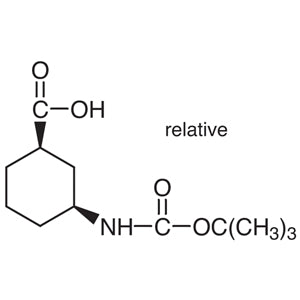
(1S,3R)-3-(tert-Butoxycarbonylamino)cyclohexanecarboxylic Acid is a specialized chemical compound used in organic synthesis, particularly in the fields of peptide chemistry and chemical biology. This compound plays a crucial role in laboratories where researchers aim to develop bioactive molecules and complex structures. Its unique molecular structure enables it to participate in specific chemical reactions, making it an essential reagent for the synthesis of peptides and their analogs. Due to its functional group, it is also widely used in molecular modification and conjugation processes.
The compound’s stability under controlled conditions, along with its sensitivity to moisture and air, makes it a preferred choice for precise chemical synthesis. The presence of the tert-butoxycarbonyl (Boc) group allows it to act as a protecting group, enabling selective reactions and controlled functionalization of amino acids. This property is vital in the synthesis of complex molecules where reaction specificity is required. Its chemical versatility and reactivity make it a reliable component in advanced organic and biochemical research.
In Indonesian laboratories, this compound is commonly used in pharmacological, biochemical, and organic chemistry research. Scientists rely on it to develop new bioactive compounds and to explore molecular interactions. Its role in the synthesis of peptides and bioactive molecules makes it a valuable tool for researchers working on drug discovery and molecular biology projects. Its application in these fields highlights its importance in modern scientific research.
TCI brochures (PDF)
- Amino Acids and Peptide Synthesis Reagents 2025-08-14 · p. 14
Related TCI products
- TCI B3538 222530-39-4 (1R,3S)-3-(tert-Butoxycarbonylamino)cyclohexanecarboxylic Acid
- TCI B3831 35264-09-6 1-(tert-Butoxycarbonylamino)cyclopentanecarboxylic Acid
- TCI F0888 94744-50-0 2-[(9H-Fluoren-9-ylmethoxy)carbonylamino]isobutyric Acid
- TCI D2672 126828-35-1 4-[(2,4-Dimethoxyphenyl)[(9H-fluoren-9-ylmethoxy)carbonylamino]methyl]phenoxyacetic Acid
- TCI F1215 167690-53-1 trans-4-[[[[(9H-Fluoren-9-yl)methoxy]carbonyl]amino]methyl]cyclohexanecarboxylic Acid
- TCI B6437 115951-16-1 1-[(tert-Butoxycarbonyl)amino]cyclohexanecarboxylic Acid
- Peptide Synthesis: This compound is ideal for synthesizing peptides due to its Boc group, which protects the amino function during chemical reactions.
- Bioactive Compound Development: Its chemical structure allows for the creation of bioactive molecules, making it useful in pharmaceutical research.
- Molecular Modification Reactions: The compound's reactivity enables it to participate in molecular modification and conjugation processes.
- Organic Chemistry Research: It is widely used in organic synthesis to create complex chemical structures with specific functional groups.
- Drug Discovery Projects: Its role in peptide chemistry makes it a valuable tool for developing new therapeutic agents.
| Brand | TCI |
|---|---|
| CAS number | 222530-34-9 |
| Molecular formula | — |
| Purity | — |
| Category | Chemistry > Chemical Biology > Peptide Chemistry |
| Pack sizes | Available in various quantities as per standard laboratory requirements |
| Physical form | Solid |
| Storage | Store in a dry, cool place away from moisture and air exposure |
This compound should be stored in a dry, cool environment to prevent degradation due to moisture and air exposure. It is recommended to use airtight containers to maintain its chemical stability. Due to its sensitivity, it should be handled in a controlled laboratory setting with proper ventilation. Researchers should avoid direct contact with skin and eyes, and use appropriate personal protective equipment when handling. The compound is best stored in a desiccator or sealed containers to minimize exposure to humidity. Proper storage ensures the compound remains effective for use in chemical and biochemical applications.
—
Product Categories
- Chemical BiologyPeptide ChemistryAmino Acid Derivatives [Peptide Chemistry]
- Chemical BiologyPeptide ChemistryUnnatural Amino Acid Derivatives
- Pharmaceutical Development and Drug Discovery Research ReagentsPeptide ChemistryAmino Acid Derivatives [Peptide Chemistry]
- Pharmaceutical Development and Drug Discovery Research ReagentsPeptide ChemistryUnnatural Amino Acid Derivatives
Produk Terkait
-
(1R,3S)-3-(tert-Butoxycarbonylamino)cyclohexanecarboxylicAcid TCI B3538
Regular price Rp 4.081.350,00Regular priceRp 2.869.650,00Sale price Rp 4.081.350,00 -
1-(tert-Butoxycarbonylamino)cyclopentanecarboxylicAcid TCI B3831
Regular price Rp 2.518.950,00Regular priceRp 1.776.600,00Sale price Rp 2.518.950,00 -
2-[(9H-Fluoren-9-ylmethoxy)carbonylamino]isobutyricAcid TCI F0888
Regular price Rp 1.749.300,00Regular priceRp 1.239.000,00Sale price Rp 1.749.300,00 -
4-[(2,4-Dimethoxyphenyl)[(9H-fluoren-9-ylmethoxy)carbonylamino]methyl]phenoxyaceticAcid TCI D2672
Regular price Rp 2.173.500,00Regular priceRp 1.535.100,00Sale price Rp 2.173.500,00 -
trans-4-[[[[(9H-Fluoren-9-yl)methoxy]carbonyl]amino]methyl]cyclohexanecarboxylicAcid TCI F1215
Regular price From Rp 1.113.000,00Regular priceRp 793.800,00Sale price From Rp 1.113.000,00 -
1-[(tert-Butoxycarbonyl)amino]cyclohexanecarboxylicAcid TCI B6437
Regular price From Rp 1.881.600,00Regular priceRp 1.331.400,00Sale price From Rp 1.881.600,00 -
cis-3-(tert-Butoxycarbonylamino)cyclohexanecarboxylicAcid TCI B3518
Regular price From Rp 1.378.650,00Regular priceRp 979.650,00Sale price From Rp 1.378.650,00 -
Sodium1-[(9H-Fluoren-9-ylmethoxy)carbonylamino]cyclopropanecarboxylate TCI F0861
Regular price Rp 3.180.450,00Regular priceRp 2.239.650,00Sale price Rp 3.180.450,00


![TCI F1215 167690-53-1 trans-4-[[[[(9H-Fluoren-9-yl)methoxy]carbonyl]amino]methyl]cyclohexanecarboxylic Acid](http://amiscientific.com/cdn/shop/files/TCI2510F1215_ddd11b8e-9610-4ac1-936a-c4a350811088.jpg?v=1792642742&width=533)
![trans-4-[[[[(9H-Fluoren-9-yl)methoxy]carbonyl]amino]methyl]cyclohexanecarboxylic Acid (CAS 167690-53-1) - TCI F1215 - AMI Scientific](http://amiscientific.com/cdn/shop/files/TCI2510F1215.jpg?v=1768205454&width=533)