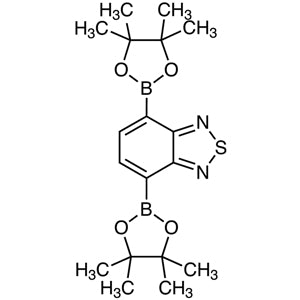
4,7-Bis(5-bromo-2-thienyl)-2,1,3-benzothiadiazole is a chemical compound widely used in materials science research, particularly in the development of organic semiconductor materials. This compound plays a crucial role in the synthesis of advanced materials that exhibit unique electronic properties. It is commonly utilized in the creation of organic photovoltaic cells and optoelectronic devices, where its molecular structure contributes to efficient charge transport and light responsiveness. In laboratory settings, it serves as a fundamental building block for the design of high-performance semiconductors.
The compound is valued for its stable chemical properties and controlled reactivity, making it a reliable choice for synthetic processes. Its molecular structure features bromo and thienyl groups, which provide specific electronic characteristics essential for semiconductor applications. These groups enhance the material’s ability to interact with light and conduct electricity, making it ideal for use in advanced material synthesis. The compound’s structural complexity also allows for the development of materials with tailored optical and electrical properties.
In Indonesian laboratories, this compound is extensively used in material science and technology research. Researchers from educational institutions and research organizations rely on it to develop new materials with potential applications in energy and electronics. Its versatility and reliability make it a key component in the pursuit of innovative material solutions.
TCI brochures (PDF)
- Thiophenes 2026-06-29 · p. 6
- Building Blocks for Organic Semiconductor 2026-03-24 · p. 24
Related TCI products
- TCI D4487 165190-76-1 4,7-Di(2-thienyl)-2,1,3-benzothiadiazole
- TCI B5473 1331742-86-9 7-Bromo-2,1,3-benzothiadiazole-4-carbonitrile
- TCI B4684 457931-23-6 4,7-Bis(5-bromo-4-n-octyl-2-thienyl)-2,1,3-benzothiadiazole
- TCI B4453 1025451-57-3 4,7-Bis(5-trimethylstannyl-2-thienyl)-2,1,3-benzothiadiazole
- TCI B5470 1467776-41-5 5,10-Bis(4,4,5,5-tetramethyl-1,3,2-dioxaborolan-2-yl)naphtho[1,2-c:5,6-c']bis([1,2,5]thiadiazole)
- TCI B3573 934365-16-9 4,7-Bis(4,4,5,5-tetramethyl-1,3,2-dioxaborolan-2-yl)-2,1,3-benzothiadiazole
- Organic semiconductor synthesis due to its molecular structure that supports charge transport and light responsiveness.
- Development of organic photovoltaic cells because of its ability to enhance electron mobility and light absorption.
- Optoelectronic device fabrication as it contributes to the creation of materials with specific electronic and optical properties.
- Material research for high-efficiency semiconductors due to its stable chemical properties and controlled reactivity.
- Advanced material development in energy and electronics fields because of its versatility in synthetic applications.
| Brand | TCI |
|---|---|
| CAS number | 288071-87-4 |
| Molecular formula | — |
| Purity | — |
| Category | Materials Science > Material Building Blocks > Polymer/Macromolecule Semiconductor Building Blocks |
| Pack sizes | Available in standard laboratory quantities |
| Physical form | Solid |
| Storage | Store in a cool, dry place away from direct light |
This compound should be stored in a cool, dry place away from direct light to maintain its chemical stability. It is recommended to use airtight containers to prevent moisture absorption and contamination. Due to its reactivity, it should be handled with appropriate personal protective equipment, such as gloves and safety goggles. Proper ventilation is essential when working with this material to minimize exposure. It is important to keep it away from incompatible substances to avoid any chemical interactions. Regular inspection of storage conditions ensures the integrity of the compound remains intact for research applications.
—
Product Categories
- Material Building BlocksPolymer/Macromolecule Semiconductor Building BlocksDonor-Acceptor (DA) Type Monomers [Polymer/Macromolecule Semiconductor Building Blocks]
- Material Building BlocksSmall Molecule Semiconductor Building BlocksBenzothiadiazoles and Analogs [Small Molecule Semiconductor Building Blocks]
Produk Terkait
-
4,7-Di(2-thienyl)-2,1,3-benzothiadiazole TCI D4487
Regular price From Rp 2.702.700,00Regular priceRp 1.905.750,00Sale price From Rp 2.702.700,00 -
7-Bromo-2,1,3-benzothiadiazole-4-carbonitrile TCI B5473
Regular price Rp 3.260.250,00Regular priceRp 2.295.300,00Sale price Rp 3.260.250,00 -
4,7-Bis(5-bromo-4-n-octyl-2-thienyl)-2,1,3-benzothiadiazole TCI B4684
Regular price Rp 4.531.800,00Regular priceRp 3.184.650,00Sale price Rp 4.531.800,00 -
4,7-Bis(5-trimethylstannyl-2-thienyl)-2,1,3-benzothiadiazole TCI B4453
Regular price Rp 5.087.250,00Regular priceRp 3.573.150,00Sale price Rp 5.087.250,00 -
5,10-Bis(4,4,5,5-tetramethyl-1,3,2-dioxaborolan-2-yl)naphtho[1,2-c:5,6-c']bis([1,2,5]thiadiazole) TCI B5470
Regular price Rp 7.737.450,00Regular priceRp 5.426.400,00Sale price Rp 7.737.450,00 -
4,7-Bis(4,4,5,5-tetramethyl-1,3,2-dioxaborolan-2-yl)-2,1,3-benzothiadiazole TCI B3573
Regular price From Rp 5.855.850,00Regular priceRp 4.110.750,00Sale price From Rp 5.855.850,00 -
Naphtho[1,2-c:5,6-c']bis([1,2,5]thiadiazole) TCI N1105
Regular price Rp 6.545.700,00Regular priceRp 4.592.700,00Sale price Rp 6.545.700,00 -
4,7-Dibromo-5,6-dinitro-2,1,3-benzothiadiazole TCI D4985
Regular price From Rp 1.961.400,00Regular priceRp 1.387.050,00Sale price From Rp 1.961.400,00