

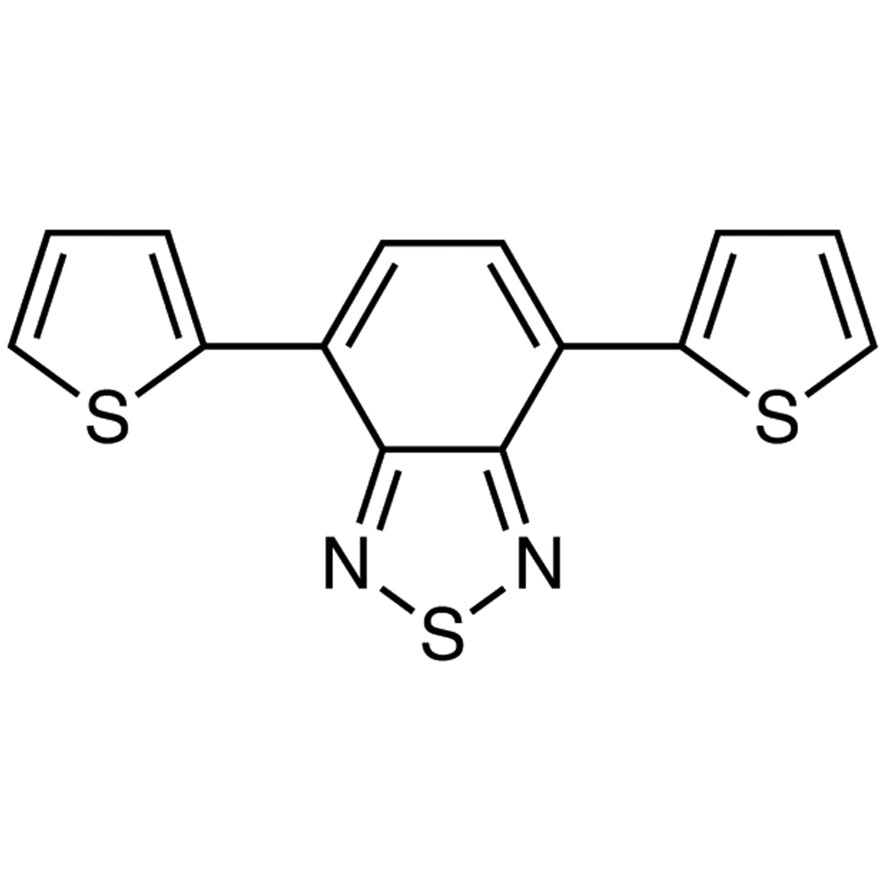
4,7-Di(2-thienyl)-2,1,3-benzothiadiazole is an organic compound widely used in electronic material research, particularly in the development of organic field-effect transistors (OFETs). This compound plays a crucial role in laboratory settings where researchers are working on flexible and lightweight electronic devices. Its unique molecular structure enables efficient electron transport, making it a key component in the fabrication of organic semiconductor layers. As a core material in advanced electronic applications, it supports innovation in next-generation electronic systems.
The compound is valued for its high chemical stability, ability to form smooth and uniform layers, and compatibility with a variety of substrates. These properties make it ideal for high-precision material processing techniques. Additionally, its optical characteristics open up opportunities for use in optoelectronic applications. The compound’s versatility and performance in various experimental conditions contribute to its popularity among researchers.
In Indonesian laboratories, 4,7-Di(2-thienyl)-2,1,3-benzothiadiazole is commonly used in material science and information technology research. It is a key material for developing new electronic devices and exploring advanced semiconductor technologies. Its application is widespread in academic and industrial research settings, supporting both fundamental and applied studies in electronic materials.
- Organic Field-Effect Transistor (OFET) Development: This compound is ideal for fabricating organic semiconductor layers due to its high electron mobility and stability, enabling efficient transistor performance.
- Flexible Electronic Device Research: Its lightweight and flexible properties make it suitable for creating bendable and wearable electronic systems.
- Optoelectronic Material Investigation: The compound’s optical properties allow it to be used in the development of light-emitting and photodetecting devices.
- Semiconductor Layer Coating: Its ability to form smooth and uniform layers makes it a preferred choice for coating processes in thin-film transistor fabrication.
- Material Science Research: It is frequently used in studies focused on the synthesis and characterization of new organic electronic materials.
| Brand | TCI |
|---|---|
| CAS number | 165190-76-1 |
| Molecular formula | — |
| Purity | — |
| Category | Materials Science > Electronic Materials > Organic Transistor (OFET) Materials |
| Pack sizes | Available in various quantities as per supplier specifications |
| Physical form | Solid (as per standard product description) |
| Storage | Store in a cool, dry place away from direct light |
This compound should be stored in a cool, dry environment, away from direct sunlight and sources of heat. It is recommended to use airtight containers to prevent exposure to moisture and air, which may affect its stability. Proper labeling of containers is essential for safe handling and identification. Due to its chemical nature, it should be handled with appropriate personal protective equipment, such as gloves and safety goggles, to ensure laboratory safety. Avoid contact with skin and eyes, and ensure adequate ventilation when working with the material. Regular monitoring of storage conditions is advised to maintain the integrity of the compound.
—
Produk Terkait
-
5-Bromobenzoxazole TCI B5515
Regular price From Rp 1.696.800,00Regular price -
BMS-599626 TCI B5520
Regular price From Rp 3.525.900,00Regular price -
6-Bromobenzo[b]thiophene TCI B5523
Regular price Rp 3.392.550,00Regular price -
3-tert-Butyl4-Methyl(4R,5S)-2,2,5-Trimethyloxazolidine-3,4-dicarboxylate TCI B5538
Regular price Rp 2.969.400,00Regular price -
Biotin-PEG4-Azide TCI B5546
Regular price Rp 7.897.050,00Regular price -
Benzo[b]benzo[4,5]thieno[2,3-d]thiophene TCI B5551
Regular price From Rp 903.000,00Regular price -
2-Bromo-5-(4-hexylphenyl)thiophene TCI B5553
Regular price Rp 3.207.750,00Regular price -
Biotin-PEG4-Amine TCI B5560
Regular price From Rp 1.510.950,00Regular price


![6-Bromobenzo[b]thiophene (CAS 17347-32-9) - TCI B5523 - AMI Scientific](http://amiscientific.com/cdn/shop/files/TCI2510B5523.jpg?v=1767092466&width=533)


![Benzo[b]benzo[4,5]thieno[2,3-d]thiophene (CAS 248-70-4) - TCI B5551 - AMI Scientific](http://amiscientific.com/cdn/shop/files/TCI2510B5551.jpg?v=1768815817&width=533)

