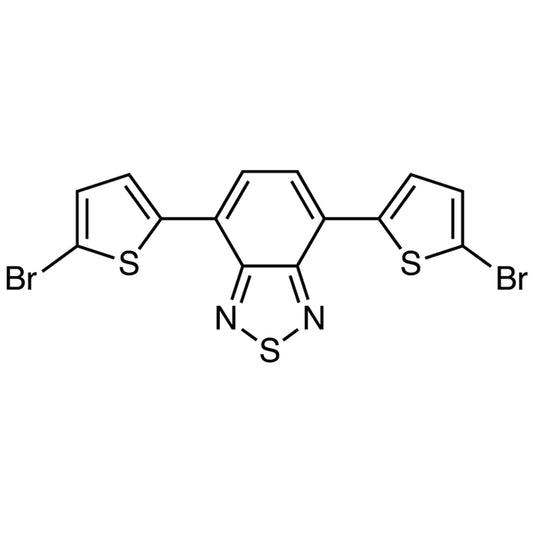
4,7-Bis(5-trimethylstannyl-2-thienyl)-2,1,3-benzothiadiazole is a complex organic compound widely used in scientific material research, particularly in the development of organic semiconductor materials. This compound plays a crucial role in laboratories where researchers are working on advanced materials that require precise molecular structures. Its unique chemical composition allows it to serve as a building block for creating functional organic films, which are essential in modern display technologies and photovoltaic systems. The compound’s versatility makes it a valuable asset in both academic and industrial research settings.
The compound is preferred due to its stable molecular structure and tunable electronic properties. The presence of trimethylstannyl groups enhances its chemical stability and reactivity, enabling it to participate in complex chemical reactions. Additionally, its good solubility in organic solvents simplifies processing and application in various synthetic techniques. These properties make it ideal for use in advanced material synthesis and functional device fabrication. The compound’s ability to form stable molecular frameworks also supports the development of materials with desired electrical and optical characteristics.
In Indonesian laboratories, this compound is commonly used in semiconductor material research. It is a key component in the development of organic thin-film transistors and solar cell materials. Its application supports the growth of advanced materials science research in the region, contributing to technological innovation and scientific advancement. Researchers rely on its consistent performance and compatibility with various synthetic methods to achieve reliable results in their experiments.
TCI brochures (PDF)
- Thiophenes 2026-06-29 · p. 6
- Building Blocks for Organic Semiconductor 2026-03-24 · p. 39
Related TCI products
- TCI B4684 457931-23-6 4,7-Bis(5-bromo-4-n-octyl-2-thienyl)-2,1,3-benzothiadiazole
- TCI B3886 288071-87-4 4,7-Bis(5-bromo-2-thienyl)-2,1,3-benzothiadiazole
- TCI D4487 165190-76-1 4,7-Di(2-thienyl)-2,1,3-benzothiadiazole
- TCI B5753 1192352-10-5 4,7-Bis(5-bromothiophen-2-yl)-5,6-bis(n-octyloxy)-2,1,3-benzothiadiazole
- TCI D3969 850583-75-4 3,6-Di(2-thienyl)-2,5-dihydropyrrolo[3,4-c]pyrrole-1,4-dione
- TCI B5470 1467776-41-5 5,10-Bis(4,4,5,5-tetramethyl-1,3,2-dioxaborolan-2-yl)naphtho[1,2-c:5,6-c']bis([1,2,5]thiadiazole)
- Organic Semiconductor Development: This compound is ideal for creating organic semiconductors due to its stable molecular structure and tunable electronic properties.
- Thin-Film Transistor Fabrication: Its ability to form stable molecular frameworks makes it suitable for use in organic thin-film transistor applications.
- Solar Cell Material Synthesis: The compound's solubility and reactivity support the synthesis of organic photovoltaic materials.
- Display Technology Research: It is used in the development of organic light-emitting diodes (OLEDs) due to its optical and electronic characteristics.
- Advanced Material Processing: Its compatibility with organic solvents enables its use in various synthetic techniques for material processing.
| Brand | TCI |
|---|---|
| CAS number | 1025451-57-3 |
| Molecular formula | — |
| Purity | — |
| Category | Materials Science > Material Building Blocks > Polymer/Macromolecule Semiconductor Building Blocks |
| Pack sizes | As per supplier specifications |
| Physical form | Solid (as per standard chemical form) |
| Storage | Store in a cool, dry place away from light and moisture |
This compound should be stored in a cool, dry environment, away from direct light and moisture to maintain its chemical stability. It is recommended to use airtight containers made of glass or high-density polyethylene to prevent contamination and degradation. Due to its organic nature, it should be handled in a well-ventilated area, and appropriate personal protective equipment such as gloves and safety goggles should be worn. Avoid exposure to heat or open flames, as it may react with certain substances. Proper labeling and storage conditions are essential to ensure safe handling and long-term usability in laboratory settings.
—
Produk Terkait
-
4,7-Bis(5-bromo-4-n-octyl-2-thienyl)-2,1,3-benzothiadiazole TCI B4684
Regular price Rp 4.531.800,00Regular priceRp 3.184.650,00Sale price Rp 4.531.800,00 -
4,7-Bis(5-bromo-2-thienyl)-2,1,3-benzothiadiazole TCI B3886
Regular price From Rp 1.749.300,00Regular priceRp 1.239.000,00Sale price From Rp 1.749.300,00 -
4,7-Di(2-thienyl)-2,1,3-benzothiadiazole TCI D4487
Regular price From Rp 2.702.700,00Regular priceRp 1.905.750,00Sale price From Rp 2.702.700,00 -
4,7-Bis(5-bromothiophen-2-yl)-5,6-bis(n-octyloxy)-2,1,3-benzothiadiazole TCI B5753
Regular price Rp 3.472.350,00Regular priceRp 2.443.350,00Sale price Rp 3.472.350,00 -
3,6-Di(2-thienyl)-2,5-dihydropyrrolo[3,4-c]pyrrole-1,4-dione TCI D3969
Regular price From Rp 2.702.700,00Regular priceRp 1.905.750,00Sale price From Rp 2.702.700,00 -
5,10-Bis(4,4,5,5-tetramethyl-1,3,2-dioxaborolan-2-yl)naphtho[1,2-c:5,6-c']bis([1,2,5]thiadiazole) TCI B5470
Regular price Rp 7.737.450,00Regular priceRp 5.426.400,00Sale price Rp 7.737.450,00 -
trans-1,2-Bis[5-(trimethylstannyl)thiophen-2-yl]ethene TCI B5377
Regular price Rp 7.182.000,00Regular priceRp 5.037.900,00Sale price Rp 7.182.000,00 -
2,5-Bis(trimethylstannyl)thieno[3,2-b]thiophene TCI B4536
Regular price From Rp 3.207.750,00Regular priceRp 2.258.550,00Sale price From Rp 3.207.750,00