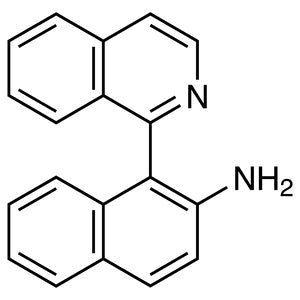
8-Bromoisoquinoline is a chemical compound widely used as a building block in the synthesis of complex heterocyclic compounds. It plays a crucial role in laboratory settings where researchers aim to construct intricate molecular structures. This compound is particularly valued for its versatility and applicability in various chemical processes. Its unique molecular structure, featuring a bromine atom attached at a specific position, makes it a key component in organic chemistry research.
The stability and controlled reactivity of 8-Bromoisoquinoline make it a preferred choice for chemists. Its ability to undergo substitution and ring-opening reactions allows for the synthesis of a wide range of heterocyclic derivatives. These properties enable researchers to modify molecular structures effectively, making it an essential tool in the development of new compounds. Its chemical characteristics ensure reliable performance in experimental conditions, supporting both academic and industrial research.
In Indonesian laboratories, 8-Bromoisoquinoline is extensively used in chemical research, including the development of new compounds and organic molecule modifications. It is a common reagent in pharmaceutical and chemical research projects, contributing to the advancement of scientific knowledge. Its availability and reliability make it a go-to material for scientists working on complex chemical syntheses.
- Pharmaceutical research utilizes 8-Bromoisoquinoline for the synthesis of novel drug compounds due to its reactivity and structural versatility.
- Organic chemistry experiments benefit from its ability to undergo substitution and ring-opening reactions, enabling the creation of diverse heterocyclic derivatives.
- Drug development projects rely on this compound for the modification of molecular structures, enhancing the properties of potential therapeutic agents.
- Academic research institutions use it as a key building block in the study of heterocyclic chemistry and molecular design.
- Industrial chemical synthesis processes incorporate it to produce complex organic compounds with specific functional groups.
| Brand | TCI |
|---|---|
| CAS number | 63927-22-0 |
| Molecular formula | — |
| Purity | — |
| Category | Chemistry > Building Blocks > Heterocyclic Building Blocks |
| Pack sizes | Available in various quantities as per standard laboratory supply |
| Physical form | Solid |
| Storage | Store in a cool, dry place away from light and incompatible substances |
8-Bromoisoquinoline should be stored in a cool, dry place, away from direct light and incompatible materials such as strong oxidizers. It is recommended to use airtight containers made of glass or polyethylene to prevent contamination and maintain chemical integrity. Proper labeling of storage containers is essential for safety and identification. Laboratory personnel should wear appropriate personal protective equipment, including gloves and safety goggles, when handling this compound. Avoid inhalation of vapors and ensure good ventilation in the workspace to minimize exposure risks. Regular inspection of storage conditions ensures the compound remains stable and safe for use in experimental settings.
—
Produk Terkait
-
7-Bromoisoquinoline TCI B5071
Regular price From Rp 1.618.050,00Regular priceRp 1.146.600,00Sale price From Rp 1.618.050,00 -
6-Bromoisoquinoline TCI B4715
Regular price Rp 1.483.650,00Regular priceRp 1.053.150,00Sale price Rp 1.483.650,00 -
1-Bromoisoquinoline TCI B3445
Regular price From Rp 3.683.400,00Regular priceRp 2.591.400,00Sale price From Rp 3.683.400,00 -
5-Bromoisoquinoline TCI B3313
Regular price From Rp 1.167.600,00Regular priceRp 831.600,00Sale price From Rp 1.167.600,00 -
4-Bromoisoquinoline TCI B0930
Regular price From Rp 1.670.550,00Regular priceRp 1.183.350,00Sale price From Rp 1.670.550,00 -
1-Iodoisoquinoline TCI I0750
Regular price From Rp 4.636.800,00Regular priceRp 3.258.150,00Sale price From Rp 4.636.800,00 -
1-(2-Amino-1-naphthyl)isoquinoline TCI A2221
Regular price Rp 7.499.100,00Regular priceRp 5.259.450,00Sale price Rp 7.499.100,00 -
Isoquinoline-3-carboxylicAcid TCI I1246
Regular price From Rp 2.862.300,00Regular priceRp 2.017.050,00Sale price From Rp 2.862.300,00