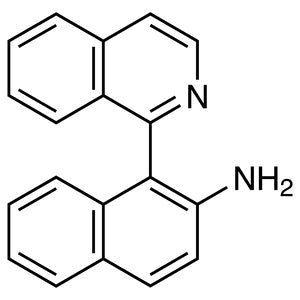
7-Bromoisoquinoline is a chemical compound belonging to the heterocyclic category, commonly used as a building block in the synthesis of complex molecules. It features a unique molecular structure consisting of an isoquinoline ring with a bromo substituent at the 7-position. This compound plays a crucial role in organic chemistry research, enabling the development of compounds with specific functional properties. Its presence in laboratories allows scientists to manipulate molecular structures through various chemical reactions, enhancing the potential for innovation in chemical synthesis.
The stability and controlled reactivity of 7-Bromoisoquinoline make it a preferred choice for researchers. It exhibits a high degree of versatility, participating in nucleophilic, electrophilic, and substitution reactions. These properties allow it to be a valuable tool in the creation of new compounds with tailored characteristics. Its ability to engage in multiple reaction types ensures its relevance in diverse chemical applications, particularly in the development of pharmaceuticals and industrial chemicals.
In Indonesian laboratories, 7-Bromoisoquinoline is widely used in organic chemistry research, especially by scientists working in pharmacology and chemical synthesis. Its role in building complex molecular structures supports advancements in drug discovery and material science. The compound's reliability and effectiveness make it a staple in research settings where precision and reproducibility are essential.
- Organic synthesis research utilizes 7-Bromoisoquinoline for constructing complex molecular frameworks due to its versatile reactivity and structural adaptability.
- Pharmaceutical development benefits from this compound as it enables the synthesis of bioactive molecules with targeted pharmacological properties.
- Heterocyclic compound synthesis relies on 7-Bromoisoquinoline as a key intermediate in creating a wide range of nitrogen-containing ring structures.
- Medicinal chemistry studies employ this compound to explore new drug candidates with potential therapeutic applications.
- Industrial chemical production uses 7-Bromoisoquinoline as a foundational building block for the development of specialty chemicals and materials.
| Brand | TCI |
|---|---|
| CAS number | 58794-09-5 |
| Molecular formula | — |
| Purity | — |
| Category | Chemistry > Building Blocks > Heterocyclic Building Blocks |
| Pack sizes | — |
| Physical form | — |
| Storage | Store in a cool, dry place away from light and moisture |
7-Bromoisoquinoline should be stored in a cool, dry place, away from direct light and moisture to maintain its chemical integrity. It is recommended to use airtight containers to prevent exposure to air and humidity, which could affect its stability. In laboratory settings, proper ventilation is essential when handling this compound to minimize inhalation risks. Personal protective equipment such as gloves, goggles, and a lab coat should be worn to ensure safety. Avoid contact with skin and eyes, and ensure that spillage is promptly cleaned using appropriate safety protocols. The compound should be handled in a well-ventilated area to reduce the risk of exposure to vapors.
—
Produk Terkait
-
6-Bromoisoquinoline TCI B4715
Regular price Rp 1.483.650,00Regular priceRp 1.053.150,00Sale price Rp 1.483.650,00 -
8-Bromoisoquinoline TCI B4144
Regular price From Rp 1.008.000,00Regular priceRp 720.300,00Sale price From Rp 1.008.000,00 -
1-Bromoisoquinoline TCI B3445
Regular price From Rp 3.683.400,00Regular priceRp 2.591.400,00Sale price From Rp 3.683.400,00 -
5-Bromoisoquinoline TCI B3313
Regular price From Rp 1.167.600,00Regular priceRp 831.600,00Sale price From Rp 1.167.600,00 -
4-Bromoisoquinoline TCI B0930
Regular price From Rp 1.670.550,00Regular priceRp 1.183.350,00Sale price From Rp 1.670.550,00 -
1-Iodoisoquinoline TCI I0750
Regular price From Rp 4.636.800,00Regular priceRp 3.258.150,00Sale price From Rp 4.636.800,00 -
1-(2-Amino-1-naphthyl)isoquinoline TCI A2221
Regular price Rp 7.499.100,00Regular priceRp 5.259.450,00Sale price Rp 7.499.100,00 -
Isoquinoline-3-carboxylicAcid TCI I1246
Regular price From Rp 2.862.300,00Regular priceRp 2.017.050,00Sale price From Rp 2.862.300,00