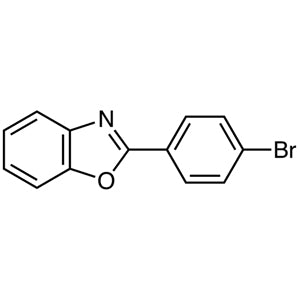
2-(4-Bromophenyl)-1-phenylbenzimidazole is a chemical compound widely used as a building block in the synthesis of complex heterocyclic compounds. This material plays a crucial role in organic chemistry laboratories, where it is employed to construct intricate molecular structures with specific functional groups. Its presence is essential in reactions that involve the formation of aromatic bonds and the development of benzimidazole-based frameworks. Due to its structural versatility, it is a key component in the design of molecules with targeted biological activities.
The compound is valued for its molecular stability and resistance to degradation, which ensures consistent performance in chemical reactions. Its ability to form stable bonds with various functional groups makes it highly adaptable to different synthetic strategies. These properties make it a preferred choice for researchers aiming to achieve high precision and reproducibility in their experiments. Its chemical inertness under controlled conditions further enhances its reliability in laboratory settings.
In Indonesian laboratories, this compound is commonly used in organic chemistry research, particularly in academic institutions and research centers focused on drug development and molecular synthesis. Its availability in the local market supports ongoing scientific investigations, enabling researchers to access high-quality reagents for their experiments. Its relevance in creating bioactive compounds makes it an essential tool for advancing chemical research in the region.
TCI brochures (PDF)
- Building Blocks for Organic Semiconductor 2026-03-24 · p. 17
Related TCI products
- TCI I0983 760212-42-8 2-(4-Iodophenyl)-1-phenylbenzimidazole
- TCI B6092 13275-42-8 2-(2-Bromophenyl)-1H-benzimidazole
- TCI B5437 1616607-88-5 2-(2-Bromophenyl)-9-phenyl-9H-carbazole
- TCI B5313 601454-33-5 9-(4-Bromophenyl)-3,6-di-tert-butylcarbazole
- TCI B5107 1226860-66-7 3-Bromo-9-(4-bromophenyl)-9H-carbazole
- TCI B5017 3164-13-4 2-(4-Bromophenyl)benzoxazole
- Organic synthesis of bioactive compounds due to its structural versatility and reactivity in forming aromatic bonds.
- Development of heterocyclic frameworks for pharmaceutical applications because of its stable molecular structure.
- Research in medicinal chemistry for designing molecules with specific pharmacological properties.
- Synthesis of complex aromatic compounds where benzimidazole derivatives are required.
- Investigation of functional group modifications in organic molecules for enhanced biological activity.
| Brand | TCI |
|---|---|
| CAS number | 2620-76-0 |
| Molecular formula | — |
| Purity | — |
| Category | Chemistry > Building Blocks > Heterocyclic Building Blocks |
| Pack sizes | Available in standard laboratory quantities as per supplier offerings |
| Physical form | Solid (as per typical chemical compound presentation) |
| Storage | Store in a cool, dry place away from direct sunlight and moisture |
This compound should be stored in a cool, dry environment to maintain its chemical integrity and prevent degradation. It is recommended to use airtight containers to minimize exposure to moisture and air, which could affect its stability. Proper labeling of storage containers is essential for safe handling and identification. Laboratory personnel should wear appropriate personal protective equipment when handling the compound to ensure safety. The compound should be kept away from incompatible substances to avoid any potential chemical reactions. Regular monitoring of storage conditions helps maintain the quality and usability of the material for research purposes.
—
Produk Terkait
-
2-(4-Iodophenyl)-1-phenylbenzimidazole TCI I0983
Regular price From Rp 1.961.400,00Regular priceRp 1.387.050,00Sale price From Rp 1.961.400,00 -
2-(2-Bromophenyl)-1H-benzimidazole TCI B6092
Regular price From Rp 1.008.000,00Regular priceRp 720.300,00Sale price From Rp 1.008.000,00 -
2-(2-Bromophenyl)-9-phenyl-9H-carbazole TCI B5437
Regular price From Rp 1.246.350,00Regular priceRp 887.250,00Sale price From Rp 1.246.350,00 -
9-(4-Bromophenyl)-3,6-di-tert-butylcarbazole TCI B5313
Regular price From Rp 2.969.400,00Regular priceRp 2.091.600,00Sale price From Rp 2.969.400,00 -
3-Bromo-9-(4-bromophenyl)-9H-carbazole TCI B5107
Regular price From Rp 2.623.950,00Regular priceRp 1.850.100,00Sale price From Rp 2.623.950,00 -
2-(4-Bromophenyl)benzoxazole TCI B5017
Regular price From Rp 717.150,00Regular priceRp 516.600,00Sale price From Rp 717.150,00 -
4-(4-Bromophenyl)dibenzofuran TCI B4884
Regular price From Rp 3.735.900,00Regular priceRp 2.628.150,00Sale price From Rp 3.735.900,00 -
2-(4-Bromophenyl)imidazo[1,2-a]pyridine TCI B4871
Regular price Rp 1.351.350,00Regular priceRp 960.750,00Sale price Rp 1.351.350,00