

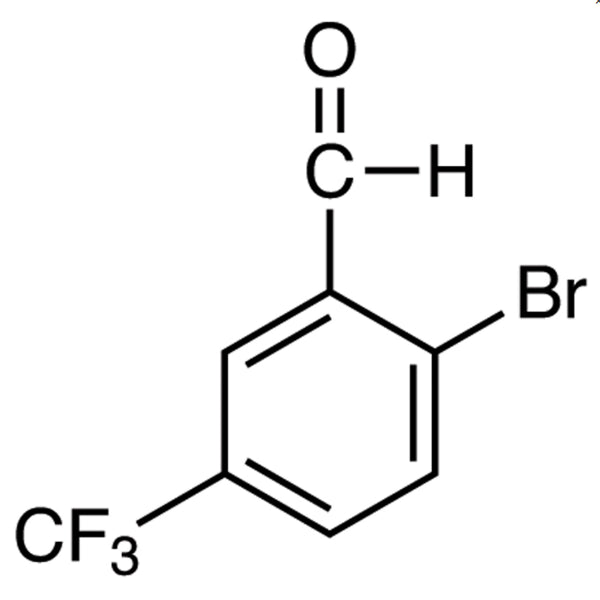
2-Bromo-5-(trifluoromethyl)benzaldehyde is a chemical compound widely used as a building block in the synthesis of complex organic molecules. This versatile reagent plays a crucial role in laboratory settings where the development of aromatic compounds with halogen and fluorine substituents is required. Its unique molecular structure, featuring both bromo and trifluoromethyl groups, makes it an essential component in various synthetic pathways. Due to its chemical reactivity and functional group versatility, it is frequently utilized in organic chemistry research and pharmaceutical development.
The compound's chemical properties, including its reactivity in nucleophilic, electrophilic, and catalytic reactions, make it a preferred choice for researchers. The presence of fluorine atoms contributes to molecular stability and introduces unique chemical behavior, enhancing its applicability in advanced synthetic strategies. Its ability to participate in a wide range of chemical transformations makes it a valuable tool for scientists working on drug discovery and material science. The combination of bromine and trifluoromethyl groups also allows for the creation of diverse derivatives, expanding its utility in chemical research.
In Indonesian laboratories, this compound is commonly used in scientific research related to the synthesis of new compounds, drug development, and the study of organic reactivity. Its specific properties make it a top choice for laboratories focused on organic chemistry and pharmacology. Researchers rely on its predictable behavior and compatibility with various reaction conditions to achieve desired outcomes in their experiments. It is a key reagent in the pursuit of innovation and discovery in chemical sciences.
TCI brochures (PDF)
- Fluorination Reagents, Fluorinated Building Blocks 2026-03-18 · p. 41
Related TCI products
- TCI T1399 454-89-7 3-(Trifluoromethyl)benzaldehyde
- TCI T1281 447-61-0 2-(Trifluoromethyl)benzaldehyde
- TCI B4206 59664-42-5 2,4-Bis(trifluoromethyl)benzaldehyde
- TCI B1751 401-95-6 3,5-Bis(trifluoromethyl)benzaldehyde
- TCI T1091 455-19-6 4-(Trifluoromethyl)benzaldehyde
- TCI M2162 106312-36-1 4-Methoxy-2-(trifluoromethyl)benzaldehyde
- Synthesis of Organic Compounds: This compound is ideal for creating complex organic molecules due to its reactive functional groups and structural versatility.
- Drug Development: Its ability to participate in various chemical reactions makes it a valuable tool in the synthesis of pharmaceutical compounds.
- Fluorinated Compound Research: The presence of trifluoromethyl groups makes it suitable for studying fluorinated compounds and their properties.
- Material Science Investigations: Its chemical stability and reactivity are useful in the development of new materials with unique properties.
- Organic Reactivity Studies: The compound's behavior in different reaction conditions makes it a key reagent for studying organic reactivity and functional group transformations.
| Brand | TCI |
|---|---|
| CAS number | 102684-91-3 |
| Molecular formula | — |
| Purity | — |
| Category | Chemistry > Building Blocks > Fluorinated Building Blocks |
| Pack sizes | — |
| Physical form | — |
| Storage | Store in a cool, dry place away from light and incompatible materials |
This compound should be stored in a cool, dry environment, away from direct sunlight and sources of heat. It is recommended to use airtight containers made of materials that are chemically inert to prevent any unwanted reactions. Due to its chemical reactivity, it should be kept away from incompatible substances such as strong oxidizers and acids. Proper ventilation is essential when handling this material to minimize exposure. Always wear appropriate personal protective equipment, including gloves, goggles, and a lab coat, to ensure safety during handling and use. Regular monitoring of storage conditions is advised to maintain the integrity and stability of the compound.
—
Produk Terkait
-
3-(Trifluoromethyl)benzaldehyde TCI T1399
Regular price From Rp 557.550,00Regular priceRp 389.550,00Sale price From Rp 557.550,00 -
2-(Trifluoromethyl)benzaldehyde TCI T1281
Regular price Rp 1.378.650,00Regular priceRp 963.900,00Sale price Rp 1.378.650,00 -
2,4-Bis(trifluoromethyl)benzaldehyde TCI B4206
Regular price From Rp 1.829.100,00Regular priceRp 1.278.900,00Sale price From Rp 1.829.100,00 -
3,5-Bis(trifluoromethyl)benzaldehyde TCI B1751
Regular price From Rp 1.220.100,00Regular priceRp 852.600,00Sale price From Rp 1.220.100,00 -
4-(Trifluoromethyl)benzaldehyde TCI T1091
Regular price From Rp 903.000,00Regular priceRp 631.050,00Sale price From Rp 903.000,00 -
4-Methoxy-2-(trifluoromethyl)benzaldehyde TCI M2162
Regular price Rp 955.500,00Regular priceRp 667.800,00Sale price Rp 955.500,00 -
2-Fluoro-6-(trifluoromethyl)benzaldehyde TCI F1033
Regular price From Rp 848.400,00Regular priceRp 593.250,00Sale price From Rp 848.400,00 -
3-Fluoro-5-(trifluoromethyl)benzaldehyde TCI F0774
Regular price From Rp 769.650,00Regular priceRp 537.600,00Sale price From Rp 769.650,00


