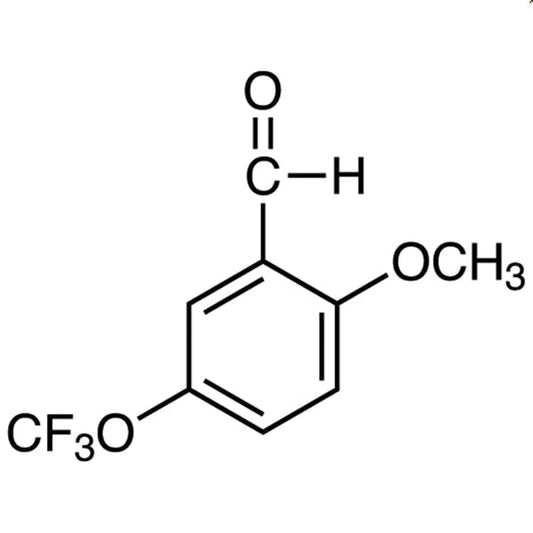
4-Methoxy-2-(trifluoromethyl)benzaldehyde is a chemical compound widely used in organic laboratory reactions. It serves as a versatile building block in the synthesis of various organic compounds, particularly those requiring specific functional groups. This compound is commonly found in research settings where the introduction of fluorinated and methoxy groups is essential. Its role in laboratory work is critical for the development of pharmaceuticals, materials science, and other chemical applications. Due to its unique molecular structure, it is a valuable tool for chemists aiming to create complex molecules with tailored properties.
The compound's properties make it a preferred choice in chemical synthesis. The presence of the trifluoromethyl group provides unique electronic and reactive characteristics, enhancing the compound's utility in a variety of chemical transformations. This group also contributes to the compound's chemical stability, allowing it to be used under a wide range of reaction conditions. Additionally, the aldehyde functional group makes it highly reactive with various reagents, offering flexibility in synthetic pathways. These features make it a reliable and effective reagent in both academic and industrial research environments.
In Indonesian laboratories, 4-Methoxy-2-(trifluoromethyl)benzaldehyde is frequently used in organic chemistry research, especially in pharmaceutical and material science applications. Its ability to participate in multiple reactions and its stability under different conditions make it a sought-after compound for researchers. It is often employed in the development of new drugs and advanced materials, supporting innovation in both academic and industrial sectors. Its availability through suppliers like AMI Scientific ensures that it remains accessible for use in local research facilities.
TCI brochures (PDF)
- Fluorination Reagents, Fluorinated Building Blocks 2026-03-18 · p. 42
Related TCI products
- TCI T1399 454-89-7 3-(Trifluoromethyl)benzaldehyde
- TCI T1281 447-61-0 2-(Trifluoromethyl)benzaldehyde
- TCI B4508 102684-91-3 2-Bromo-5-(trifluoromethyl)benzaldehyde
- TCI B4206 59664-42-5 2,4-Bis(trifluoromethyl)benzaldehyde
- TCI B1751 401-95-6 3,5-Bis(trifluoromethyl)benzaldehyde
- TCI T1091 455-19-6 4-(Trifluoromethyl)benzaldehyde
- Organic synthesis where fluorinated and methoxy groups are required for molecular design and functionalization.
- Pharmaceutical research to develop compounds with specific biological activity and chemical stability.
- Material science applications for creating polymers and coatings with enhanced properties.
- Chemical modification of existing compounds to improve reactivity or introduce new functionalities.
- Analytical chemistry for use as a reference standard in spectroscopic and chromatographic analyses.
| Brand | TCI |
|---|---|
| CAS number | 106312-36-1 |
| Molecular formula | — |
| Purity | — |
| Category | Chemistry > Building Blocks > Fluorinated Building Blocks |
| Pack sizes | Available in various quantities as per supplier specifications |
| Physical form | Solid or liquid, depending on the specific product variant |
| Storage | Store in a cool, dry place away from light and moisture |
This compound should be stored in a cool, dry environment, away from direct sunlight and moisture. It is recommended to use airtight containers to prevent exposure to air and humidity, which can affect its stability. Due to its chemical nature, it should be handled with appropriate personal protective equipment, such as gloves and safety goggles, to ensure laboratory safety. It is important to keep the compound in a well-ventilated area to minimize the risk of inhalation. Proper labeling and storage conditions are essential to maintain its integrity and ensure safe handling in the laboratory setting.
—
Produk Terkait
-
3-(Trifluoromethyl)benzaldehyde TCI T1399
Regular price From Rp 557.550,00Regular price -
2-(Trifluoromethyl)benzaldehyde TCI T1281
Regular price Rp 1.378.650,00Regular price -
2-Bromo-5-(trifluoromethyl)benzaldehyde TCI B4508
Regular price From Rp 928.200,00Regular price -
2,4-Bis(trifluoromethyl)benzaldehyde TCI B4206
Regular price From Rp 1.829.100,00Regular price -
3,5-Bis(trifluoromethyl)benzaldehyde TCI B1751
Regular price From Rp 1.220.100,00Regular price -
4-(Trifluoromethyl)benzaldehyde TCI T1091
Regular price From Rp 903.000,00Regular price -
2-Methoxy-5-(trifluoromethoxy)benzaldehyde TCI M1945
Regular price Rp 955.500,00Regular price -
2-Fluoro-6-(trifluoromethyl)benzaldehyde TCI F1033
Regular price From Rp 848.400,00Regular price