

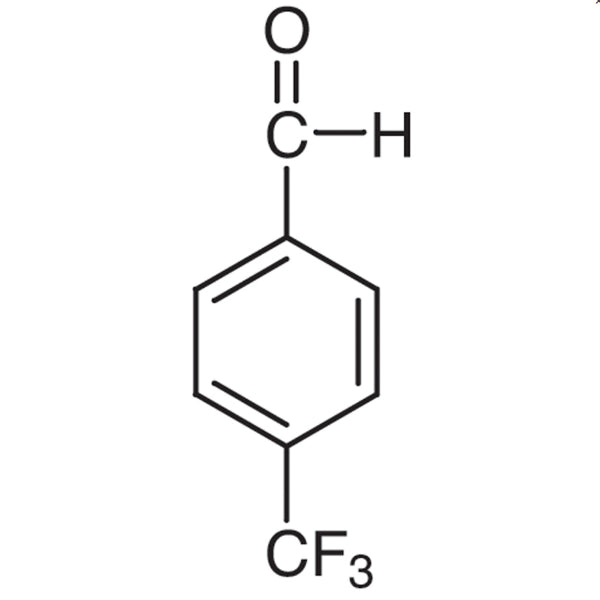
TCI T1091 is 4-(Trifluoromethyl)benzaldehyde (CAS 455-19-6), an aromatic aldehyde that carries a trifluoromethyl group in the para position relative to the formyl group. It belongs to the fluorinated building blocks, a category that is especially important in medicinal chemistry and agrochemistry. In the laboratory it is used to introduce a CF3-bearing aryl unit into target molecules through characteristic aldehyde reactions such as condensation, reductive amination, and olefination.
The trifluoromethyl group is a strongly electron-withdrawing substituent. It makes the carbonyl carbon of the aldehyde more electrophilic, so the compound is generally more reactive toward nucleophiles. The CF3 group is also frequently built into drug candidates because it can influence the lipophilicity and metabolic stability of a molecule. This combination of aldehyde reactivity and the distinctive properties of a fluorinated group makes the compound a popular choice among synthetic chemists.
In Indonesian laboratories, 4-(Trifluoromethyl)benzaldehyde suits research groups working in organic synthesis, medicinal chemistry, and agrochemical development. It is supplied in 5 g, 25 g, and 250 g packs, so researchers can match the quantity to the work at hand, from initial exploration and routine synthesis to larger-scale preparation of intermediates.
TCI brochures (PDF)
- Fluorination Reagents, Fluorinated Building Blocks 2026-03-18 · p. 40
Related TCI products
- TCI T2256 659-28-9 4-(Trifluoromethoxy)benzaldehyde
- TCI T1399 454-89-7 3-(Trifluoromethyl)benzaldehyde
- TCI T1281 447-61-0 2-(Trifluoromethyl)benzaldehyde
- TCI B4508 102684-91-3 2-Bromo-5-(trifluoromethyl)benzaldehyde
- TCI B4206 59664-42-5 2,4-Bis(trifluoromethyl)benzaldehyde
- TCI B1751 401-95-6 3,5-Bis(trifluoromethyl)benzaldehyde
- Reductive amination: the aldehyde group reacts with primary or secondary amines to form imines that are then reduced, and the electron-poor carbonyl carbon makes this a convenient route to CF3-substituted benzylamines.
- Condensation reactions: the enhanced electrophilicity of the carbonyl carbon allows the compound to condense with active methylene compounds and other nucleophiles, giving CF3-bearing products suitable for further synthetic steps.
- Olefination: reactions such as the Wittig and related methods convert the formyl group into a carbon-carbon double bond, attaching the 4-(trifluoromethyl)phenyl unit to a new alkene framework.
- Medicinal chemistry building block: the CF3 group is often added to candidate molecules to influence lipophilicity and metabolic stability, so this aldehyde is a practical way to introduce that feature into compound series.
- Agrochemical development: fluorinated aromatic units are valued in agrochemical research, and this compound provides a ready source of a para-CF3 aryl group for synthesizing and evaluating new candidate structures.
| Brand | TCI |
|---|---|
| CAS number | 455-19-6 |
| Molecular formula | — |
| Purity | — |
| Category | Chemistry > Building Blocks > Fluorinated Building Blocks |
| Pack sizes | 5 g, 25 g, and 250 g |
| Physical form | — |
| Storage | keep in the original tightly closed container; consult the supplier's label and safety data sheet for the exact conditions |
- Product code: T1091
Store 4-(Trifluoromethyl)benzaldehyde in its original, tightly closed container in a cool, dry, well-ventilated place away from heat, direct sunlight, and incompatible materials such as strong oxidizing agents. Aldehydes can be sensitive to air over time, so close the container promptly after each use and follow the storage instructions printed on the label and in the safety data sheet. Handle the material in a fume hood while wearing a laboratory coat, chemical-resistant gloves, and safety glasses. Avoid inhaling vapors and avoid contact with skin and eyes. Dispose of waste according to your institution's chemical waste procedures and local regulations.
—
Produk Terkait
-
4-(Trifluoromethoxy)benzaldehyde TCI T2256
Regular price From Rp 1.378.650,00Regular priceRp 963.900,00Sale price From Rp 1.378.650,00 -
3-(Trifluoromethyl)benzaldehyde TCI T1399
Regular price From Rp 557.550,00Regular priceRp 389.550,00Sale price From Rp 557.550,00 -
2-(Trifluoromethyl)benzaldehyde TCI T1281
Regular price Rp 1.378.650,00Regular priceRp 963.900,00Sale price Rp 1.378.650,00 -
2-Bromo-5-(trifluoromethyl)benzaldehyde TCI B4508
Regular price From Rp 928.200,00Regular priceRp 648.900,00Sale price From Rp 928.200,00 -
2,4-Bis(trifluoromethyl)benzaldehyde TCI B4206
Regular price From Rp 1.829.100,00Regular priceRp 1.278.900,00Sale price From Rp 1.829.100,00 -
3,5-Bis(trifluoromethyl)benzaldehyde TCI B1751
Regular price From Rp 1.220.100,00Regular priceRp 852.600,00Sale price From Rp 1.220.100,00 -
4-Methoxy-2-(trifluoromethyl)benzaldehyde TCI M2162
Regular price Rp 955.500,00Regular priceRp 667.800,00Sale price Rp 955.500,00 -
2-Fluoro-6-(trifluoromethyl)benzaldehyde TCI F1033
Regular price From Rp 848.400,00Regular priceRp 593.250,00Sale price From Rp 848.400,00


