

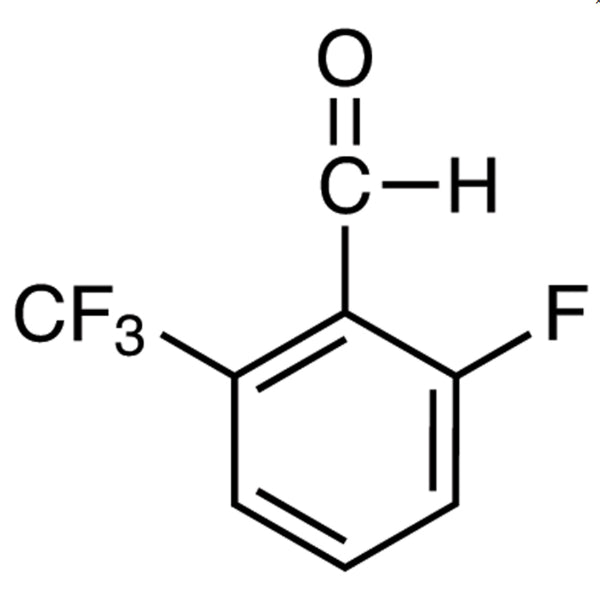
2-Fluoro-6-(trifluoromethyl)benzaldehyde is a chemical compound widely used in laboratory settings as a building block for the synthesis of complex organic molecules. This compound plays a crucial role in organic chemistry research, particularly in the development of pharmaceuticals, industrial chemicals, and functional compounds. Its unique molecular structure, featuring two fluorine atoms and a carbonyl group, makes it an essential component in the creation of various chemical derivatives. Due to its reactivity and versatility, it is frequently employed in synthetic pathways requiring precise molecular manipulation.
The compound's fluorinated groups contribute to its distinct electronic and reactive properties, which are vital for achieving specific chemical outcomes. These fluorine atoms influence the polarity and reactivity of the molecule, enabling targeted chemical transformations. The compound's stability under controlled conditions further enhances its utility in laboratory applications. Its ability to participate in a wide range of reactions makes it a preferred choice for chemists seeking to construct complex molecular structures with high specificity.
In Indonesian laboratories, 2-Fluoro-6-(trifluoromethyl)benzaldehyde is commonly used in research focused on drug development, material science, and chemical synthesis. Its availability through reliable suppliers like AMI Scientific ensures that researchers have access to this essential reagent for their experimental needs. The compound's role in creating functional compounds with tailored properties underscores its importance in both academic and industrial research environments.
TCI brochures (PDF)
- Fluorination Reagents, Fluorinated Building Blocks 2026-03-18 · p. 17
Related TCI products
- TCI T1399 454-89-7 3-(Trifluoromethyl)benzaldehyde
- TCI T1281 447-61-0 2-(Trifluoromethyl)benzaldehyde
- TCI B4508 102684-91-3 2-Bromo-5-(trifluoromethyl)benzaldehyde
- TCI B4206 59664-42-5 2,4-Bis(trifluoromethyl)benzaldehyde
- TCI B1751 401-95-6 3,5-Bis(trifluoromethyl)benzaldehyde
- TCI T1091 455-19-6 4-(Trifluoromethyl)benzaldehyde
- Organic synthesis is a primary application where this compound is used to create complex molecules through various chemical reactions.
- Pharmaceutical research benefits from its ability to serve as a building block in the development of new drugs and therapeutic agents.
- Industrial chemical production relies on this compound for the synthesis of functional materials and specialty chemicals.
- Functional compound development utilizes its unique reactivity to design molecules with specific properties and applications.
- Chemical modification processes take advantage of its structural versatility to generate a wide range of derivatives for different uses.
| Brand | TCI |
|---|---|
| CAS number | 60611-24-7 |
| Molecular formula | — |
| Purity | — |
| Category | Chemistry > Building Blocks > Fluorinated Building Blocks |
| Pack sizes | Available in various quantities as per supplier specifications |
| Physical form | Solid or liquid, depending on the specific formulation |
| Storage | Store in a cool, dry place away from direct sunlight and moisture |
This compound should be stored in a cool, dry environment to maintain its stability and prevent degradation. It is recommended to use airtight containers to protect it from moisture and air exposure. Due to its fluorinated nature, it is important to handle it with care to avoid any potential chemical reactions with incompatible substances. Proper ventilation should be ensured in the laboratory when working with this material. Always follow standard safety protocols, including the use of personal protective equipment, to minimize exposure risks. The compound is generally stable under normal storage conditions but should be kept away from heat sources and direct sunlight to ensure long-term usability.
—
Produk Terkait
-
3-(Trifluoromethyl)benzaldehyde TCI T1399
Regular price From Rp 557.550,00Regular price -
2-(Trifluoromethyl)benzaldehyde TCI T1281
Regular price Rp 1.378.650,00Regular price -
2-Bromo-5-(trifluoromethyl)benzaldehyde TCI B4508
Regular price From Rp 928.200,00Regular price -
2,4-Bis(trifluoromethyl)benzaldehyde TCI B4206
Regular price From Rp 1.829.100,00Regular price -
3,5-Bis(trifluoromethyl)benzaldehyde TCI B1751
Regular price From Rp 1.220.100,00Regular price -
4-(Trifluoromethyl)benzaldehyde TCI T1091
Regular price From Rp 903.000,00Regular price -
4-Methoxy-2-(trifluoromethyl)benzaldehyde TCI M2162
Regular price Rp 955.500,00Regular price -
3-Fluoro-5-(trifluoromethyl)benzaldehyde TCI F0774
Regular price From Rp 769.650,00Regular price


