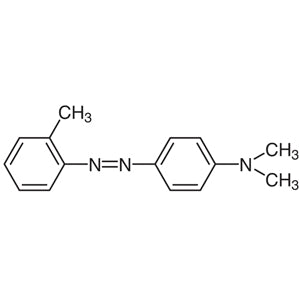
4,4'-Bis(dodecyloxy)-3-methylazobenzene is a photochromic dye widely used in materials science and optical research. This compound plays a crucial role in laboratories where the study of light-responsive materials is essential. Its ability to undergo reversible structural changes upon exposure to ultraviolet light makes it a valuable tool for investigating optical properties and photochemical behavior. As a key component in the development of smart materials, it supports innovation in fields such as optoelectronics and sensor technology.
The unique molecular structure of 4,4'-Bis(dodecyloxy)-3-methylazobenzene allows for stable and predictable color changes, making it a preferred choice for researchers. It exhibits excellent solubility in organic solvents, which simplifies its integration into experimental setups. This property enables consistent performance in various applications, from thin-film fabrication to color-switching experiments. Its reliability and reproducibility ensure accurate and repeatable results in laboratory settings.
In Indonesian laboratories, this compound is commonly used in academic and industrial research focused on photochromic materials. Its application spans from basic research in material science to the development of advanced optical devices. The compound’s stability and ease of handling make it a practical option for both educational and commercial research projects. Its relevance in the field of functional materials continues to grow, supporting innovation in optical technologies.
Advantages (TCI brochure)
- Exhibits the highest adhesion value of the three materials
- Same reversible solid-liquid switching by UV and visible light at room temperature
TCI brochures (PDF)
Related TCI products
- TCI B4597 1627844-78-3 4,4'-Bis(decyloxy)-3-methylazobenzene
- TCI B4596 1440509-03-4 4,4'-Bis(hexyloxy)-3-methylazobenzene
- TCI B6252 2052287-45-1 (E)-4,4'-Bis(octyloxy)-3-methylazobenzene
- TCI T3624 117241-32-4 3,4,5-Tris(dodecyloxy)benzaldehyde
- TCI T3606 117241-31-3 3,4,5-Tris(dodecyloxy)benzoic Acid
- TCI B5454 1044795-04-1 4,8-Bis(dodecyloxy)benzo[1,2-b:4,5-b']dithiophene
- Photochromic Material Development: This compound is ideal for creating materials that change color upon light exposure, useful in optical sensors and smart windows.
- Optical Sensor Fabrication: Its reversible color change properties make it suitable for designing sensors that detect and respond to UV radiation.
- Thin-Film Coating Research: The compound's solubility in organic solvents allows it to be used in creating thin films for optical and electronic applications.
- Color Switching Experiments: It is widely used in experiments that study the optical response of materials to different light wavelengths.
- Functional Material Innovation: Its unique molecular structure supports research into new materials with tunable optical properties.
From the TCI brochure
- Light-controlled adhesion of glass slides (Application 1)
- Photoresist for simple lithography (Application 2)
| Brand | TCI |
|---|---|
| CAS number | 1440509-01-2 |
| Molecular formula | — |
| Purity | — |
| Category | Materials Science > Photonic Materials and Optical Materials > Photochromic Dyes |
| Pack sizes | As per supplier packaging |
| Physical form | Solid |
| Storage | Store in a cool, dark place away from light and moisture |
Data from the TCI brochure
| Kemasan | 500 mg / 5 g |
|---|---|
| Light adhesion, liquefaction | 365 nm, 80 mW cm-2, 3 min (Application 1, light adhesion) |
| Light adhesion, solidification | 450 nm, 40 mW cm-2, 3 min (Application 1, light adhesion) |
| Maximal adhesion value | 60 N cm-2 (0.6 MPa) (nilai tertinggi dari ketiga material) |
| Waktu respons UV | 55 sec (Film kristal ca. 1 μm, polarized light microscopy; bergantung pada ketebalan film dan intensitas cahaya) |
| Waktu respons visible | 1 sec (Film kristal ca. 1 μm, polarized light microscopy; bergantung pada ketebalan film dan intensitas cahaya) |
Source: TCI brochure FF032 (2024-07-05)
This compound should be stored in a cool, dark environment to prevent degradation due to light exposure. It is recommended to keep it in a tightly sealed container to avoid moisture absorption. Due to its photochromic nature, it is important to minimize exposure to UV light during storage and handling. Laboratory personnel should wear appropriate personal protective equipment, such as gloves and safety goggles, when working with this material. The compound is non-hazardous under normal conditions but should be handled with care to maintain its stability and effectiveness. Proper storage ensures that the material remains suitable for use in research applications without compromising its optical properties.
—
Produk Terkait
-
4,4'-Bis(decyloxy)-3-methylazobenzene TCI B4597
Regular price From Rp 4.213.650,00Regular priceRp 2.946.300,00Sale price From Rp 4.213.650,00 -
4,4'-Bis(hexyloxy)-3-methylazobenzene TCI B4596
Regular price From Rp 3.710.700,00Regular priceRp 2.594.550,00Sale price From Rp 3.710.700,00 -
(E)-4,4'-Bis(octyloxy)-3-methylazobenzene TCI B6252
Regular price Rp 2.359.350,00Regular priceRp 1.649.550,00Sale price Rp 2.359.350,00 -
3,4,5-Tris(dodecyloxy)benzaldehyde TCI T3624
Regular price From Rp 1.405.950,00Regular priceRp 982.800,00Sale price From Rp 1.405.950,00 -
3,4,5-Tris(dodecyloxy)benzoicAcid TCI T3606
Regular price Rp 3.790.500,00Regular priceRp 2.665.950,00Sale price Rp 3.790.500,00 -
4,8-Bis(dodecyloxy)benzo[1,2-b:4,5-b']dithiophene TCI B5454
Regular price Rp 2.384.550,00Regular priceRp 1.683.150,00Sale price Rp 2.384.550,00 -
4-(Dimethylamino)-2'-methylazobenzene TCI M0789
Regular price Rp 2.518.950,00Regular priceRp 1.760.850,00Sale price Rp 2.518.950,00 -
4-(Dimethylamino)-3'-methylazobenzene TCI M0207
Regular price Rp 2.837.100,00Regular priceRp 1.983.450,00Sale price Rp 2.837.100,00