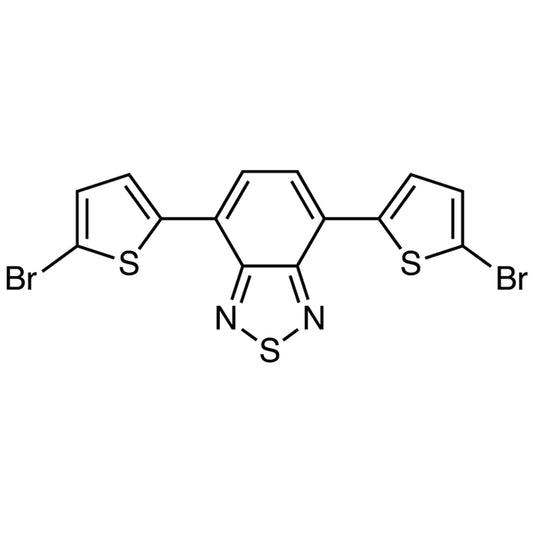
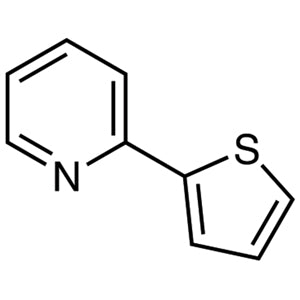
5-Bromo-2-(2-thienyl)pyridine is a synthetic organic compound widely used in scientific research, particularly in the fields of materials science and chemical engineering. This compound plays a crucial role in laboratory settings where the development of advanced materials and electronic components is required. Its unique molecular structure, combining a pyridine ring with a thiophene group and a bromo substituent, allows it to participate in various chemical reactions, making it a versatile building block for the synthesis of complex compounds. Due to its chemical reactivity and structural specificity, it is often employed in the creation of semiconductor materials and functional polymers.
The compound's reactivity and chemical versatility make it a preferred choice for researchers aiming to design and synthesize new materials with tailored properties. Its ability to undergo substitution, copolymerization, and electrophilic reactions enables the development of materials with specific electrical, optical, or mechanical characteristics. Additionally, its stability under certain conditions ensures that it remains a reliable reagent for consistent results in laboratory experiments. These properties contribute to its widespread use in both academic and industrial research environments.
In Indonesian laboratories, 5-Bromo-2-(2-thienyl)pyridine is commonly utilized in material science and organic chemistry research. It is a key component in the development of new materials with applications in electronics, optoelectronics, and nanotechnology. Many research institutions and universities in Indonesia rely on this compound for advancing their studies in semiconductor technology and advanced material synthesis. Its availability and reliability make it an essential tool for scientific innovation in the region.
TCI brochures (PDF)
- Thiophenes 2026-06-29 · p. 6
- Building Blocks for Organic Semiconductor 2026-03-24 · p. 25
Related TCI products
- TCI B4886 136902-53-9 5-Bromo-2-(5-bromo-2-thienyl)pyridine
- TCI B5456 1308671-90-0 3-(5-Bromo-2-thienyl)-2,5-bis(2-ethylhexyl)-6-(2-thienyl)pyrrolo[3,4-c]pyrrole-1,4-dione
- TCI P2210 499793-84-9 1-(4-Propylphenyl)-2,5-di(2-thienyl)-1H-pyrrole
- TCI H1680 154717-22-3 (4-Hexyl-2-thienyl)trimethylstannane
- TCI E1295 1390584-88-9 2-[5-(2-Ethylhexyl)-2-thienyl]-4,4,5,5-tetramethyl-1,3,2-dioxaborolane
- TCI D5544 211181-63-4 (4-Dodecyl-2-thienyl)trimethylstannane
- Used in semiconductor material synthesis due to its ability to form complex molecular structures essential for electronic components.
- Applied in organic chemistry research for its reactivity in substitution and electrophilic reactions, enabling the creation of functional compounds.
- Employed in polymer science for copolymerization processes, contributing to the development of advanced polymeric materials.
- Utilized in nanotechnology research for the synthesis of nanostructured materials with tailored properties.
- Integrated into electronic device development for the fabrication of components requiring precise chemical functionality.
| Brand | TCI |
|---|---|
| CAS number | 91891-74-6 |
| Molecular formula | — |
| Purity | — |
| Category | Materials Science > Material Building Blocks > Small Molecule Semiconductor Building Blocks |
| Pack sizes | Available in various quantities as per standard laboratory supply options |
| Physical form | Solid, typically in crystalline or powder form |
| Storage | Store in a cool, dry place away from light and moisture |
This compound should be stored in a cool, dry environment, away from direct light and moisture to maintain its chemical integrity. It is recommended to use airtight containers made of glass or inert plastic to prevent contamination and degradation. Due to its reactivity, it should be handled with care, using appropriate personal protective equipment such as gloves and safety goggles. It is important to ensure proper ventilation in the laboratory when working with this material. Avoid exposure to heat or incompatible substances to prevent unwanted chemical reactions. Proper storage and handling protocols help ensure the safety of laboratory personnel and the consistency of experimental results.
—
Produk Terkait
-
5-Bromo-2-(5-bromo-2-thienyl)pyridine TCI B4886
Regular price From Rp 1.538.250,00Regular priceRp 1.090.950,00Sale price From Rp 1.538.250,00 -
3-(5-Bromo-2-thienyl)-2,5-bis(2-ethylhexyl)-6-(2-thienyl)pyrrolo[3,4-c]pyrrole-1,4-dione TCI B5456
Regular price Rp 7.075.950,00Regular priceRp 4.963.350,00Sale price Rp 7.075.950,00 -
1-(4-Propylphenyl)-2,5-di(2-thienyl)-1H-pyrrole TCI P2210
Regular price Rp 3.949.050,00Regular priceRp 2.777.250,00Sale price Rp 3.949.050,00 -
(4-Hexyl-2-thienyl)trimethylstannane TCI H1680
Regular price Rp 3.207.750,00Regular priceRp 2.258.550,00Sale price Rp 3.207.750,00 -
2-[5-(2-Ethylhexyl)-2-thienyl]-4,4,5,5-tetramethyl-1,3,2-dioxaborolane TCI E1295
Regular price Rp 5.592.300,00Regular priceRp 3.925.950,00Sale price Rp 5.592.300,00 -
(4-Dodecyl-2-thienyl)trimethylstannane TCI D5544
Regular price Rp 3.419.850,00Regular priceRp 2.406.600,00Sale price Rp 3.419.850,00 -
4,7-Bis(5-bromo-2-thienyl)-2,1,3-benzothiadiazole TCI B3886
Regular price From Rp 1.749.300,00Regular priceRp 1.239.000,00Sale price From Rp 1.749.300,00 -
2-(2-Thienyl)pyridine TCI T2936
Regular price From Rp 2.279.550,00Regular priceRp 1.609.650,00Sale price From Rp 2.279.550,00