

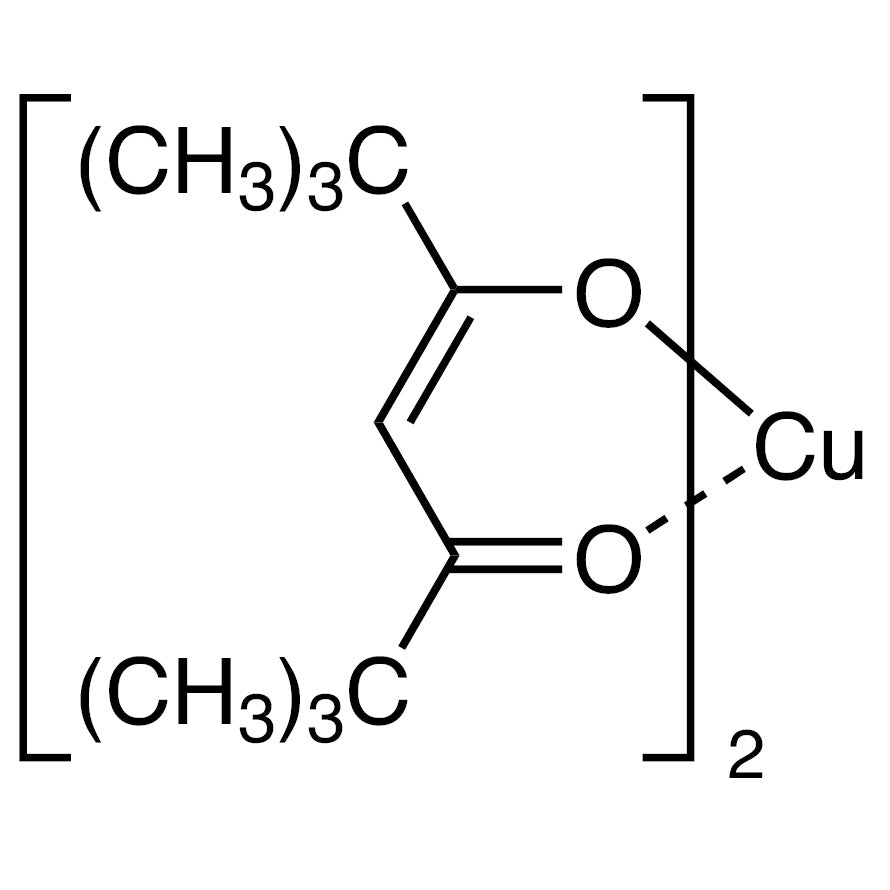
Bis(2,2,6,6-tetramethyl-3,5-heptanedionato)copper(II) is a chemical compound widely used as a catalyst in various chemical reactions. It belongs to the category of transition metals and is particularly effective in oxidation and reduction reactions. In the laboratory, this compound functions as an efficient catalyst that accelerates chemical reactions without being consumed in the process. Its role is critical in enhancing reaction rates and improving the yield of desired products. This compound is commonly used in synthetic chemistry to facilitate complex transformations under controlled conditions.
The compound is valued for its stability and controlled reactivity, making it a preferred choice for laboratory applications. Its complex structure, consisting of copper(II) ions coordinated with 2,2,6,6-tetramethyl-3,5-heptanedionato ligands, provides excellent catalytic properties. This structure allows the compound to maintain its activity across a range of reaction conditions, including varying temperatures and solvents. The compound’s resistance to oxidation further enhances its reliability in long-term experiments, ensuring consistent performance. These properties make it a reliable and versatile reagent in chemical synthesis.
In Indonesian laboratories, this compound is extensively used in chemical research, especially in catalysis and inorganic chemistry. It is a key component in the development of new synthetic methods and the study of reaction mechanisms. Many research institutions and universities in Indonesia rely on this compound for its effectiveness and reliability in experimental setups. Its widespread use underscores its importance in advancing chemical knowledge and innovation in the region.
TCI brochures (PDF)
- Transition Metal Catalysts 2026-04-10 · p. 15
Related TCI products
- TCI T4217 14324-99-3 Tris(2,2,6,6-tetramethyl-3,5-heptanedionato)manganese(III)
- TCI T4048 18865-74-2 Tetrakis(2,2,6,6-tetramethyl-3,5-heptanedionato)zirconium(IV)
- TCI T3905 58452-28-1 Tetrakis(acetonitrile)copper(I) Trifluoromethanesulfonate
- TCI T1442 42152-46-5 Copper(I) Trifluoromethanesulfonate Benzene Complex
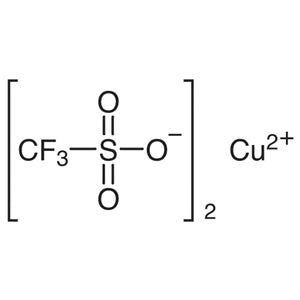
- TCI T1292 34946-82-2 Copper(II) Trifluoromethanesulfonate
- TCI B3351 920739-11-3 [1,3-Bis(2,6-diisopropylphenyl)imidazol-2-ylidene](1,3-diphenyl-1,3-propanedionato)copper(I)
- Oxidation and Reduction Reactions: This compound is ideal for facilitating redox processes due to its ability to transfer electrons efficiently, making it suitable for a wide range of synthetic transformations.
- Catalytic Organic Synthesis: Its complex structure enables it to act as a versatile catalyst in organic reactions, enhancing reaction efficiency and selectivity in laboratory settings.
- Inorganic Chemistry Experiments: The compound is frequently used in studies involving transition metals, where its coordination properties are essential for understanding reaction mechanisms.
- Analytical Chemistry Applications: Its stability and controlled reactivity make it a valuable reagent for analytical procedures requiring precise chemical behavior under varied conditions.
- Industrial Process Development: It is used in the development of industrial chemical processes, where its catalytic properties help improve reaction efficiency and product yield.
| Brand | TCI |
|---|---|
| CAS number | 14040-05-2 |
| Molecular formula | — |
| Purity | — |
| Category | Chemistry > Catalysis and Inorganic Chemistry > Transition Elements |
| Pack sizes | Available in various quantities as per supplier specifications |
| Physical form | Solid |
| Storage | Store in a cool, dry place away from moisture and direct sunlight |
This compound should be stored in a cool, dry environment to maintain its chemical stability and prevent degradation. It is recommended to use airtight containers to protect it from moisture and air exposure. Due to its reactivity, it should be handled with care, using appropriate personal protective equipment such as gloves and safety goggles. It is important to store it away from incompatible substances to avoid any potential chemical interactions. In laboratory settings, it should be kept in a designated chemical storage area that is accessible only to authorized personnel. Proper labeling of containers is essential to ensure safe handling and prevent accidental exposure.
—
Produk Terkait
-
Tris(2,2,6,6-tetramethyl-3,5-heptanedionato)manganese(III) TCI T4217
Regular price Rp 2.068.500,00Regular price -
Tetrakis(2,2,6,6-tetramethyl-3,5-heptanedionato)zirconium(IV) TCI T4048
Regular price From Rp 1.538.250,00Regular price -
Tetrakis(acetonitrile)copper(I)Trifluoromethanesulfonate TCI T3905
Regular price From Rp 2.199.750,00Regular price -
Copper(I)TrifluoromethanesulfonateBenzeneComplex TCI T1442
Regular price From Rp 2.041.200,00Regular price -
Copper(II)Trifluoromethanesulfonate TCI T1292
Regular price From Rp 1.510.950,00Regular price -
[1,3-Bis(2,6-diisopropylphenyl)imidazol-2-ylidene](1,3-diphenyl-1,3-propanedionato)copper(I) TCI B3351
Regular price From Rp 1.353.450,00Regular price -
Bis(1,3-propanediamine)Copper(II)Dichloride TCI B1513
Regular price From Rp 1.326.150,00Regular price -
Copper(II)Bis(2-hydroxyethyl)dithiocarbamate TCI B0491
Regular price From Rp 903.000,00Regular price


copper(I) - AMI Scientific](http://amiscientific.com/cdn/shop/files/TCI2510B3351_e8931cd7-8c99-4c22-8466-a4a766eb25fb.jpg?v=1767432375&width=533)

