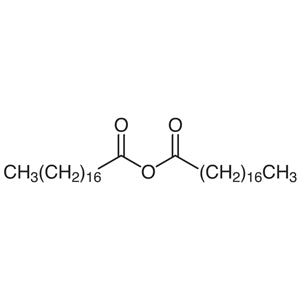
Decanoic Anhydride from TCI, also known as capric anhydride, is a carboxylic acid anhydride made up of two decanoic acid units, each with a ten-carbon chain. In the laboratory it serves as an acylating reagent that introduces the decanoyl group onto alcohols, amines and other nucleophiles. The resulting medium-chain esters and amides are widely needed in lipid chemistry, materials science and the development of bioactive molecules. In the TCI catalogue, this material is classified as a non-heterocyclic building block.
Researchers choose Decanoic Anhydride because it is reactive enough for efficient acylation while being easier to handle than the corresponding acid chloride. Its reaction by-product is decanoic acid rather than hydrogen chloride, which makes it well suited to substrates that are sensitive to strong acids. The ten-carbon alkyl chain gives the product a predictable degree of lipophilicity, which helps chemists tune the solubility, membrane permeability or surface behaviour of a molecule. The reaction can also be catalysed readily with common organic bases or nucleophilic catalysts.
In Indonesia, this material is useful for research laboratories developing fatty acid derivatives, as well as university groups working in organic synthesis, lipid chemistry and materials science. It also supports pharmaceutical and natural-product research teams that need to modify the lipophilicity of lead compounds or prepare medium-chain ester and amide standards. Because the decanoyl group can be introduced under mild conditions, it fits the routine synthetic workflows of both academic and industrial laboratories.
- Esterification of alcohols: the anhydride transfers the decanoyl group to hydroxyl groups efficiently, producing medium-chain esters without releasing hydrogen chloride into the reaction mixture.
- Amide formation from amines: it acylates primary and secondary amines to give decanoyl amides, which are useful in lipid chemistry and in the synthesis of bioactive molecules.
- Lipophilicity tuning of drug candidates: the ten-carbon chain adds a predictable lipophilic character that helps researchers adjust solubility and membrane permeability during lead optimisation.
- Acylation of acid-sensitive substrates: because the by-product is decanoic acid rather than hydrogen chloride, it suits delicate substrates that would degrade under strongly acidic conditions.
- Surface and materials modification: decanoyl groups introduced with this reagent can change the surface behaviour of molecules and materials, supporting materials science and surfactant-related research.
| Brand | TCI (product code C0020) |
|---|---|
| CAS number | 2082-76-0 |
| Molecular formula | — |
| Purity | — |
| Category | Chemistry > Building Blocks > Non-Heterocyclic Building Blocks |
| Pack sizes | available in the standard TCI pack sizes listed on the product page |
| Physical form | — |
| Storage | keep tightly closed in a cool, dry place, protected from moisture |
- Synonym: Capric anhydride
Store Decanoic Anhydride in its original, tightly sealed container in a cool, dry and well-ventilated area, away from moisture, strong bases, oxidising agents and nucleophilic reagents. Acid anhydrides slowly hydrolyse when exposed to humid air, so reseal the container promptly after each use and consider keeping it under an inert atmosphere. Handle the material in a fume hood while wearing chemical-resistant gloves, safety glasses and a laboratory coat, and avoid contact with skin, eyes and inhalation. Always consult the supplier's Safety Data Sheet before use and dispose of waste according to local regulations.
—
Product Categories
- Biochemicals and ReagentsAlbumin Binding AgentsAlbumin Binding Modification Reagents
- Biochemicals and ReagentsBioconjugationAlbumin Binding Modification Reagents
- Pharmaceutical Development and Drug Discovery ResearchAlbumin Binding AgentsAlbumin Binding Modification Reagents
- Pharmaceutical Development and Drug Discovery ResearchBioconjugationAlbumin Binding Modification Reagents
Produk Terkait
-
StearicAnhydride TCI S0083
Regular price From Rp 2.518.950,00Regular priceRp 1.776.600,00Sale price From Rp 2.518.950,00 -
PalmiticAnhydride TCI P0008
Regular price From Rp 2.623.950,00Regular priceRp 1.850.100,00Sale price From Rp 2.623.950,00 -
MyristicAnhydride TCI M0484
Regular price From Rp 3.790.500,00Regular priceRp 2.665.950,00Sale price From Rp 3.790.500,00 -
LauricAnhydride TCI L0017
Regular price From Rp 2.173.500,00Regular priceRp 1.535.100,00Sale price From Rp 2.173.500,00 -
DecanoicAcid TCI D0017
Regular price From Rp 530.250,00Regular priceRp 386.400,00Sale price From Rp 530.250,00 -
UndecanoylChloride TCI U0026
Regular price From Rp 1.590.750,00Regular priceRp 1.127.700,00Sale price From Rp 1.590.750,00 -
MyristoylChloride TCI T0086
Regular price From Rp 1.272.600,00Regular priceRp 905.100,00Sale price From Rp 1.272.600,00 -
StearoylChloride TCI S0404
Regular price From Rp 1.881.600,00Regular priceRp 1.331.400,00Sale price From Rp 1.881.600,00