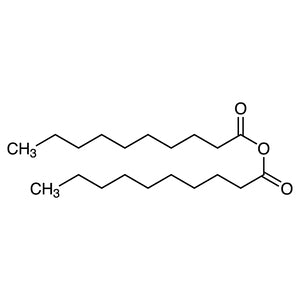
Stearic Anhydride from TCI is a carboxylic acid anhydride formed from two molecules of stearic acid. It belongs to the non-heterocyclic building block category and works mainly as an acylating agent, a reagent that attaches a stearoyl group to other molecules. In the laboratory, chemists use it to prepare long-chain esters and amides. It is also widely used to modify natural polymers such as cellulose and starch so that they become more hydrophobic, and to synthesise lipid derivatives for research and material development.
Researchers choose Stearic Anhydride because it is more reactive than free stearic acid. Acylation reactions can therefore run under milder conditions without an extra activating agent. Compared with stearoyl chloride, the anhydride is generally easier to handle and does not release hydrogen chloride, because its by-product is stearic acid. The saturated C18 chain gives the final product strong hydrophobic character, which is valuable when water repellency or reduced moisture uptake is the goal. These features make it a practical and dependable reagent for controlled stearoylation work.
In Indonesia, Stearic Anhydride is relevant to organic chemistry, food technology, and advanced materials laboratories, particularly groups that modify cassava starch and cellulose. University research groups, government research institutes, and industrial R&D teams can use it to explore hydrophobic starch esters, modified cellulose materials, and lipid-based compounds. The 25 g and 500 g pack sizes suit both small-scale synthesis research and larger material development work, so laboratories can match the quantity to the stage of their project.
- Esterification of alcohols: The anhydride acylates hydroxyl groups efficiently and forms long-chain stearate esters under milder conditions than free stearic acid would require.
- Amide synthesis: Stearic Anhydride reacts with amines to give stearoyl amides, and it avoids the hydrogen chloride by-product that comes with stearoyl chloride.
- Hydrophobic modification of starch: Researchers use it to graft stearoyl chains onto starch, including cassava starch, to increase water resistance for food and packaging material studies.
- Cellulose surface modification: The saturated C18 chain gives cellulose strong hydrophobic character, which supports the development of water-repellent fibres, films, and composite materials.
- Synthesis of lipid derivatives: It is a convenient stearoyl source for building lipid-like molecules in biochemical, formulation, and materials research, and its only by-product is stearic acid.
| Brand | TCI (product code S0083) |
|---|---|
| CAS number | 638-08-4 |
| Molecular formula | — |
| Purity | — |
| Category | Chemistry > Building Blocks > Non-Heterocyclic Building Blocks |
| Pack sizes | 25 g and 500 g |
| Physical form | — |
| Storage | keep tightly closed in a cool, dry place. Refer to the label and SDS for specific conditions. |
- Chemical type: carboxylic acid anhydride of stearic acid (C18 saturated chain)
Store Stearic Anhydride in its original, tightly sealed container in a cool, dry, well-ventilated area, away from moisture. Moisture gradually hydrolyses acid anhydrides back to the parent acid, so close the container promptly after each use. Keep it away from strong oxidisers, strong bases, amines, and alcohols during storage. Wear safety glasses, gloves, and a lab coat when handling it, avoid inhaling dust or contact with skin and eyes, and weigh it in a fume hood or ventilated area. Always follow the supplier's Safety Data Sheet (SDS) and your local laboratory safety procedures for handling and disposal.
—
Product Categories
- Biochemicals and ReagentsAlbumin Binding AgentsAlbumin Binding Modification Reagents
- Biochemicals and ReagentsBioconjugationAlbumin Binding Modification Reagents
- Pharmaceutical Development and Drug Discovery ResearchAlbumin Binding AgentsAlbumin Binding Modification Reagents
- Pharmaceutical Development and Drug Discovery ResearchBioconjugationAlbumin Binding Modification Reagents
Produk Terkait
-
PalmiticAnhydride TCI P0008
Regular price From Rp 2.623.950,00Regular priceRp 1.850.100,00Sale price From Rp 2.623.950,00 -
MyristicAnhydride TCI M0484
Regular price From Rp 3.790.500,00Regular priceRp 2.665.950,00Sale price From Rp 3.790.500,00 -
LauricAnhydride TCI L0017
Regular price From Rp 2.173.500,00Regular priceRp 1.535.100,00Sale price From Rp 2.173.500,00 -
DecanoicAnhydride TCI C0020
Regular price From Rp 2.041.200,00Regular priceRp 1.442.700,00Sale price From Rp 2.041.200,00 -
StearicHydrazide TCI S0222
Regular price Rp 4.399.500,00Regular priceRp 3.092.250,00Sale price Rp 4.399.500,00 -
StearicAcid TCI S0163
Regular price From Rp 477.750,00Regular priceRp 333.900,00Sale price From Rp 477.750,00 -
UndecanoylChloride TCI U0026
Regular price From Rp 1.590.750,00Regular priceRp 1.127.700,00Sale price From Rp 1.590.750,00 -
MyristoylChloride TCI T0086
Regular price From Rp 1.272.600,00Regular priceRp 905.100,00Sale price From Rp 1.272.600,00