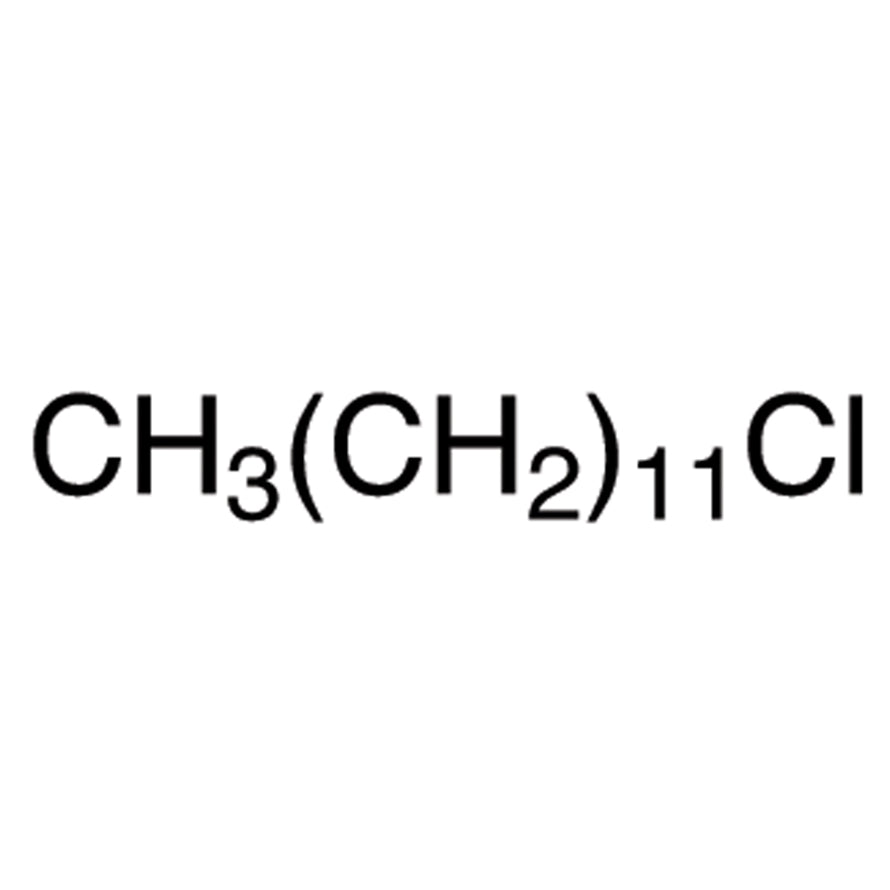
1-Chlorododecane is an organic compound classified as a straight-chain alkyl chloride. It has twelve carbon atoms, with a chlorine atom bonded at the end of the chain. In the laboratory it is used as a non-heterocyclic building block, a starting material for attaching a dodecyl group (a long hydrocarbon chain) to a target molecule. It is used in organic synthesis, surfactant research and the development of materials based on alkyl chains. TCI supplies it under product code C0163 for research and development.
The defining feature of 1-Chlorododecane is the primary chloride group at the end of its long alkyl chain. The chlorine atom acts as a leaving group in nucleophilic substitution reactions. This makes the compound suitable for forming carbon–heteroatom bonds with nucleophiles such as amines, thiols, phenolates and carboxylates. The dodecyl chain is hydrophobic, so it makes the final product more lipophilic. The compound can also be used to prepare organometallic reagents. It is generally supplied as a liquid. For its physical properties, refer to the manufacturer's official data sheet.
In Indonesia, chemistry laboratories at universities, research institutions and industrial R&D facilities use materials like this regularly. Researchers working on organic synthesis, surface-active compounds or functional materials use 1-Chlorododecane to add long alkyl chains to their target molecules. Because it comes from an established brand such as TCI, research teams can expect consistent quality from batch to batch. This consistency matters for repeatable experiments, academic work and early-stage product development in local laboratories.
TCI brochures (PDF)
- Building Blocks for Organic Semiconductor 2026-03-24 · p. 41
- Alkylation in organic synthesis: the primary chloride is a good leaving group, so the compound can attach a dodecyl chain to amines, thiols, phenolates or carboxylates through nucleophilic substitution.
- Surfactant research: the long hydrophobic dodecyl chain can serve as the lipophilic tail of surface-active molecules, which is useful when studying amphiphilic compounds and how they behave.
- Preparation of organometallic reagents: the terminal alkyl chloride can be converted into organometallic intermediates, which are then used to form new carbon–carbon bonds in later synthesis steps.
- Development of alkyl-chain-based materials: adding a twelve-carbon chain makes a material more lipophilic, which helps researchers who are studying how chain length affects a material's properties.
- Building block for target molecule design: as a non-heterocyclic building block, it is a simple and predictable way to add a straight dodecyl group to a more complex research molecule.
| Brand | TCI (product code C0163) |
|---|---|
| CAS number | 112-52-7 |
| Molecular formula | — |
| Purity | — |
| Category | Chemistry > Building Blocks > Non-Heterocyclic Building Blocks |
| Pack sizes | see the available options on the product listing |
| Physical form | generally a liquid (confirm with the manufacturer's data sheet) |
| Storage | follow the storage conditions on the manufacturer's label and Safety Data Sheet |
Store 1-Chlorododecane in its original tightly closed container, in a cool, dry and well-ventilated area away from heat, direct sunlight and incompatible substances such as strong oxidizing agents. Glass or chemically compatible containers are recommended. Always label containers clearly after opening. Handle the material in a fume hood or a well-ventilated workspace while wearing suitable personal protective equipment, including chemical-resistant gloves, safety glasses and a laboratory coat. Avoid contact with skin and eyes, and do not inhale vapors. Before use, read the manufacturer's Safety Data Sheet for complete hazard, first-aid and disposal information. Dispose of waste according to local regulations.
—
Product Categories
Produk Terkait
-
1-Iododecane(stabilizedwithCopperchip) TCI I0494
Regular price Rp 1.378.650,00Regular priceRp 963.900,00Sale price Rp 1.378.650,00 -
1-Iodododecane(stabilizedwithCopperchip) TCI I0511
Regular price Rp 1.618.050,00Regular priceRp 1.130.850,00Sale price Rp 1.618.050,00 -
1-Bromododecane TCI B0587
Regular price From Rp 505.050,00Regular priceRp 352.800,00Sale price From Rp 505.050,00 -
1-Bromoheptadecane TCI B0937
Regular price From Rp 3.340.050,00Regular priceRp 2.335.200,00Sale price From Rp 3.340.050,00 -
1-Bromopentadecane TCI B0936
Regular price From Rp 3.949.050,00Regular priceRp 2.761.500,00Sale price From Rp 3.949.050,00 -
1-Bromotridecane TCI B0935
Regular price From Rp 2.518.950,00Regular priceRp 1.760.850,00Sale price From Rp 2.518.950,00 -
1-Bromoundecane TCI B0934
Regular price From Rp 1.035.300,00Regular priceRp 723.450,00Sale price From Rp 1.035.300,00 -
1-Bromononane TCI B0933
Regular price From Rp 1.485.750,00Regular priceRp 1.038.450,00Sale price From Rp 1.485.750,00