

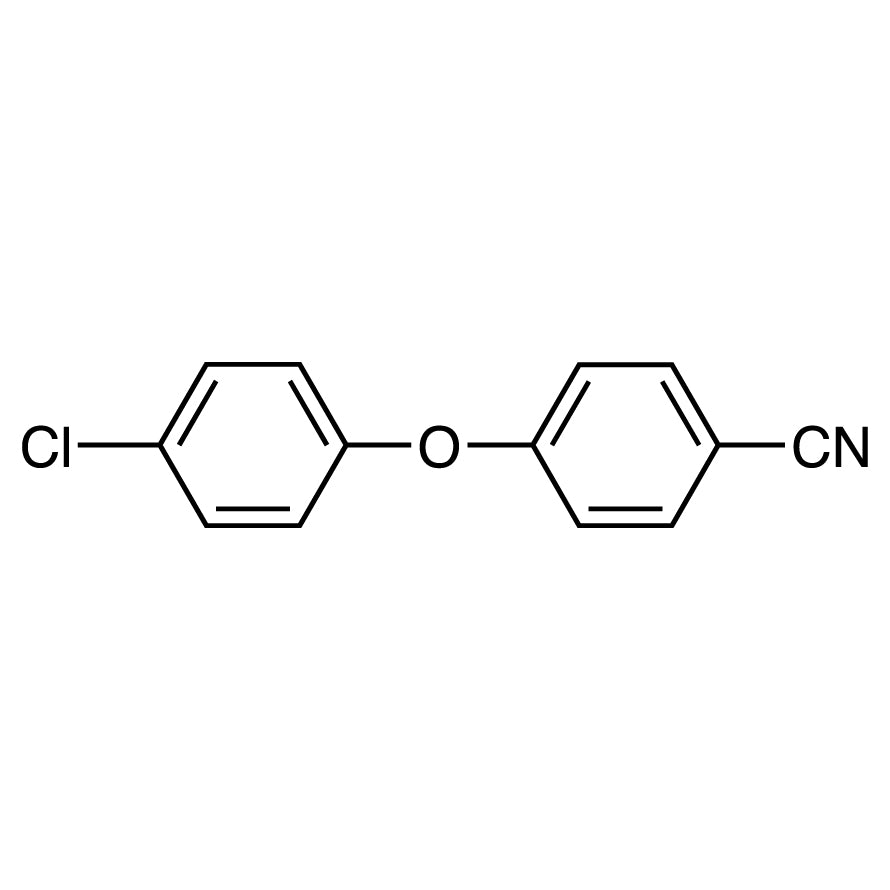
4-(4-Chlorophenoxy)benzonitrile is a chemical compound widely used as a building block in the synthesis of complex organic molecules. It plays a crucial role in laboratory settings where the formation of covalent bonds between chlorophenyl and nitrile groups is required. This compound is particularly valuable in organic chemistry research due to its structural versatility and reactivity. Its presence in non-heterocyclic building blocks makes it a key component in the development of new compounds with diverse applications across multiple scientific fields.
The compound's stable molecular structure and predictable reactivity make it a preferred choice for researchers seeking consistent chemical behavior in their experiments. Its ability to react with various reagents and its availability in solid form enhance its utility in a wide range of chemical processes. These properties contribute to its popularity among scientists working on both fundamental and applied research projects. The compound’s reliability and adaptability make it a go-to material for those requiring a dependable and flexible chemical building block.
In Indonesian laboratories, 4-(4-Chlorophenoxy)benzonitrile is commonly used in organic chemistry research, especially in projects focused on the synthesis of bioactive compounds. It is also integrated into research programs at higher education institutions and local research organizations that aim to develop new materials and pharmacological substances. Its role in advancing scientific innovation is significant, particularly in the fields of pharmaceuticals and chemical materials.
- Organic synthesis projects benefit from this compound due to its ability to form stable covalent bonds with chlorophenyl and nitrile groups, enabling the creation of complex molecular structures.
- Pharmaceutical research utilizes this compound to develop new bioactive compounds, as its reactivity supports the synthesis of drug-related molecules.
- Material science applications leverage its chemical stability and reactivity to create novel materials with specific functional properties.
- Academic research institutions use it in educational and experimental settings to teach and explore organic chemistry principles.
- Industrial chemical development incorporates this compound to design and test new chemical products with tailored properties.
| Brand | TCI |
|---|---|
| CAS number | 74448-92-3 |
| Molecular formula | — |
| Purity | — |
| Category | Chemistry > Building Blocks > Non-Heterocyclic Building Blocks |
| Pack sizes | Available in standard laboratory quantities |
| Physical form | Solid |
| Storage | Store in a cool, dry place away from light and moisture |
This compound should be stored in a cool, dry environment, away from direct light and moisture to maintain its chemical stability. It is recommended to use airtight containers made of materials such as glass or high-density polyethylene to prevent contamination and degradation. In laboratory settings, it is essential to handle the compound with appropriate personal protective equipment, including gloves and safety goggles, to ensure safety during handling. Proper labeling of containers is also important to prevent accidental exposure. Due to its chemical nature, it should be kept away from incompatible substances such as strong acids or bases to avoid unwanted reactions. Regular monitoring of storage conditions ensures the compound remains in optimal condition for use in research applications.
—
Produk Terkait
-
4-Bromo-2-(trifluoromethyl)benzonitrile TCI B5828
Regular price From Rp 2.518.950,00Regular price -
4-tert-Butylphenylacetonitrile TCI B5935
Regular price Rp 1.670.550,00Regular price -
2-(4-Bromophenyl)-2-methylpropanenitrile TCI B5950
Regular price From Rp 823.200,00Regular price -
3'-Bromo[1,1'-biphenyl]-3-carbonitrile TCI B5964
Regular price From Rp 2.094.750,00Regular price -
3'-Bromo[1,1'-biphenyl]-4-carbonitrile TCI B5965
Regular price From Rp 2.359.350,00Regular price -
4-(10-Bromoanthracen-9-yl)benzonitrile TCI B6114
Regular price Rp 3.419.850,00Regular price -
2-Bromo-2-methylpropanenitrile TCI B6477
Regular price From Rp 1.298.850,00Regular price


![3'-Bromo[1,1'-biphenyl]-3-carbonitrile (CAS 1040141-34-1) - TCI B5964 - AMI Scientific](http://amiscientific.com/cdn/shop/files/TCI2510B5964.jpg?v=1769144661&width=533)
![3'-Bromo[1,1'-biphenyl]-4-carbonitrile (CAS 160521-46-0) - TCI B5965 - AMI Scientific](http://amiscientific.com/cdn/shop/files/TCI2510B5965.jpg?v=1769180247&width=533)

