

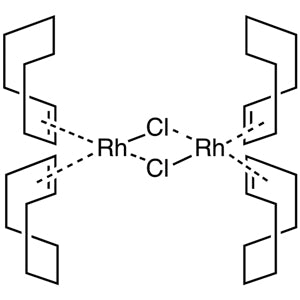
TCI C2253 Chlorobis(cyclooctene)rhodium(I) Dimer is a binuclear rhodium complex bridged by chloride ligands, in which each rhodium center binds two cyclooctene molecules acting as olefin ligands. The compound serves as a versatile precatalyst widely applied in C–H bond activation chemistry, hydroacylation, hydroamination, and a broad range of carbon–carbon bond forming reactions. In organometallic synthesis laboratories, this complex represents the most practical entry point for generating active rhodium catalysts tailored to the requirements of a particular transformation.
The principal advantage of this material lies in its weakly bound and readily displaced cyclooctene ligands. These olefin ligands function as temporary protecting groups for the rhodium center, then dissociate easily once phosphine ligands, N-heterocyclic carbenes, or other bidentate ligands are introduced into the reaction mixture. In this way a single starting material can give rise to a diverse family of rhodium catalysts simply by changing the supporting ligand, which saves considerable laboratory time and resources. The chloride bridge linking the two metal centers can likewise be cleaved by donor ligands, generating reactive mononuclear species.
Within Indonesian laboratories, this precatalyst is typically encountered in university and institutional catalysis research groups working on organometallic synthesis and methodology development. It suits research environments where a single reliable rhodium source must support several distinct catalytic systems across an ongoing project, allowing groups to screen ligand classes without maintaining a large inventory of separate rhodium complexes. Its role as a common entry point makes it a sensible stock item for synthetic chemistry laboratories.
TCI brochures (PDF)
- C-H Bond Activation Reaction 2025-06-20 · p. 5
- Transition Metal Catalysts 2026-04-10 · p. 10
Related TCI products
- TCI B1045 12092-47-6 Chloro(1,5-cyclooctadiene)rhodium(I) Dimer
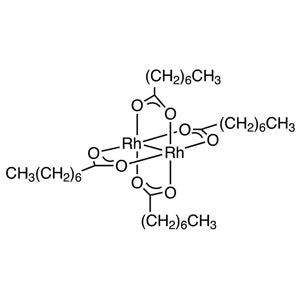
- TCI R0161 73482-96-9 Rhodium(II) Octanoate Dimer
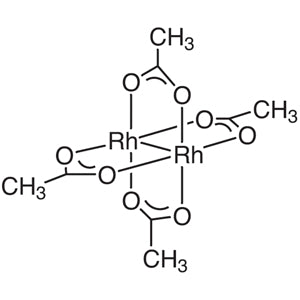
- TCI R0069 15956-28-2 Rhodium(II) Acetate Dimer
- TCI P1788 12354-85-7 (Pentamethylcyclopentadienyl)rhodium(III) Dichloride Dimer
- TCI N0453 12257-42-0 Norbornadiene Rhodium(I) Chloride Dimer
- TCI H1562 73468-85-6 Hydroxy(1,5-cyclooctadiene)rhodium(I) Dimer
- C–H bond activation studies: the labile cyclooctene ligands vacate coordination sites readily, allowing the rhodium center to engage substrate C–H bonds under the directing-group strategies common in modern methodology work.
- Hydroacylation reactions: the complex generates the active rhodium species needed for aldehyde addition chemistry, and its bridged structure is cleaved in situ by added donor ligands to form the working catalyst.
- Hydroamination transformations: researchers use this precatalyst as the rhodium source for carbon–nitrogen bond formation, pairing it with the phosphine or carbene ligand best matched to the amine substrate.
- Carbon–carbon bond forming reactions: as a general-purpose rhodium entry point, it supports coupling and addition chemistry where the supporting ligand, rather than the metal source, determines selectivity.
- Ligand screening and catalyst preparation: a single container of this dimer lets a group prepare many tailored rhodium catalysts by varying only the added ligand, streamlining exploratory catalysis campaigns.
| Brand | TCI |
|---|---|
| CAS number | 12279-09-3 |
| Molecular formula | — |
| Purity | — |
| Category | Chemistry > Catalysis and Inorganic Chemistry > C-H Activation [Catalysis] |
| Pack sizes | please refer to the available packaging options listed for this catalogue item |
| Physical form | — |
| Storage | store under inert atmosphere in a cool, dark place; see the manufacturer documentation for the specified conditions |
- Chemical class: binuclear rhodium(I) complex with bridging chloride and cyclooctene olefin ligands
Store the container tightly closed under an inert atmosphere such as nitrogen or argon, in a cool and dark place away from heat sources, oxidising agents, and direct sunlight. Amber glass vials or the original manufacturer container with a well-sealed cap are appropriate; transfers are best carried out in a glovebox or using Schlenk technique to limit exposure to air and moisture. Handle in a fume hood with gloves, safety goggles, and a laboratory coat, and avoid raising dust during weighing. Consult the manufacturer safety data sheet before use and dispose of residues through the recognised chemical waste stream.
—
Produk Terkait
-
Chloro(1,5-cyclooctadiene)rhodium(I)Dimer TCI B1045
Regular price From Rp 2.889.600,00Regular price -
Rhodium(II)OctanoateDimer TCI R0161
Regular price From Rp 5.803.350,00Regular price -
Rhodium(II)AcetateDimer TCI R0069
Regular price From Rp 3.843.000,00Regular price -
(Pentamethylcyclopentadienyl)rhodium(III)DichlorideDimer TCI P1788
Regular price From Rp 4.347.000,00Regular price -
NorbornadieneRhodium(I)ChlorideDimer TCI N0453
Regular price Rp 6.520.500,00Regular price -
Hydroxy(1,5-cyclooctadiene)rhodium(I)Dimer TCI H1562
Regular price From Rp 4.108.650,00Regular price -
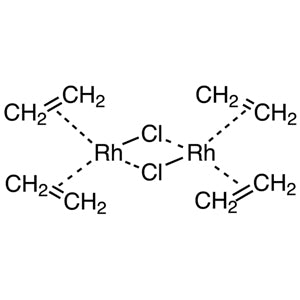
Chlorobis(ethylene)rhodium(I)Dimer TCI C2461
Regular price Rp 5.512.500,00Regular price -
[1,3-Bis(ethoxycarbonyl)-2,4,5-trimethylcyclopentadien-1-yl]rhodium(III)DichlorideDimer TCI B6169
Regular price Rp 10.838.100,00Regular price



![[1,3-Bis(ethoxycarbonyl)-2,4,5-trimethylcyclopentadien-1-yl]rhodium(III) Dichloride Dimer (CAS 1352745-18-6) - TCI B6169 - AMI Scientific](http://amiscientific.com/cdn/shop/files/TCI2510B6169.jpg?v=1767093258&width=533)