

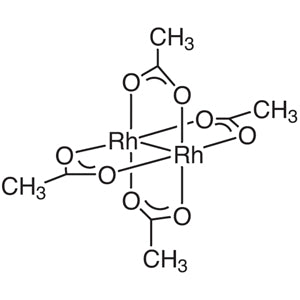
Rhodium(II) Acetate Dimer (TCI R0069) is a chemical compound widely used in catalytic reactions, particularly in C-H activation processes. This material plays a crucial role in organic chemistry by facilitating the transformation of carbon-hydrogen bonds under controlled conditions. Its application is essential in laboratories where efficient and stable catalysts are required for complex chemical transformations. The compound is especially valued for its ability to enhance reaction rates without undergoing significant degradation, making it a reliable choice for research and industrial applications.
Rhodium(II) Acetate Dimer is preferred due to its unique chemical properties, including its stability and specificity in interacting with organic substrates. The dimeric structure contributes to its enhanced stability compared to monomeric forms, allowing for a longer active life during catalytic cycles. Its inertness towards common solvents also ensures compatibility with a wide range of reaction conditions. These characteristics make it an ideal catalyst for applications requiring precision and control in chemical synthesis.
In Indonesian laboratories, Rhodium(II) Acetate Dimer is commonly used in organic chemistry and catalysis research. It is particularly favored for its effectiveness in hydrodefunctionalization and isomerization reactions. Its reliability and performance make it a go-to material for researchers aiming to achieve high yields and selectivity in their experiments.
Advantages (TCI brochure)
- Effective for the formation of heterocycles including nitrogen and oxygen
TCI brochures (PDF)
- Binuclear Rhodium Complexes Effective for Small and Medium-ring Formation 2025-06-05 · p. 1
- C-H Bond Activation Reaction 2025-06-20 · p. 5
- Metallic Salts 2025-11-06 · p. 12
- Transition Metal Catalysts 2026-04-10 · p. 11
Related TCI products
- TCI B1045 12092-47-6 Chloro(1,5-cyclooctadiene)rhodium(I) Dimer
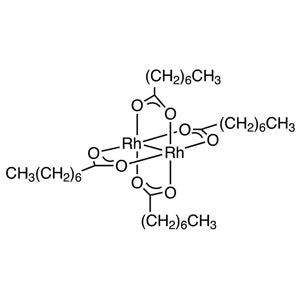
- TCI R0161 73482-96-9 Rhodium(II) Octanoate Dimer
- TCI P1788 12354-85-7 (Pentamethylcyclopentadienyl)rhodium(III) Dichloride Dimer
- TCI N0453 12257-42-0 Norbornadiene Rhodium(I) Chloride Dimer
- TCI H1562 73468-85-6 Hydroxy(1,5-cyclooctadiene)rhodium(I) Dimer
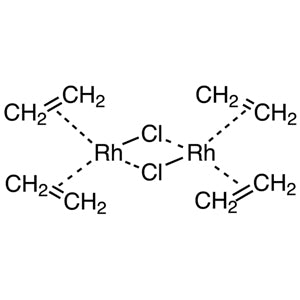
- TCI C2461 12081-16-2 Chlorobis(ethylene)rhodium(I) Dimer
- C-H Activation Reactions: Rhodium(II) Acetate Dimer is ideal for C-H activation due to its ability to selectively activate carbon-hydrogen bonds, enabling complex organic transformations with high efficiency.
- Hydrodefunctionalization Processes: This compound is well-suited for hydrodefunctionalization reactions, where it facilitates the removal of functional groups from organic molecules under mild conditions.
- Isomerization Reactions: Its catalytic properties make it a preferred choice for isomerization reactions, allowing for the rearrangement of molecular structures with minimal side reactions.
- Organic Synthesis Research: The compound is widely used in organic synthesis to enhance reaction rates and improve the selectivity of chemical transformations.
- Catalytic Stability Studies: Its stable dimeric structure makes it suitable for studies focused on catalyst longevity and performance under various reaction conditions.
From the TCI brochure
- Pyrrole ring formation from aryl alkyne, TsN3 and ethoxyalkene (with CuTC, DCE, rt - 80 °C)
| Brand | TCI |
|---|---|
| CAS number | 15956-28-2 |
| Molecular formula | — |
| Purity | — |
| Category | Chemistry > Catalysis and Inorganic Chemistry > C-H Activation [Catalysis] |
| Pack sizes | Available in various quantities as per supplier specifications |
| Physical form | Solid |
| Storage | Store in a cool, dry place away from moisture and direct sunlight |
Rhodium(II) Acetate Dimer should be stored in a cool, dry environment to maintain its stability and effectiveness. It is recommended to keep the material in a tightly sealed container to prevent exposure to moisture and air. Due to its inert nature, it is generally compatible with most laboratory solvents, but care should be taken to avoid contamination. The compound should be handled with appropriate personal protective equipment, such as gloves and safety goggles, to ensure safe laboratory practices. Proper labeling and storage conditions help maintain the integrity of the material and support consistent performance in catalytic applications.
—
Product Categories
- Catalysis and Inorganic ChemistryC-H Activation [Catalysis]Rhodium Compounds [C-H Activation]
- Catalysis and Inorganic ChemistryTransition Elements [Catalysis and Inorganic Chemistry]Rhodium [Catalysis and Inorganic Chemistry]
- Catalysis and Inorganic ChemistryMetallic Salts [Catalysis and Inorganic Chemistry]Acetate Salts [Metallic Salts]
Produk Terkait
-
Chloro(1,5-cyclooctadiene)rhodium(I)Dimer TCI B1045
Regular price From Rp 2.889.600,00Regular price -
Rhodium(II)OctanoateDimer TCI R0161
Regular price From Rp 5.803.350,00Regular price -
(Pentamethylcyclopentadienyl)rhodium(III)DichlorideDimer TCI P1788
Regular price From Rp 4.347.000,00Regular price -
NorbornadieneRhodium(I)ChlorideDimer TCI N0453
Regular price Rp 6.520.500,00Regular price -
Hydroxy(1,5-cyclooctadiene)rhodium(I)Dimer TCI H1562
Regular price From Rp 4.108.650,00Regular price -
Chlorobis(ethylene)rhodium(I)Dimer TCI C2461
Regular price Rp 5.512.500,00Regular price -
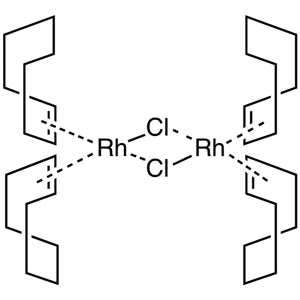
Chlorobis(cyclooctene)rhodium(I)Dimer TCI C2253
Regular price From Rp 2.809.800,00Regular price -
[1,3-Bis(ethoxycarbonyl)-2,4,5-trimethylcyclopentadien-1-yl]rhodium(III)DichlorideDimer TCI B6169
Regular price Rp 10.838.100,00Regular price



![[1,3-Bis(ethoxycarbonyl)-2,4,5-trimethylcyclopentadien-1-yl]rhodium(III) Dichloride Dimer (CAS 1352745-18-6) - TCI B6169 - AMI Scientific](http://amiscientific.com/cdn/shop/files/TCI2510B6169.jpg?v=1767093258&width=533)