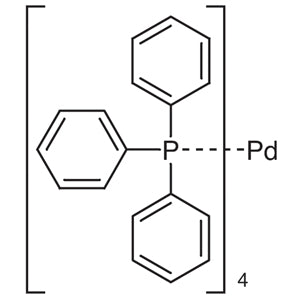
This material is a metal-based complex compound used in catalytic reactions to accelerate chemical processes without participating in the chemical reaction itself. It is classified as an organic catalyst, playing a crucial role in the synthesis of complex compounds and substitution reactions. In the laboratory, this compound is frequently used to speed up chemical reactions that require metal-based catalysts, especially in the synthesis of heterocyclic compounds and coupling reactions. Its complex structure, composed of imidazole and amine groups, provides highly efficient catalytic properties. This structure allows the compound to function as a highly specific and effective catalyst in various chemical reactions.
The compound is preferred due to its stable nature and high reactivity, enabling it to accelerate reactions without significant degradation. Its efficiency and specificity make it a valuable tool in chemical research. The compound's ability to maintain its activity under various reaction conditions further enhances its appeal for laboratory use. Its reliability and consistent performance contribute to its popularity among researchers seeking effective catalytic solutions.
In Indonesian laboratories, this compound is widely used in chemical research, particularly in the fields of organic synthesis and heterogeneous catalysis. It is especially relevant for studies requiring efficient and specific catalysts. Its application supports the development of new chemical processes and materials, making it an essential component in modern chemical research.
TCI brochures (PDF)
- Palladium Catalyst with Both Ease-of-Handling and High Reactivity 2025-01-06 · p. 1
- Useful Palladacycle Catalysts 2025-04-17 · p. 1
- N-Heterocyclic Carbene (NHC) Ligands and Metal Complexes 2026-02-10 · p. 2
- Transition Metal Catalysts 2026-04-10 · p. 14
- Suzuki-Miyaura Cross Coupling Reaction 2025-12-01 · p. 23
Related TCI products
- TCI C2387 1228009-69-5 Chloro[[1,3-bis(2,6-diisopropylphenyl)imidazol-2-ylidene](acetanilide)palladium(II)]
- TCI C2372 930796-10-4 Chloro[[1,3-bis(2,6-diisopropylphenyl)imidazol-2-ylidene](N,N-dimethylbenzylamine)palladium(II)]
- TCI B6199 905459-27-0 [1,3-Bis(2,6-Diisopropylphenyl)imidazol-2-ylidene](3-chloropyridyl)palladium(II) Dichloride
- TCI D4333 205319-10-4 Dichloro[9,9-dimethyl-4,5-bis(diphenylphosphino)xanthene]palladium(II)
- TCI D3806 287410-78-0 Di-mu-chlorobis[5-chloro-2-[(4-chlorophenyl)(hydroxyimino)methyl]phenyl]palladium(II) Dimer
- TCI C2734 1375325-71-5 Chloro[(tri-tert-butylphosphine)-2-(2-aminobiphenyl)]palladium(II)
- Organic synthesis reactions benefit from this compound's ability to accelerate complex chemical transformations with high selectivity.
- Heterogeneous catalysis applications rely on its stability and efficiency in promoting reaction pathways without degradation.
- Coupling reactions in synthetic chemistry utilize its unique structure to facilitate bond formation between different molecular entities.
- Heterocyclic compound synthesis leverages its catalytic activity to produce complex ring structures with high yield and purity.
- Industrial chemical processes incorporate this material for its consistent performance in large-scale catalytic systems.
| Brand | TCI |
|---|---|
| CAS number | 1093348-08-3 |
| Molecular formula | — |
| Purity | — |
| Category | Chemistry > Catalysis and Inorganic Chemistry > Transition Elements [Catalysis and Inorganic Chemistry] |
| Pack sizes | — |
| Physical form | — |
| Storage | Store in a cool, dry place away from moisture and direct sunlight |
This compound should be stored in a cool, dry place, away from moisture and direct sunlight to maintain its stability and catalytic activity. It is recommended to use airtight containers to prevent exposure to air and potential degradation. Laboratory personnel should handle the material with care, using appropriate personal protective equipment such as gloves and safety goggles. The compound should not be stored near incompatible substances to avoid any chemical interactions. Regular inspection of storage conditions is advised to ensure the material remains in optimal condition for use in catalytic processes.
—
Product Categories
- Catalysis and Inorganic ChemistryTransition Elements [Catalysis and Inorganic Chemistry]Palladium [Catalysis and Inorganic Chemistry]
- Catalysis and Inorganic ChemistryCross-coupling Reaction using Transition Metal Catalysts [C-C Bond Formation]Palladium Catalysts [Cross-coupling Reaction using Transition Metal Catalysts]
- Synthetic ReagentsC-C Bond Formation [Synthetic Reagents]Cross-coupling Reaction using Transition Metal Catalysts [C-C Bond Formation]
Produk Terkait
-
Chloro[[1,3-bis(2,6-diisopropylphenyl)imidazol-2-ylidene](acetanilide)palladium(II)] TCI C2387
Regular price From Rp 2.650.200,00Regular priceRp 1.869.000,00Sale price From Rp 2.650.200,00 -
Chloro[[1,3-bis(2,6-diisopropylphenyl)imidazol-2-ylidene](N,N-dimethylbenzylamine)palladium(II)] TCI C2372
Regular price From Rp 2.994.600,00Regular priceRp 2.109.450,00Sale price From Rp 2.994.600,00 -
palladium(II) Dichloride](//amiscientific.com/cdn/shop/files/TCI2510B6199.jpg?v=1792631285&width=533)
palladium(II) Dichloride (CAS 905459-27-0) - TCI B6199 - AMI Scientific](//amiscientific.com/cdn/shop/files/TCI2510B6199_8fb24a5d-0ce1-4fc9-b0bc-4be9be705d27.jpg?v=1767864859&width=533)
[1,3-Bis(2,6-Diisopropylphenyl)imidazol-2-ylidene](3-chloropyridyl)palladium(II)Dichloride TCI B6199
Regular price From Rp 3.922.800,00Regular priceRp 2.758.350,00Sale price From Rp 3.922.800,00 -
Dichloro[9,9-dimethyl-4,5-bis(diphenylphosphino)xanthene]palladium(II) TCI D4333
Regular price From Rp 928.200,00Regular priceRp 664.650,00Sale price From Rp 928.200,00 -


Di-mu-chlorobis[5-chloro-2-[(4-chlorophenyl)(hydroxyimino)methyl]phenyl]palladium(II)Dimer TCI D3806
Regular price From Rp 1.961.400,00Regular priceRp 1.387.050,00Sale price From Rp 1.961.400,00 -
Chloro[(tri-tert-butylphosphine)-2-(2-aminobiphenyl)]palladium(II) TCI C2734
Regular price Rp 7.261.800,00Regular priceRp 5.093.550,00Sale price Rp 7.261.800,00 -
Tetrakis(triphenylphosphine)palladium(0) TCI T1350
Regular price From Rp 1.458.450,00Regular priceRp 1.035.300,00Sale price From Rp 1.458.450,00 -
Bis[1,2-bis(diphenylphosphino)ethane]palladium(0) TCI B3224
Regular price Rp 2.359.350,00Regular priceRp 1.665.300,00Sale price Rp 2.359.350,00


palladium(II) Dichloride](http://amiscientific.com/cdn/shop/files/TCI2510B6199.jpg?v=1792631285&width=533)
palladium(II) Dichloride (CAS 905459-27-0) - TCI B6199 - AMI Scientific](http://amiscientific.com/cdn/shop/files/TCI2510B6199_8fb24a5d-0ce1-4fc9-b0bc-4be9be705d27.jpg?v=1767864859&width=533)