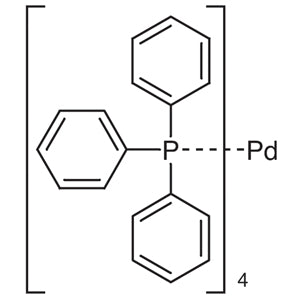
This material is a metal complex palladium compound used in catalytic reactions to accelerate chemical processes without participating in the final reaction. It belongs to the category of organopalladium catalysts, which play a crucial role in the synthesis of complex organic compounds. In the laboratory, this compound is frequently employed in catalytic reactions such as coupling, hydroformylation, and metathesis. Due to its strong catalytic properties, it is a preferred choice in both organic and inorganic chemical research.
The compound's structure includes imidazole and dimethylbenzylamine, which contribute to its stability and high catalytic efficiency. Its reactive nature allows it to form covalent bonds with specific substrates, enhancing its effectiveness in various chemical transformations. Additionally, it exhibits resistance to harsh reaction conditions, making it suitable for a wide range of chemical processes. This characteristic ensures its reliability in demanding laboratory environments.
In Indonesian laboratories, this compound is widely used for research in organic chemistry, catalysis, and the synthesis of complex compounds. Many research institutions and universities in Indonesia utilize it for the development of chemical technologies and processes. Its versatility and performance make it a valuable tool for advancing chemical research and innovation in the region.
TCI brochures (PDF)
- Palladium Catalyst with Both Ease-of-Handling and High Reactivity 2025-01-06 · p. 1
- Useful Palladacycle Catalysts 2025-04-17 · p. 1
- N-Heterocyclic Carbene (NHC) Ligands and Metal Complexes 2026-02-10 · p. 2
- Transition Metal Catalysts 2026-04-10 · p. 14
- Suzuki-Miyaura Cross Coupling Reaction 2025-12-01 · p. 23
Related TCI products
- TCI C2406 1093348-08-3 Chloro[[1,3-bis(2,6-diisopropylphenyl)imidazol-2-ylidene](N,N-dimethyl-3,5-dimethoxybenzylamine)palladium(II)]
- TCI C2387 1228009-69-5 Chloro[[1,3-bis(2,6-diisopropylphenyl)imidazol-2-ylidene](acetanilide)palladium(II)]
- TCI B6199 905459-27-0 [1,3-Bis(2,6-Diisopropylphenyl)imidazol-2-ylidene](3-chloropyridyl)palladium(II) Dichloride
- TCI D3806 287410-78-0 Di-mu-chlorobis[5-chloro-2-[(4-chlorophenyl)(hydroxyimino)methyl]phenyl]palladium(II) Dimer
- TCI C2734 1375325-71-5 Chloro[(tri-tert-butylphosphine)-2-(2-aminobiphenyl)]palladium(II)
- TCI T1350 14221-01-3 Tetrakis(triphenylphosphine)palladium(0)
- Catalytic Coupling Reactions: This compound is ideal for coupling reactions due to its high catalytic activity and stability under reaction conditions.
- Hydroformylation Processes: It is well-suited for hydroformylation because of its ability to facilitate the formation of carbon-carbon bonds under controlled conditions.
- Metathesis Reactions: The compound's reactivity and structural integrity make it an effective catalyst for metathesis reactions in organic synthesis.
- Organic Synthesis Research: Its efficiency in forming covalent bonds with substrates makes it a preferred choice for complex organic synthesis projects.
- Inorganic Chemistry Studies: It is used in inorganic chemistry research for its ability to withstand harsh conditions and maintain catalytic performance.
From the TCI brochure
- Highly active Suzuki-Miyaura coupling catalyst
| Brand | TCI |
|---|---|
| CAS number | 930796-10-4 |
| Molecular formula | — |
| Purity | — |
| Category | Chemistry > Catalysis and Inorganic Chemistry > Transition Elements [Catalysis and Inorganic Chemistry] |
| Pack sizes | — |
| Physical form | — |
| Storage | — |
This compound should be stored in a cool, dry, and well-ventilated area away from direct sunlight and sources of heat. It is recommended to use airtight containers made of glass or polyethylene to prevent contamination and maintain its stability. Due to its reactive nature, it should be handled with care using appropriate personal protective equipment such as gloves and safety goggles. It is important to ensure that the storage area is secure and inaccessible to unauthorized personnel. Regular monitoring of storage conditions is advised to maintain the compound's integrity and effectiveness for laboratory use.
—
Product Categories
- Catalysis and Inorganic ChemistryTransition Elements [Catalysis and Inorganic Chemistry]Palladium [Catalysis and Inorganic Chemistry]
- Catalysis and Inorganic ChemistryCross-coupling Reaction using Transition Metal Catalysts [C-C Bond Formation]Palladium Catalysts [Cross-coupling Reaction using Transition Metal Catalysts]
- Synthetic ReagentsC-C Bond Formation [Synthetic Reagents]Cross-coupling Reaction using Transition Metal Catalysts [C-C Bond Formation]
Produk Terkait
-
Chloro[[1,3-bis(2,6-diisopropylphenyl)imidazol-2-ylidene](N,N-dimethyl-3,5-dimethoxybenzylamine)palladium(II)] TCI C2406
Regular price From Rp 1.696.800,00Regular priceRp 1.202.250,00Sale price From Rp 1.696.800,00 -
Chloro[[1,3-bis(2,6-diisopropylphenyl)imidazol-2-ylidene](acetanilide)palladium(II)] TCI C2387
Regular price From Rp 2.650.200,00Regular priceRp 1.869.000,00Sale price From Rp 2.650.200,00 -
palladium(II) Dichloride](//amiscientific.com/cdn/shop/files/TCI2510B6199.jpg?v=1792631285&width=533)
palladium(II) Dichloride (CAS 905459-27-0) - TCI B6199 - AMI Scientific](//amiscientific.com/cdn/shop/files/TCI2510B6199_8fb24a5d-0ce1-4fc9-b0bc-4be9be705d27.jpg?v=1767864859&width=533)
[1,3-Bis(2,6-Diisopropylphenyl)imidazol-2-ylidene](3-chloropyridyl)palladium(II)Dichloride TCI B6199
Regular price From Rp 3.922.800,00Regular priceRp 2.758.350,00Sale price From Rp 3.922.800,00 -


Di-mu-chlorobis[5-chloro-2-[(4-chlorophenyl)(hydroxyimino)methyl]phenyl]palladium(II)Dimer TCI D3806
Regular price From Rp 1.961.400,00Regular priceRp 1.387.050,00Sale price From Rp 1.961.400,00 -
Chloro[(tri-tert-butylphosphine)-2-(2-aminobiphenyl)]palladium(II) TCI C2734
Regular price Rp 7.261.800,00Regular priceRp 5.093.550,00Sale price Rp 7.261.800,00 -
Tetrakis(triphenylphosphine)palladium(0) TCI T1350
Regular price From Rp 1.458.450,00Regular priceRp 1.035.300,00Sale price From Rp 1.458.450,00 -
Bis[1,2-bis(diphenylphosphino)ethane]palladium(0) TCI B3224
Regular price Rp 2.359.350,00Regular priceRp 1.665.300,00Sale price Rp 2.359.350,00 -
Bis(tri-tert-butylphosphine)palladium(0) TCI B3161
Regular price From Rp 2.702.700,00Regular priceRp 1.905.750,00Sale price From Rp 2.702.700,00


palladium(II) Dichloride](http://amiscientific.com/cdn/shop/files/TCI2510B6199.jpg?v=1792631285&width=533)
palladium(II) Dichloride (CAS 905459-27-0) - TCI B6199 - AMI Scientific](http://amiscientific.com/cdn/shop/files/TCI2510B6199_8fb24a5d-0ce1-4fc9-b0bc-4be9be705d27.jpg?v=1767864859&width=533)