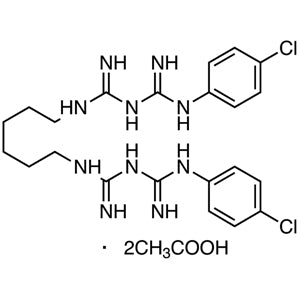
Chlorhexidine Diacetate (CAS No. 56-95-1) is a chemical compound widely used in laboratory settings, particularly in biochemistry and pharmacology. It is a derivative of chlorhexidine, a well-known antiseptic and antibacterial agent. In laboratory applications, this compound serves as a key reagent for antimicrobial activity testing and as a building block for the synthesis of other compounds. Its versatility makes it an essential component in various research protocols.
One of the main reasons Chlorhexidine Diacetate is preferred is its chemical stability and resistance to degradation under normal conditions. This ensures consistent performance in experiments requiring reliability and accuracy. Additionally, its solubility in organic solvents simplifies its use in a wide range of chemical reactions. The diacetate form also facilitates deprotonation and other chemical processes, enhancing its utility in synthetic and analytical applications.
In Indonesian laboratories, Chlorhexidine Diacetate is commonly used in microbiological studies, pharmaceutical research, and biochemical assays. Its role in antimicrobial testing and as a reagent in drug development makes it a valuable resource for researchers. Its stability and solubility properties make it suitable for use in both academic and industrial research environments, supporting the pursuit of scientific innovation.
- Antimicrobial Activity Testing – Chlorhexidine Diacetate is widely used to evaluate the effectiveness of antimicrobial agents in laboratory settings due to its known antibacterial properties.
- Biochemical Synthesis – Its chemical stability and reactivity make it an ideal reagent for the synthesis of various organic compounds in biochemistry research.
- Pharmaceutical Research – It is frequently employed in drug development to test the efficacy of new compounds against bacterial strains.
- Microbial Culture Media Preparation – Its antiseptic properties help in maintaining sterile conditions during the preparation of culture media for microbial growth.
- Analytical Chemistry – It is used in analytical procedures to assess the presence and concentration of specific compounds in samples.
| Brand | TCI |
|---|---|
| CAS number | 56-95-1 |
| Molecular formula | — |
| Purity | — |
| Category | Life Science > Biochemicals and Reagents > Antibiotics |
| Pack sizes | Available in various quantities as per standard laboratory supply |
| Physical form | Solid powder |
| Storage | Store in a cool, dry place away from direct sunlight and moisture |
Chlorhexidine Diacetate should be stored in a cool, dry place, away from direct sunlight and moisture to maintain its chemical stability. It is recommended to use airtight containers to prevent exposure to humidity and contaminants. Due to its chemical nature, it should be handled with care, using appropriate personal protective equipment such as gloves and safety goggles. Avoid contact with skin and eyes, and ensure proper ventilation when working with the compound. It is important to keep the material away from incompatible substances to prevent any potential chemical reactions. Proper storage and handling are essential to ensure the integrity and effectiveness of the compound in laboratory applications.
—
Produk Terkait
-
2,3-Bis(2,6-diisopropylphenylimino)butane TCI B5606
Regular price From Rp 2.942.100,00Regular price -
(R,R)-(-)-N,N'-Bis(3,5-di-tert-butylsalicylidene)-1,2-cyclohexanediaminomanganese(III)Chloride TCI B5613
Regular price Rp 3.127.950,00Regular price -
(R,R)-N,N'-Bis(3,5-di-tert-butylsalicylidene)-1,2-cyclohexanediaminocobalt(II) TCI B5732
Regular price From Rp 1.670.550,00Regular price -
BuforminHydrochloride TCI B6007
Regular price From Rp 1.961.400,00Regular price -
2-tert-Butyl-1,1,3,3-tetramethylguanidine TCI B6052
Regular price From Rp 1.565.550,00Regular price -
Boc-Arg-OH TCI B6362
Regular price From Rp 903.000,00Regular price -
6,6'-[[Ethane-1,2-diylbis(azaneylylidene)]bis(methaneylylidene)]bis(2,4-di-tert-butylphenol) TCI B6501
Regular price Rp 3.287.550,00Regular price -
(E)-N-Benzyl-1-phenylmethanimine TCI B6850
Regular price From Rp 2.862.300,00Regular price





![6,6'-[[Ethane-1,2-diylbis(azaneylylidene)]bis(methaneylylidene)]bis(2,4-di-tert-butylphenol) (CAS 103595-81-9) - TCI B6501 - AMI Scientific](http://amiscientific.com/cdn/shop/files/TCI2510B6501.jpg?v=1767093755&width=533)