


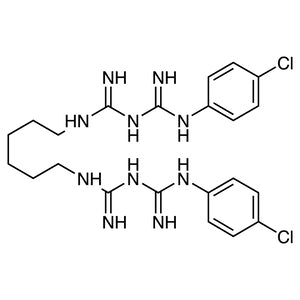
Chlorhexidine, with CAS number 55-56-1, is a widely used chemical compound in laboratory settings related to life sciences and biochemistry. It is a key reagent in various experimental processes due to its antimicrobial properties, making it essential for maintaining sterile conditions in laboratory environments. This compound is commonly employed in sterilization testing, sample preservation, and the preparation of antiseptic solutions. Its role in scientific research spans across multiple disciplines, including microbiology, pharmacology, and clinical diagnostics.
Chlorhexidine is preferred for its stability and resistance to degradation, which ensures consistent performance across different experimental conditions. Its ability to bind to bacterial proteins effectively inhibits microbial growth, making it a reliable choice for antimicrobial applications. Additionally, its good solubility in water allows for easy preparation of various solutions, enhancing its versatility in laboratory use. These properties make it a staple in both academic and industrial research settings.
In Indonesian laboratories, Chlorhexidine is extensively used in educational institutions and research facilities. It is a fundamental component in laboratory protocols for maintaining hygiene and preventing contamination. Its widespread application supports the accuracy and reliability of experimental results, reinforcing its importance in the scientific community.
TCI brochures (PDF)
- Antibiotic Ingredients for Drug-Resistant Pathogens 2026-10-01 · p. 1
- Antimicrobials and Antitumor Agents for Research and Experimental Use 2025-04-24 · p. 7
- Pharmaceutical Ingredients for Research and Experimental Use 2026-03-09 · p. 8
- Sterilization Testing: Chlorhexidine is used to assess the effectiveness of sterilization methods by inhibiting microbial growth in controlled environments.
- Sample Preservation: Its antimicrobial properties help in preserving biological samples by preventing microbial contamination during storage.
- Antiseptic Solution Preparation: Chlorhexidine is commonly used to create antiseptic solutions for laboratory use, ensuring a safe and clean working environment.
- Microbial Inhibition Studies: It is employed in research to study the effects of antimicrobial agents on bacterial and fungal growth.
- Clinical Diagnostic Testing: Chlorhexidine is used in diagnostic procedures to maintain sterile conditions and prevent cross-contamination of samples.
| Brand | TCI |
|---|---|
| CAS number | 55-56-1 |
| Molecular formula | — |
| Purity | — |
| Category | Life Science > Biochemicals and Reagents > Antibiotics |
| Pack sizes | Available in various quantities as per standard laboratory requirements |
| Physical form | Liquid |
| Storage | Store in a cool, dry place away from direct sunlight |
Chlorhexidine should be stored in a cool, dry location, away from direct sunlight and heat sources to maintain its stability and effectiveness. It is recommended to use sealed containers to prevent contamination and evaporation. Due to its chemical nature, it should be handled with appropriate personal protective equipment, such as gloves and safety goggles, to ensure laboratory safety. Avoid exposure to incompatible substances, and ensure proper ventilation in the workspace. Regular monitoring of storage conditions is essential to maintain the integrity of the product. Always follow standard laboratory safety protocols when handling and using this compound.
—
Product Categories
- Biochemicals and ReagentsAntibioticsAntibiotics (Chemical Structure Class)
- Biochemicals and ReagentsPharmaceutical Research Reagents (for Experimental Use)Antimicrobial Ingredients (for Research and Experimental Use)
- MicrobiologyAntibioticsAntibiotics (Chemical Structure Class)
- Pharmaceutical Development and Drug Discovery ResearchPharmaceutical Research Reagents (for Experimental Use)Antimicrobial Ingredients (for Research and Experimental Use)
- Pharmaceutical Development and Drug Discovery ResearchAntibioticsAntibiotics (Chemical Structure Class)
Produk Terkait
-
ChlorhexidineDigluconate(ca.20%inWater) TCI C3105
Regular price Rp 900.900,00Regular priceRp 645.750,00Sale price Rp 900.900,00 -
ChlorhexidineDiacetate TCI C2511
Regular price From Rp 1.510.950,00Regular priceRp 1.072.050,00Sale price From Rp 1.510.950,00 -
ChlorhexidineDihydrochloride TCI C1254
Regular price From Rp 1.192.800,00Regular priceRp 849.450,00Sale price From Rp 1.192.800,00 -
4-AminosalicylicAcid TCI A0420
Regular price From Rp 822.150,00Regular priceRp 590.100,00Sale price From Rp 822.150,00 -
Sodium4-AminosalicylateDihydrate TCI A0423
Regular price From Rp 928.200,00Regular priceRp 664.650,00Sale price From Rp 928.200,00 -
Wortmannin TCI W0007
Regular price Rp 11.632.950,00Regular priceRp 8.150.100,00Sale price Rp 11.632.950,00 -
ValganciclovirHydrochloride TCI V0158
Regular price From Rp 1.618.050,00Regular priceRp 1.146.600,00Sale price From Rp 1.618.050,00 -
ValnemulinHydrochloride TCI V0144
Regular price From Rp 4.982.250,00Regular priceRp 3.499.650,00Sale price From Rp 4.982.250,00


