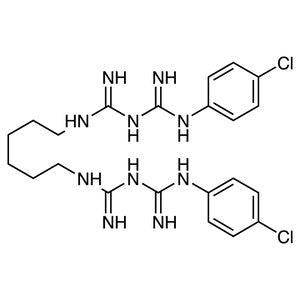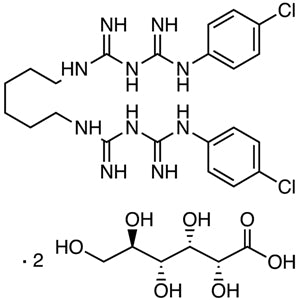
The TCI Chlorhexidine Digluconate (ca. 20% in Water), catalogue code C3105, is an aqueous solution preparation of the digluconate salt of chlorhexidine, a cationic bisbiguanide compound long recognised as a broad-spectrum antiseptic and disinfectant agent. In the laboratory, this material serves as a working reagent for antimicrobial activity testing, as a comparative control in inhibition-zone assays, and as a base material for preparing antiseptic solutions in microbiology research, dentistry, biomedical materials science, and research-based personal care product formulation.
The characteristic that makes this preparation a widely preferred choice is that it already arrives as a concentrated solution in water, so users do not need to dissolve a hygroscopic solid or handle a fine powder that scatters easily during weighing. The cationic nature of the chlorhexidine molecule allows it to interact strongly with negatively charged microbial cell surfaces, while the gluconate group confers good water solubility and makes serial dilution straightforward. Its availability as a ready-to-dilute solution also simplifies the preparation of concentration series for MIC testing and for surface efficacy testing in a reproducible manner.
In Indonesian laboratories, this reagent is typically found in microbiology and dental research units, in biomedical materials groups evaluating antimicrobial surfaces or coatings, and in formulation laboratories developing personal care preparations on a research scale. It is commonly used where a well-established antiseptic reference is needed alongside test samples, and its solution format suits teaching and routine testing settings in which dilution series must be prepared quickly and consistently from a single stock.
- Antimicrobial activity testing — supplied as a concentrated aqueous solution, it dilutes readily into the working concentrations required for inhibition assays without any dissolution step beforehand.
- Comparative control in inhibition assays — as a long-established broad-spectrum antiseptic, it provides a recognised reference against which the inhibitory performance of test samples can be judged.
- Minimum inhibitory concentration (MIC) determination — its good water solubility and ready-to-dilute format allow reproducible serial concentration series to be built directly from the stock solution.
- Microbiology and dental research — the cationic bisbiguanide structure interacts strongly with negatively charged microbial cell surfaces, making it relevant to oral and general microbiological investigations.
- Biomedical materials and personal care formulation research — it functions as a base material for preparing antiseptic solutions used in surface efficacy testing and research-scale product development.
| Brand | TCI |
|---|---|
| CAS number | 18472-51-0 |
| Molecular formula | — |
| Purity | — |
| Category | Chemistry > Chemical Biology > Glycoscience |
| Pack sizes | available in the packaging options offered for this catalogue item; please confirm the currently listed sizes when ordering |
| Physical form | aqueous solution, ca. 20% in water |
| Storage | — |
- Catalogue Code: C3105
Store the container tightly closed in a cool, dry place away from direct sunlight and sources of heat, following the storage conditions stated on the manufacturer's label and safety data sheet. Keep the solution in its original supplier container or in a clean, chemically compatible, well-sealed bottle that is clearly labelled with the contents and the date of opening. Handle the material in a well-ventilated area using standard laboratory personal protective equipment, including gloves, safety glasses, and a laboratory coat, and avoid contact with skin and eyes. Use clean pipettes and glassware when withdrawing aliquots to prevent contamination of the stock, and dispose of residues and rinsings in accordance with applicable institutional and local chemical waste regulations.
—
Product Categories
- GlycoscienceMonosaccharides [Glycoscience]Glucoses [Glycoscience]
- Biochemicals and ReagentsAntibioticsAntibiotics (Chemical Structure Class)
- Biochemicals and ReagentsCarbohydrates
- Biochemicals and ReagentsPharmaceutical Research Reagents (for Experimental Use)Antimicrobial Ingredients (for Research and Experimental Use)
- MicrobiologyAntibioticsAntibiotics (Chemical Structure Class)
- Pharmaceutical Development and Drug Discovery ResearchPharmaceutical Research Reagents (for Experimental Use)Antimicrobial Ingredients (for Research and Experimental Use)
- Pharmaceutical Development and Drug Discovery ResearchAntibioticsAntibiotics (Chemical Structure Class)
Produk Terkait
-
Chlorhexidine TCI C2530
Regular price From Rp 1.405.950,00Regular price -
GluconicAcid(containsGluconolactone)(45-50%inWater) TCI G0036
Regular price From Rp 477.750,00Regular price -
ChlorhexidineDiacetate TCI C2511
Regular price From Rp 1.458.450,00Regular price -
ChlorhexidineDihydrochloride TCI C1254
Regular price From Rp 1.140.300,00Regular price -
Arbutin TCI A0522
Regular price From Rp 452.550,00Regular price -
Teniposide TCI T3109
Regular price From Rp 1.485.750,00Regular price -
Arctiin TCI A3118
Regular price From Rp 1.431.150,00Regular price -
Paeoniflorin TCI P1876
Regular price Rp 4.559.100,00Regular price