

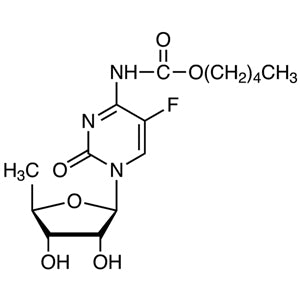
Capecitabine is a chemical compound widely utilized in biochemical and pharmacological research. As an analog of nucleosides, it plays a crucial role in the study of nucleotide metabolism and the activation of specific enzymes. In the laboratory, it serves as a key reagent for the synthesis of complex compounds, biological activity testing, and cancer therapy research. Its stability and controlled reactivity make it a reliable choice for experiments requiring precision and reproducibility.
Capecitabine is valued for its high purity and consistent quality, ensuring accurate and dependable results in laboratory settings. Its simple yet specific chemical structure allows for easy identification and processing under various reaction conditions. Additionally, its solubility in organic solvents such as ethyl acetate and acetone facilitates separation and application in diverse analytical methods. These properties make it a preferred material for researchers seeking reliable and reproducible outcomes.
In Indonesian laboratories, Capecitabine is commonly used in chemical, pharmaceutical, and biomedical research. It supports a wide range of studies, including drug development, enzyme activity investigations, and cancer-related research. Its availability and reliability make it an essential component for scientific inquiry in the region.
- Biochemical Research: Capecitabine is ideal for studying nucleotide metabolism and enzyme activation due to its nucleoside analog properties.
- Cancer Therapy Development: It is used in the synthesis of compounds and testing of biological activities relevant to anti-cancer drug development.
- Pharmaceutical Analysis: Its solubility in organic solvents makes it suitable for analytical methods in drug formulation and quality control.
- Enzyme Kinetics Studies: The compound is useful for investigating enzyme interactions and catalytic mechanisms in biochemical processes.
- Synthetic Chemistry Applications: Capecitabine serves as a building block for the synthesis of more complex organic molecules in laboratory settings.
| Brand | TCI |
|---|---|
| CAS number | 154361-50-9 |
| Molecular formula | — |
| Purity | — |
| Category | Life Science > Biochemicals and Reagents > Nucleosides, Nucleotides, Oligonucleotides |
| Pack sizes | 50g |
| Physical form | Powder |
| Storage | Store in a cool, dry place away from light |
Capecitabine should be stored in a cool, dry place away from direct light to maintain its chemical stability and purity. It is recommended to use airtight containers to prevent moisture absorption and contamination. Due to its reactivity, it should be handled with care, using appropriate personal protective equipment such as gloves and safety goggles. Proper ventilation is essential when working with this compound to minimize exposure. In laboratory settings, it should be stored separately from incompatible substances to ensure safety. Regular monitoring of storage conditions helps maintain the integrity of the material for reliable experimental results.
—
Produk Terkait
-
5-Bromobenzoxazole TCI B5515
Regular price From Rp 1.696.800,00Regular price -
BMS-599626 TCI B5520
Regular price From Rp 3.525.900,00Regular price -
6-Bromobenzo[b]thiophene TCI B5523
Regular price Rp 3.392.550,00Regular price -
3-tert-Butyl4-Methyl(4R,5S)-2,2,5-Trimethyloxazolidine-3,4-dicarboxylate TCI B5538
Regular price Rp 2.969.400,00Regular price -
Biotin-PEG4-Azide TCI B5546
Regular price Rp 7.897.050,00Regular price -
Benzo[b]benzo[4,5]thieno[2,3-d]thiophene TCI B5551
Regular price From Rp 903.000,00Regular price -
2-Bromo-5-(4-hexylphenyl)thiophene TCI B5553
Regular price Rp 3.207.750,00Regular price -
Biotin-PEG4-Amine TCI B5560
Regular price From Rp 1.510.950,00Regular price


![6-Bromobenzo[b]thiophene (CAS 17347-32-9) - TCI B5523 - AMI Scientific](http://amiscientific.com/cdn/shop/files/TCI2510B5523.jpg?v=1767092466&width=533)


![Benzo[b]benzo[4,5]thieno[2,3-d]thiophene (CAS 248-70-4) - TCI B5551 - AMI Scientific](http://amiscientific.com/cdn/shop/files/TCI2510B5551.jpg?v=1768815817&width=533)

