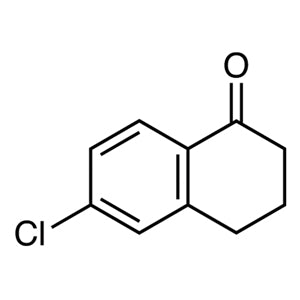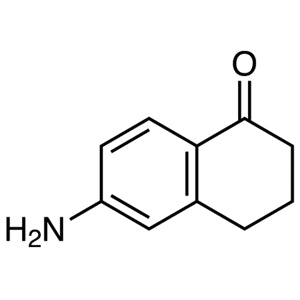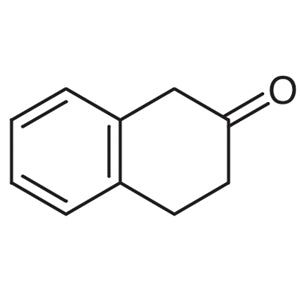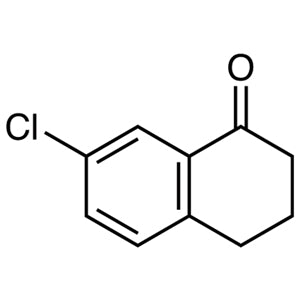
7-Chloro-1-tetralone is a chemical compound widely used in organic synthesis reactions within laboratory settings. It serves as a fundamental building block in the creation of complex organic molecules, particularly in the development of heterocyclic and aromatic compounds. Its unique structure, featuring a chloro group at the seventh position of the tetralone ring, makes it a versatile reagent for various synthetic pathways. This compound is especially valuable in pharmaceutical research, where it contributes to the synthesis of bioactive compounds and drug precursors. Its role in the laboratory extends beyond mere reactivity, as it is integral to the design and execution of advanced chemical processes.
The compound's stability and reactivity make it a preferred choice for chemists working in both academic and industrial environments. It exhibits good solubility in organic solvents such as ethyl acetate and chloroform, which facilitates its use in a wide range of chemical reactions. Its consistent chemical properties ensure reliable results, making it a trusted material in high-precision laboratory applications. Additionally, its compatibility with various reaction conditions allows for flexibility in synthetic strategies, supporting both routine and specialized research.
In Indonesian laboratories, 7-Chloro-1-tetralone is commonly used in organic chemistry research, particularly in pharmaceutical and synthetic chemistry fields. It is also utilized in higher education institutions as a teaching material to illustrate reaction mechanisms and synthetic methodologies. Its presence in laboratory workflows underscores its importance in advancing chemical knowledge and practical applications in Indonesia.
- Organic synthesis is a key application where 7-Chloro-1-tetralone is used to create complex molecules due to its versatile reactivity and structural adaptability.
- Pharmaceutical research benefits from this compound as it is a precursor in the development of bioactive compounds and drug molecules.
- Heterocyclic compound synthesis relies on 7-Chloro-1-tetralone for its ability to participate in ring-forming reactions and functional group transformations.
- Educational institutions incorporate this material to teach students about reaction mechanisms and synthetic strategies in organic chemistry.
- Industrial chemical processes use it as a building block for the production of specialty chemicals and fine chemicals.
| Brand | TCI |
|---|---|
| CAS number | 26673-32-5 |
| Molecular formula | — |
| Purity | — |
| Category | Chemistry > Building Blocks > Non-Heterocyclic Building Blocks |
| Pack sizes | Available in various quantities as per standard laboratory supply |
| Physical form | Solid |
| Storage | Store in a cool, dry place away from light and moisture |
7-Chloro-1-tetralone should be stored in a cool, dry environment, away from direct light and moisture to maintain its chemical integrity. It is recommended to use airtight containers to prevent exposure to air and humidity, which may affect its stability. In laboratory settings, proper ventilation should be ensured when handling the compound to minimize inhalation risks. It is important to avoid contact with skin and eyes, and appropriate personal protective equipment should be worn when working with this material. Due to its chemical nature, it should be kept away from incompatible substances such as strong oxidizers or acids. Regular inspection of storage conditions is advised to ensure the compound remains in optimal condition for use.
—
Produk Terkait
-
6-Chloro-1-tetralone TCI C2917
Regular price From Rp 2.837.100,00Regular price -
6-Bromo-1-tetralone TCI B4841
Regular price From Rp 3.922.800,00Regular price -
7-Bromo-1-tetralone TCI B4545
Regular price From Rp 928.200,00Regular price -
6-Amino-1-tetralone TCI A2642
Regular price From Rp 1.087.800,00Regular price -
beta-Tetralone TCI T1167
Regular price From Rp 2.862.300,00Regular price -
alpha-Tetralone TCI T0134
Regular price From Rp 769.650,00Regular price -
7-Nitro-1-tetralone TCI N0945
Regular price From Rp 1.115.100,00Regular price -
7-Methyl-1-tetralone TCI M3255
Regular price From Rp 1.776.600,00Regular price