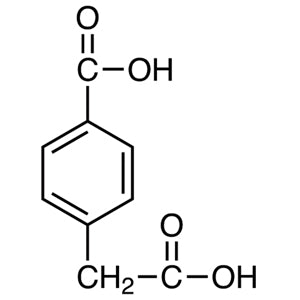
4-(Carboxymethyl)benzoic Acid is a chemical compound widely used in laboratory settings for its versatility in organic synthesis and chemical reactions. As a building block in chemistry, it serves as a foundational material for the development of complex molecules. Its structure consists of a benzoic acid core with a carboxymethyl group attached, making it a valuable intermediate in various synthetic pathways. This compound is particularly useful in the creation of pharmaceuticals, industrial chemicals, and other specialized products due to its reactivity and functional group compatibility.
The compound’s reactivity and functional group versatility make it a preferred choice in laboratory applications. It is especially effective in substitution reactions and esterification processes, where its carboxylic acid functionality can participate in multiple chemical transformations. Its solubility in organic solvents such as ethyl acetate and acetone further enhances its utility in chemical synthesis, allowing for efficient mixing and reaction conditions. Additionally, its chemical stability under controlled conditions ensures reliable performance in various experimental setups.
In Indonesian laboratories, 4-(Carboxymethyl)benzoic Acid is commonly used in chemical, pharmaceutical, and industrial research. It is a key component in the development of new products and is utilized by research institutions and universities for academic and applied research. Its availability through suppliers like AMI Scientific ensures that it remains a critical material for ongoing scientific investigations in Indonesia.
TCI brochures (PDF)
- Biomaterials Research Reagents 2025-02-19 · p. 21
- Monomers 2025-05-28 · p. 36
Related TCI products
- Organic synthesis is a primary application due to its reactivity and functional group compatibility, enabling the creation of complex molecules.
- Pharmaceutical research benefits from its use in the development of drug compounds and active pharmaceutical ingredients.
- Industrial chemical production relies on its stability and solubility properties for efficient manufacturing processes.
- Academic research in chemistry and pharmacology utilizes it for experimental studies and compound development.
- Analytical chemistry applications take advantage of its predictable chemical behavior for standardization and testing protocols.
| Brand | TCI |
|---|---|
| CAS number | 501-89-3 |
| Molecular formula | — |
| Purity | — |
| Category | Chemistry > Building Blocks > Non-Heterocyclic Building Blocks |
| Pack sizes | Available in various sizes as per supplier specifications |
| Physical form | Solid, crystalline appearance |
| Storage | Store in a cool, dry place away from moisture and heat |
This compound should be stored in a cool, dry environment to prevent degradation due to moisture and high temperatures. It is recommended to use airtight containers to maintain its chemical stability and prevent contamination. Due to its reactivity, it should be handled with appropriate personal protective equipment, such as gloves and safety goggles, to ensure laboratory safety. Avoid exposure to direct sunlight and keep it away from incompatible substances. Regular monitoring of storage conditions is essential to maintain its integrity and effectiveness in laboratory applications.
—
Product Categories
- Material Building BlocksLiquid Crystal (LC) Building BlocksBenzoic Acids [Liquid Crystal (LC) Building Blocks]
- Polymer/Macromolecule ReagentsMonomersDicarboxylic Acid Monomers
- Biomaterials/Biocompatible Materials Research ReagentsMonomers and Macromonomers [Biomaterials/Biocompatible Materials Research Reagents]Dicarboxylic Acid Monomers [Biomaterials/Biocompatible Materials Research Reagents]
Produk Terkait
-
trans-AconiticAcid TCI A0127
Regular price From Rp 2.121.000,00Regular priceRp 1.498.350,00Sale price From Rp 2.121.000,00 -
AzelaicAcid TCI A0561
Regular price From Rp 557.550,00Regular priceRp 405.300,00Sale price From Rp 557.550,00 -
AdipicAcid TCI A0161
Regular price From Rp 452.550,00Regular priceRp 316.050,00Sale price From Rp 452.550,00 -
AcetylenedicarboxylicAcid TCI A0088
Regular price From Rp 1.220.100,00Regular priceRp 868.350,00Sale price From Rp 1.220.100,00 -
alpha,alpha,alpha',alpha'-Tetramethyl-1,3-benzenedipropionicAcid TCI T3420
Regular price Rp 3.472.350,00Regular priceRp 2.427.600,00Sale price Rp 3.472.350,00 -
1,3,5-BenzenetricarboxylicAcid TCI B0043
Regular price From Rp 1.035.300,00Regular priceRp 723.450,00Sale price From Rp 1.035.300,00 -
AzelaicAcid TCI A1318
Regular price From Rp 848.400,00Regular priceRp 609.000,00Sale price From Rp 848.400,00 -
SebacicAcid TCI S0022
Regular price From Rp 557.550,00Regular priceRp 405.300,00Sale price From Rp 557.550,00