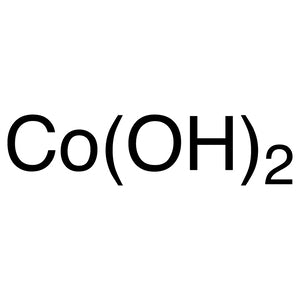
Cobalt(II) Hydroxide (Co(OH)₂), with CAS number 21041-93-0, is a chemical compound widely used in laboratory settings for its catalytic and chemical properties. As a transition metal compound, it plays a crucial role in various chemical reactions, particularly in redox processes and catalytic systems. Its versatility makes it an essential material for both academic and industrial research, supporting a wide range of experimental applications. This compound is commonly found in inorganic chemistry and catalysis, where its unique reactivity and stability contribute to the success of many chemical processes.
One of the key reasons Cobalt(II) Hydroxide is preferred is its chemical stability under controlled conditions, combined with its distinct blue-green color, which aids in visual identification. It exhibits moderate reactivity with acids and bases, making it suitable for a variety of reaction environments. Its ability to act as a catalyst in multiple chemical transformations further enhances its value in laboratory work. The compound's physical properties, including its solubility and reactivity profile, make it a reliable choice for both qualitative and quantitative analysis in chemical experiments.
In Indonesian laboratories, Cobalt(II) Hydroxide is extensively used in educational institutions, research facilities, and industrial applications. It is a fundamental component in chemistry curricula and is frequently employed in analytical and synthetic procedures. Its role in the development of new chemical compounds and the refinement of existing ones underscores its importance in the scientific community. The compound's availability and reliability make it a standard material in many laboratory workflows across Indonesia.
TCI brochures (PDF)
- Metallic Salts 2025-11-06 · p. 9
- Transition Metal Catalysts 2026-04-10 · p. 9
Related TCI products
- TCI C3901 15238-00-3 Cobalt(II) Iodide
- TCI C3823 7789-43-7 Cobalt(II) Bromide Anhydrous
- TCI C3800 1308-06-1 Cobalt(II,III) Oxide
- TCI C3752 10026-17-2 Cobalt(II) Fluoride
- TCI T3554 28277-59-0 Tris(1,10-phenanthroline)cobalt(III) Tris(hexafluorophosphate)
- TCI T3553 31876-74-1 Tris(1,10-phenanthroline)cobalt(II) Bis(hexafluorophosphate)
- Redox Reactions: Cobalt(II) Hydroxide is ideal for redox experiments due to its ability to participate in electron transfer processes, making it a valuable reagent in oxidation-reduction studies.
- Catalytic Processes: Its catalytic properties make it suitable for accelerating chemical reactions, particularly in the synthesis of complex inorganic compounds and organic molecules.
- Quantitative Analysis: The compound is used in titration and other analytical methods because of its predictable chemical behavior and ease of handling in controlled environments.
- Material Synthesis: Cobalt(II) Hydroxide serves as a precursor for the synthesis of various cobalt-based compounds, including oxides and salts, which are essential in materials science.
- Educational Demonstrations: Its distinct color and reactivity make it a useful tool for teaching fundamental chemical concepts in school and university laboratories.
| Brand | TCI |
|---|---|
| CAS number | 21041-93-0 |
| Molecular formula | — |
| Purity | — |
| Category | Chemistry > Catalysis and Inorganic Chemistry > Transition Elements |
| Pack sizes | Available in various quantities as per standard laboratory supply options |
| Physical form | Solid powder |
| Storage | Store in a cool, dry place away from moisture and direct sunlight |
Cobalt(II) Hydroxide should be stored in a cool, dry environment to maintain its chemical stability. It is recommended to keep the compound in airtight containers to prevent moisture absorption, which could affect its reactivity. Due to its moderate reactivity with acids and bases, it should be handled with care, using appropriate personal protective equipment such as gloves and safety goggles. It is advisable to store it in a well-ventilated area to minimize exposure to airborne particles. Avoid contact with incompatible substances to ensure safe handling. Always follow standard laboratory safety protocols when working with this compound to prevent any potential hazards.
—
Produk Terkait
-
Cobalt(II)Iodide TCI C3901
Regular price From Rp 1.644.300,00Regular price -
Cobalt(II)BromideAnhydrous TCI C3823
Regular price Rp 1.618.050,00Regular price -
Cobalt(II,III)Oxide TCI C3800
Regular price From Rp 1.936.200,00Regular price -
Cobalt(II)Fluoride TCI C3752
Regular price From Rp 2.041.200,00Regular price -
Tris(1,10-phenanthroline)cobalt(III)Tris(hexafluorophosphate) TCI T3554
Regular price From Rp 3.260.250,00Regular price -
Tris(1,10-phenanthroline)cobalt(II)Bis(hexafluorophosphate) TCI T3553
Regular price From Rp 2.969.400,00Regular price -
Bis(2,4-pentanedionato)cobalt(II) TCI B2681
Regular price Rp 1.696.800,00Regular price -
Bis(trifluoro-2,4-pentanedionato)cobalt(II) TCI T0746
Regular price From Rp 2.545.200,00Regular price